
Three Major Challenges Threaten IHSG; Can It Return to 8000?
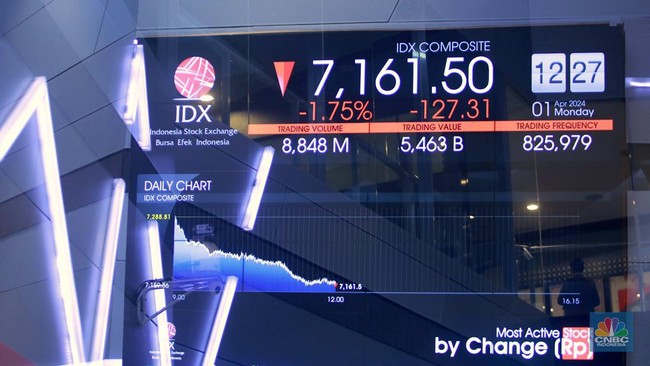
Jakarta – Indonesia’s Composite Stock Index (IHSG) continues to face three major challenges that have driven it to test the 7500 level once again.
Over the past week through Friday 6 March 2026, the IHSG plunged nearly 8% in just one week, marking its worst performance, surpassing the MSCI crash of late January.
Three major challenges now shadow the movement of Indonesia’s stock market.
In recent times, the IHSG has been influenced not only by domestic factors but also by external pressures and changing perceptions of global investors towards Indonesia as an investment destination.
First, escalating pressure from global geopolitical factors.
Intensifying geopolitical tensions, particularly in the Middle East region, have prompted global investors to adopt a more defensive stance. In conditions of such uncertainty, financial markets typically experience a shift in sentiment towards risk-off – a tendency for investors to reduce exposure to assets deemed more risky.
Developing countries, including Indonesia, often become among the most affected because previously inbound foreign investment flows can quickly reverse direction.
This situation triggers a phenomenon commonly referred to as geopolitical contagion, whereby the impact of conflicts or tensions in one region spreads to global financial markets. International investors tend to reallocate their funds to instruments deemed safer, such as government bonds of advanced nations or US dollar-based assets.
As a result, stock markets in emerging markets face pressure from capital outflows. For Indonesia, this condition can trigger volatility in the stock market whilst restraining the potential for IHSG gains in the near to medium term.
Second, mounting concerns regarding Indonesia’s position in global stock indices.
Investor attention has also turned to the possibility of Indonesia’s classification changing within global indices compiled by Morgan Stanley Capital Index (MSCI).
Currently, Indonesia’s weighting in the MSCI Emerging Markets Index continues to experience a downward trend and has already approached the 1% range. This weighting decline reflects the diminishing share of Indonesia’s stock market in global portfolios tracking this index.
A risk increasingly discussed among market participants is the potential for Indonesia to experience a downgrade in status from emerging market to frontier market category.
Although this scenario may not necessarily materialise in the near term, the mere discussion of such possibility is sufficient to influence investor sentiment. Many global investment funds, particularly passive funds and ETFs, automatically adjust their portfolios based on MSCI index composition.
Should a country experience a classification change, the flows of funds tracking that index would also shift accordingly. In an extreme scenario, such a status change could trigger significant outflows of foreign capital from the domestic stock market.
Third, increased focus on sovereign credit risk.
Beyond external pressures and market classification issues, investors are also monitoring developments from the perspective of macroeconomic fundamentals, particularly regarding the perceived risk of government debt.
Several international rating agencies such as Fitch Ratings, Moody’s Investors Service, and S&P Global Ratings have issued cautionary signals through changes to Indonesia’s outlook to a more negative stance.
This outlook change does not necessarily mean that a credit rating downgrade will occur in the near term.
However, the signal indicates that rating agencies are beginning to identify risks that warrant attention, particularly concerning fiscal conditions, government debt dynamics, and potential pressure on budget deficits in the future.
For global investors, a shift in the perception of a country’s credit risk can have widespread implications because it affects the cost of financing for both the government and the corporate sector. If risk is deemed to have increased, investors typically demand higher returns to hold assets of that country.
In the context of the stock market, growing concern about sovereign credit can also weigh on market sentiment.
Investors tend to become more selective in placing funds in domestic assets, so IHSG movements could become more limited and sensitive to various policy developments and global conditions.