
Three Innovations by the Ministry of Immigration and Naturalisation for Hajj 2026: Daily Passport Services with Minimal Queues for Pilgrims
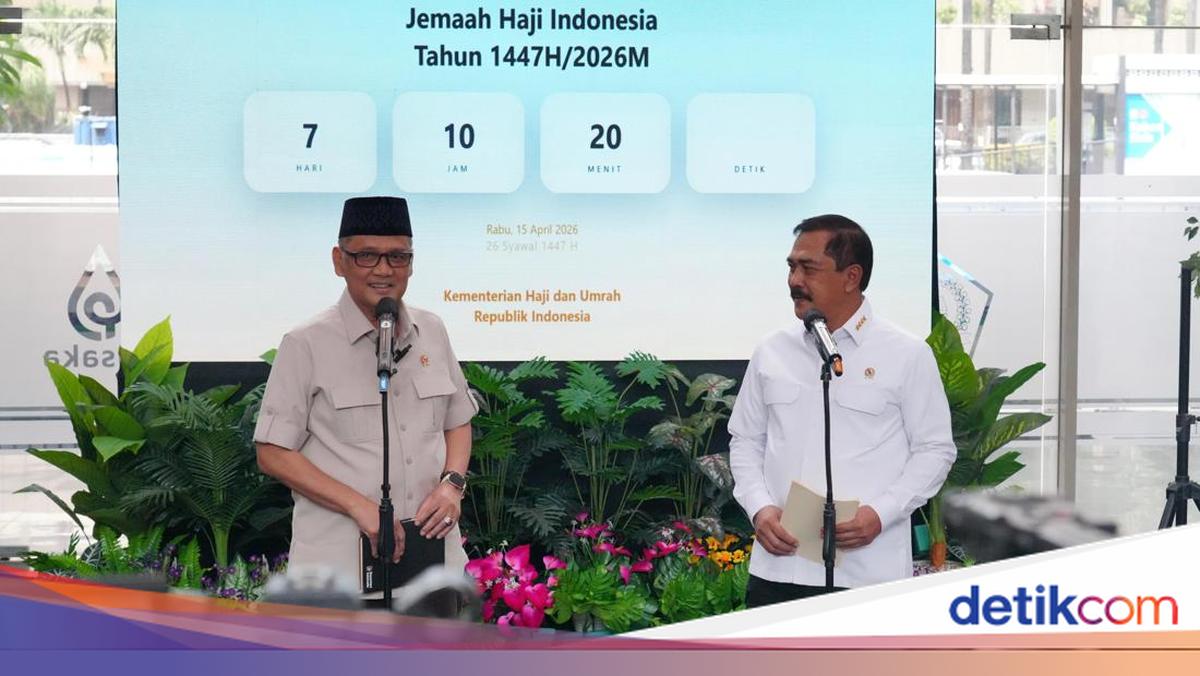
The Ministry of Immigration and Naturalisation (Imipas) attended an audience with the Ministry of Hajj and Umrah to optimise services for Hajj pilgrims this year. Imipas stated that it has implemented three innovations related to immigration matters for the pilgrims.
“Thanks to the intensive collaboration and cooperation between the Ministry of Hajj and Umrah and the Ministry of Immigration and Naturalisation, services for prospective Indonesian Hajj pilgrims can be carried out maximally,” said Imipas Minister Agus Andrianto during the audience in Jakarta on Wednesday (15/4/2026).
Referring to data from the Directorate General of Immigration under Imipas, there were 183,411 passport applicants for Hajj purposes scheduled for 2026, submitted in 2025. Hajj visa applications were submitted through the M-Paspor application, Sympathetic Passport, and Eazy Passport.
Here is the breakdown of Hajj visa applications for 2026 submitted in 2025:
Ordinary Non-Electronic Passports: 11,608 passports;
Electronic Passports: 171,097 passports;
Polycarbonate Electronic Passports: 706 passports.
Sympathetic Hajj Passport
Minister Agus explained that the Sympathetic Hajj Passport is a service provided by immigration offices to process passport applications for prospective Hajj pilgrims. The service is open from Monday to Sunday, a full week. Even on certain commemorative holidays, the service remains open.
“This service aims to accommodate the increase in direct passport applications without online submission, as well as to facilitate people who only have free time on weekends,” clarified Minister Agus.
Still related to optimising passport services for Hajj pilgrims, Imipas also provides the Eazy Passport service option. This service is collective in nature and is conducted outside immigration offices.
“Not only in passport services, the role and support of the Ministry of Immigration and Naturalisation in organising Hajj in 2026 also extends to the embarkation and repatriation processes for Indonesian pilgrims,” stated Minister Agus.
Makkah Route
Minister Agus admitted to continuously coordinating intensively with Hajj organisers. He outlined conveniences implemented from H-1 departure, where officers will conduct passport clearance for pilgrims.
“Thus, pilgrims no longer need to queue at our airport immigration counters before departing to Saudi Arabia. This is a form of service convenience to ensure a sense of security and comfort for Indonesian Hajj pilgrims,” he explained.
This service is a manifestation of cooperation between the Directorate General of Immigration under Imipas and Saudi Arabian immigration authorities. Last year, the Makkah Route was implemented at three international airports: Soekarno-Hatta, Juanda, and Adi Soemarmo.
“With a total of 120,147 prospective Hajj pilgrims using the Makkah Route mechanism, or 59 percent of the total 203,208 prospective Hajj pilgrims,” said Minister Agus.
Good news, the Makkah Route will also be implemented at the embarkation point of Sultan Hasanuddin Airport in Makassar, South Sulawesi, this year. “In 2025, passengers from the Makassar embarkation reached 15,804 pilgrims,” continued Minister Agus.
The Makkah Route, he added, is believed to greatly facilitate Indonesian Hajj pilgrims upon arrival in Saudi Arabia. Because pilgrims no longer need to go through the Saudi immigration inspection process.
“Because the process has been carried out at the Indonesian Embarkation Airport,” said Minister Agus.
Corridor Gate
Optimal services are also pursued up to the debarkation process with the Corridor Gate service. The Directorate General of Immigration under Imipas provides the Immigration Seamless Process device.
“Thus, when Hajj pilgrims arrive in Indonesia, they no longer need to queue at the Indonesian immigration inspection counters. They only need to pass through the Corridor Gate that we have prepared, as the device features Face Recognition technology,” explained Minister Agus.
Nevertheless, he did not rule out the possibility of manual inspections still being conducted in case of issues during the debarkation process. The Corridor Gate was previously implemented on 12 June 2025 at Terminal 2F of Soekarno-Hatta Airport.
“To conduct immigration checks for the arrival of Hajj pilgrims in 2025. The percentage of Seamless Process usage was 39,631 people or 78 percent of the total 50,653 pilgrims from the Jakarta-Bekasi and Jakarta Pondok Gede clusters,” concluded Minister Agus.