
Threat of Strait of Hormuz Closure Following US-Israel Attack on Iran; Global Oil Prices At Risk of Surging
ATTACK by the United States and Israel on Iran has triggered swift retaliatory strikes from Tehran, targeting their assets across several Middle Eastern nations including Israel, Qatar, the United Arab Emirates, Kuwait, Bahrain, Jordan, Saudi Arabia, Iraq, and Oman.
Analysts have warned of soaring global oil prices following Iranian officials’ indication that they will close the Strait of Hormuz, one of the world’s most critical maritime routes.
On Saturday, a European Union official told Reuters news agency that vessels transiting the strait had received very high frequency (VHF) transmissions from Iran’s elite Islamic Revolutionary Guard Corps (IRGC), stating “no vessels are permitted to pass through the Strait of Hormuz”.
However, the EU official added that Iran has not formally closed the strait. Rather, several tanker owners have suspended oil and gas shipments through the strait amid the ongoing regional conflict.
“Our vessels will remain in place for several days,” said a senior executive at a major trading company to Reuters on condition of anonymity. Nations such as Greece have also advised their vessels to avoid transiting through the waterway.
Any instability in this critical maritime route could shake economic stability worldwide.
So what is the Strait of Hormuz, and how would its closure impact oil prices?
WHERE IS THE STRAIT OF HORMUZ?
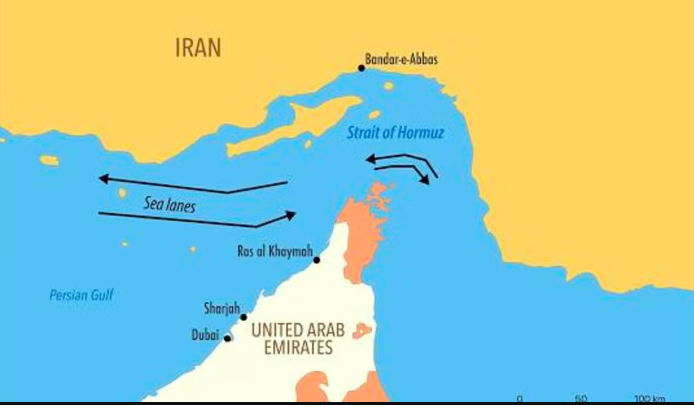
The Strait of Hormuz is located between Oman and the United Arab Emirates on one side and Iran on the other. It connects the Arabian/Persian Gulf, or simply the Gulf, with the Gulf of Oman and the Arabian Sea beyond.
It is 33 kilometres (21 miles) wide at its narrowest point, with shipping lanes only 3 kilometres (2 miles) wide in each direction, making it vulnerable to attack.
Despite its narrow width, the strait can accommodate the world’s largest crude oil tankers. Major Middle Eastern oil and gas exporters depend on it to transport supplies to international markets, whilst importing nations rely on its unobstructed operation.
HOW MUCH OIL AND GAS PASSES THROUGH THE STRAIT?
According to the US Energy Information Administration (EIA), approximately 20 million barrels of oil, valued at around $500 billion in annual global energy trade, pass through the Strait of Hormuz each day in 2024.
Crude oil transiting the strait originates from Iran, Iraq, Kuwait, Qatar, Saudi Arabia, and the United Arab Emirates.
The strait also plays a crucial role in liquefied natural gas (LNG) trade. According to the EIA, in 2024, approximately one-fifth of global LNG shipments pass through this corridor, with Qatar accounting for the majority of that volume.
WHERE DOES IT ALL GO?
The strait handles both oil and gas exports and imports.
Kuwait and the UAE import supplies sourced from outside the Gulf, including shipments from the United States and West Africa.
The EIA estimates that in 2024, 84 per cent of crude oil and condensate shipments transiting the strait are destined for Asian markets. A similar pattern emerges in gas trade, with 83 per cent of LNG volume passing through the Strait of Hormuz headed for Asian destinations.
China, India, Japan, and South Korea collectively account for 69 per cent of all crude oil and condensate flow through the strait in the past year. Their factories, transport networks, and electrical grids depend on uninterrupted energy supplies from the Gulf.
Rising oil prices will impact nations such as China, India, and several Southeast Asian countries.
HOW WILL CLOSURE OF THE STRAIT IMPACT OIL PRICES?
According to Iranian state media, the country’s Supreme National Security Council must make the final decision to close the strait, and the decision must be ratified by the government.
However, energy traders have heightened their alert in recent weeks amid rising regional tensions – which is home to some of the world’s largest oil and gas reserves. Muyu Xu, senior crude oil analyst at Kpler, told Al Jazeera that since the conflict began on Saturday, there has been a sharp decline in vessel traffic through the strait.
“At the same time, the number of idle vessels on both sides – in the Gulf of Oman and the Persian Gulf – has surged, as ship owners grow increasingly concerned about maritime security risks following Tehran’s warnings about potential navigation closure,” he said.
“The Strait of Hormuz is crucial to the global energy market, as approximately 30 per cent of crude oil transported by sea worldwide passes through this waterway. Additionally, nearly 20 per cent of global jet fuel and around 16 per cent of petrol and naphtha flows also transit the Strait,” said Muyu.
“On Sunday, an oil tanker was struck off the coast of Oman hours earlier, indicating a clear escalation of the conflict and a shift in targets from military facilities alone to energy assets.”
Shipping data shows that at least 150 tankers, including crude oil carriers and liquefied natural gas vessels, have anchored in open waters of the Gulf outside the Strait of Hormuz.
According to Reuters estimates based on vessel tracking data from the MarineTraffic platform, these tankers have gathered in open waters off major oil-producing Gulf nations, including Iraq and Saudi Arabia, as well as LNG giant Qatar.
Additionally, on Sunday, the United Kingdom Maritime Trade Operations (UKMTO) stated that it was aware of “significant military activity” in the Strait of Hormuz and reported receiving accounts of incidents in the region.