
THR for Civil Servants Tax-Exempt: How Is This Possible?
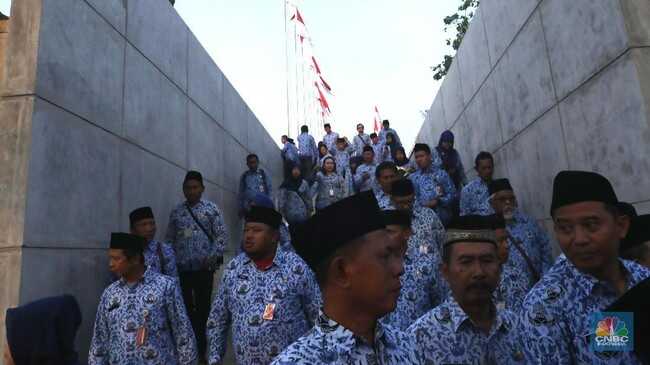
Jakarta – Finance Minister Purbaya Yudhi Sadewa has prepared a budget allocation of 55 trillion rupiah for holiday allowances (THR) in 2026, intended for state apparatus personnel (ASN), including civil servants, military and police officers.
The total budget to be disbursed represents an increase from the previous year’s 49.9 trillion rupiah. Purbaya stated that distribution is scheduled to commence on 26 February 2026. However, this has been delayed pending President Prabowo Subianto’s signature on the government regulation concerning THR for ASN, military and police personnel.
“It is currently being processed. Once the President returns, he may make an announcement,” he explained on Friday (27 February 2026).
Nevertheless, it can be confirmed that THR for ASN, military and police personnel will not be subject to deductions or taxation. THR for state apparatus is technically subject to income tax (PPh), though the government bears the entire tax burden. This tax exemption has been in place for several years. Last year, this exemption was set out in Presidential Regulation No. 11 of 2025 concerning the Provision of THR and 13th Month Salary to State Apparatus, Pensioners and Beneficiaries for 2025.
In contrast to ASN personnel, THR for private sector employees is subject to taxation through article 21 income tax (PPh 21). How is tax calculation on THR for private sector employees determined?
According to an article by Kania Laily Salsabila, official at the Directorate General of Taxes, the implementation of Average Effective Tax Rate (TER) on PPh 21 for salaries will also affect THR for private sector employees.
TER is a government policy designed to facilitate employers in calculating article 21 income tax liability for the period from January through November.
To calculate the tax liability amount, employers need only multiply the gross income provided to employees by the TER rate. The TER for permanent employees is divided into three categories based on the amount of Non-Taxable Income (PTKP) and the number of dependants at the beginning of the tax year.
Example of TER calculation on salary and THR:
Employee X earns a fixed salary of 5 million rupiah with unmarried/zero dependent status (TK/0). Employee X falls into category A effective average tax rate.
In regular months, Employee X is subject to a tax rate of 0 per cent.
In the month when salary and THR are paid simultaneously, taxation is no longer applied separately to salary and THR, but rather to the combined total. Assuming THR is paid equivalent to one month’s salary, the total gross income received in that month is 10 million rupiah. In accordance with TER provisions, Employee X is subject to tax of 10 million rupiah multiplied by 2 per cent, equalling 200,000 rupiah.
Based on the above example, Employee X, who normally receives no article 21 income tax deduction each month, experiences an increase in article 21 income tax of 200,000 rupiah when THR is paid. It should be noted that TER does not impose a new tax burden. The calculation of annual article 21 income tax liability remains unchanged, using the rate specified in article 17(1)(a) of the Income Tax Law.