
The World on the Brink of Energy Crisis as Indonesia's Neighbours Prepare Their Own Solutions
Jakarta—US President Donald Trump has spent recent days attempting to convince the world that the economic impacts of the ongoing conflict with Iran remain manageable. These efforts come amid global anxiety following the practical closure of one of the world’s most critical energy trade routes for nearly two weeks.
Trump has issued a series of claims to ease market concerns, suggesting the disrupted shipping lane may reopen shortly. Additionally, US oil sanctions against “several countries” will be temporarily lifted.
The US President has even hinted that the ongoing conflict could end soon.
However, a contrasting message came from Iran’s Supreme Leader Mojtaba Khamenei, who made his first public statement following his official succession of his late father, Ali Khamenei, who died in attacks by the US and Israel.
The statement, read by a Press TV news anchor on 12 March 2026, called for Iranian national unity whilst asserting that the Strait of Hormuz would remain closed as pressure against Tehran’s enemies.
Previously, several commercial vessels were reported attacked near the Strait of Hormuz, a vital maritime route normally used by approximately one-fifth of global oil supplies and LNG tankers.
The Islamic Revolutionary Guards Corps (IRGC) also confirmed they would not permit oil to leave the Middle East region if US and Israeli attacks on Iran continue. The forces even warned they would not allow “a single litre of oil” to be exported from the region whilst the conflict persists.
For Asian nations, the world’s largest crude oil importing region, this situation carries severe consequences. According to energy intelligence firm Kpler, in 2025 Asia relied on the Middle East for approximately 59% of its crude oil imports.
The closure of the Strait of Hormuz has made it difficult for several regional oil producers to distribute supplies to global markets, with some beginning to reduce production.
China
China, which possesses the world’s largest land-based oil reserves, has reportedly received millions of barrels of oil from Iran since the war began. These substantial reserves provide the country with temporary cushioning against global supply disruptions.
India
India has reportedly increased oil imports from Russia following US temporary sanctions exemptions. However, reports also indicate hot food and beverages have begun disappearing from some menus across Indian regions due to concerns about fuel shortages for cooking.
Japan
In Japan, the government is utilising large strategic reserves to counter the crisis. The country holds approximately 350 million barrels of oil reserves and has released approximately 80 million barrels, equivalent to 45 days’ supply.
This action constitutes part of the largest coordinated energy reserve release ever coordinated by the International Energy Agency.
However, the relatively secure conditions in some major Asian economies are not experienced by many other regional nations.
South Korea
President Lee Jae Myung stated his country heavily depends on global trade and energy imports from the Middle East.
He announced the first domestic fuel price restrictions in nearly three decades to mitigate the impacts of rising energy costs.
Thailand
In Thailand, the national fuel fund is spending tens of millions of dollars daily to maintain low fuel prices through consumer subsidies.
Thai Trade Minister Suphajee Suthumpun urged the public not to panic, stating the government has prepared various scenarios “to address every potential impact”.
The government has encouraged civil servants to implement remote working arrangements and postpone non-essential travel.
Bangladesh
The Bangladesh government has begun implementing fuel sales rationing to prevent panic buying. All universities have also been closed in efforts to preserve national energy supplies.
Military personnel have been deployed to major oil depots, whilst police have been stationed at fuel filling stations.
Myanmar
The military government in Myanmar has implemented fuel rationing and banned half of private vehicles from operating. Vehicles with even-numbered plates may only operate on even dates, whilst vehicles with odd-numbered plates may only operate on odd dates.
Pakistan
In Pakistan, the government has introduced strict conservation measures, including closing schools and limiting government office working days to four per week.
“To stabilise the economy, we have made difficult decisions,” said Prime Minister Shehbaz Sharif.
Fuel truck drivers have also reported supply shortages. One driver, Abdul Shakoor, stated the border with Iran has been closed.
“Iran has closed the border from their side,” he told AFP. “The depot is empty.”
Philippines
In the Philippines, several government officials have begun implementing four-day work weeks to reduce fuel consumption.
Government agencies, state universities, and higher education institutions have also been asked to reduce fuel consumption by at least 10%, including setting air conditioning temperatures no lower than 24 degrees Celsius.
Vietnam
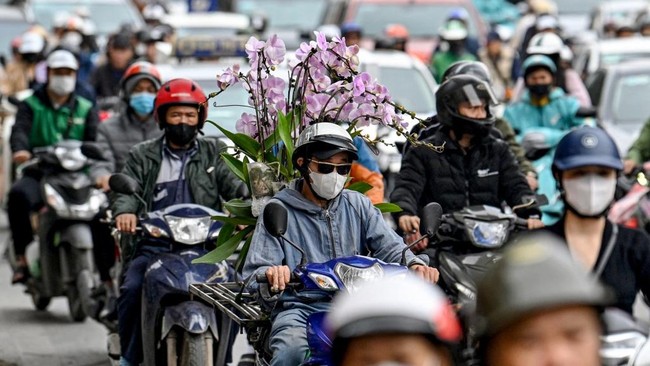
The Vietnamese government has urged companies to encourage employees to work from home where possible to reduce travel requirements.
This remote working policy echoes measures taken during the early stages of the Covid-19 pandemic.
Vietnam also plans to eliminate import tariffs on foreign fuel until the end of April to strengthen national energy supplies, amid long queues at filling stations and price increases.