
The Urgency of National Unity for the Success of Prabowo's Administration
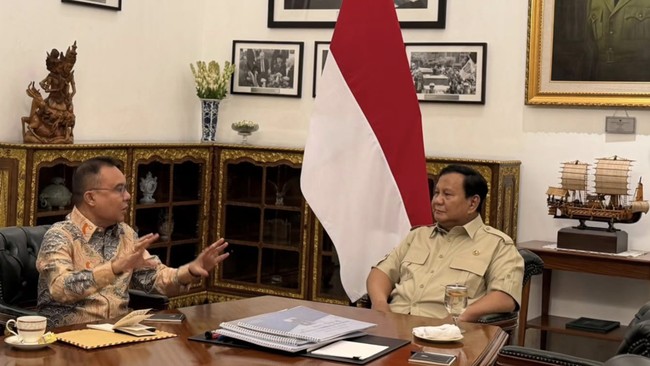
The Deputy Speaker of the House of Representatives, Prof. Sufmi Dasco Ahmad’s call to civil society to strengthen national unity is highly relevant to Indonesia’s socio-political conditions today.
In the midst of an increasingly open democracy and the rapid flow of information in the digital era, safeguarding unity is both a challenge and an important necessity for all elements of the nation.
The call deserves appreciation as it reminds us that the success of national development does not depend solely on the government, but also on the support and active participation of society.
As a country with diversity of ethnic groups, religions, cultures, and political views, Indonesia has long been known as a nation that can live with differences. The values of togetherness and mutual cooperation have been a strong foundation for national life.
However in recent years, the public space has often been coloured by sharp debates, especially on social media. Differences of opinion are not infrequently transformed into verbal conflicts that trigger polarisation in the middle of society.
In this context, the call to strengthen national unity becomes very important. Unity does not mean erasing differences of opinion or silencing criticism.
On the contrary, unity is reflected in the ability of society to manage differences in a mature and constructive manner. Criticism can still be conveyed as part of democracy, but it must be based on the intention to improve the situation, not merely to attack or muddy the atmosphere.
The civil society’s role in maintaining unity is also closely related to support for various development programs implemented by the government. The administration of President Prabowo Subianto carries a number of priority agendas aimed at improving people’s welfare.
Programs such as strengthening food security, improving the quality of human resources, regional economic development, and nutritious meals programmes are efforts that require broad support from all elements of society.
Public support for government programmes does not always mean agreeing with all policies without criticism. Constructive support is shown through active participation in the success of policies that benefit the public while also providing input so that their implementation is more effective and targeted. Thus, the relationship between society and government can operate in a healthy manner within a responsible democratic spirit.
In the digital era, the role of civil society in strengthening unity is also increasingly important due to the existence of social media. Digital platforms have become the main space for people to discuss, exchange information, and express aspirations. On the other hand, social media also often becomes a space that triggers misunderstanding, hoaxes, and narratives that divide.
Therefore, it is important for society to make social media a space of unity. Digital literacy must be continuously strengthened so that people can sift information wisely. Each social media user has a moral responsibility not to spread information whose truth is unclear and to avoid narratives that can trigger social conflict.
Conversely, social media can be used as a vehicle to spread optimism and a sense of togetherness. Information about various development programmes, success of public policies, and various positive initiatives from society can become an inspiration that strengthens national self-confidence. In this way, social media is not only a space for debate but also a venue to build national solidarity.
Strengthening national unity is also linked to the social stability needed in the development process. A state with social and political stability will be better able to develop the economy, attract investment, and open job opportunities for the people. Conversely, if the public space is filled with conflict and polarisation, the nation’s energy will be spent on unproductive debate.
The unstable global situation also increasingly demonstrates the importance of national unity. Geopolitical tensions in various parts of the world, including conflicts involving Iran and the United States, show that international dynamics can affect global economic and political stability.
In such situations, the steps of the Indonesian government under President Prabowo Subianto, which emphasise diplomacy, regional stability, and national interests, deserve praise.
The stance that prioritises peace, dialogue, and caution in responding to global dynamics demonstrates Indonesia’s commitment to remain a country that upholds stability and international cooperation. In facing global challenges, national unity becomes an important asset so that Indonesia can maintain its independence and national interests.
Therefore, all parties have a responsibility to maintain a healthy national atmosphere. The government, civil society, community leaders, academics, and the younger generation must build a culture of dialogue that respects each other. Differences of view should be seen as part of the democracy’s wealth, not as a reason to break apart the unity.
Ultimately, the call to strengthen national unity as articulated by Prof. Sufmi Dasco Ahmad serves as an important reminder for all elements of the nation. Unity is not only a slogan, but the foundation that allows the nation to face various challenges, both domestic and international.