
The Universe Is ‘Noisy’ After All: Scientists Detect Hundreds of New Black Hole Mergers
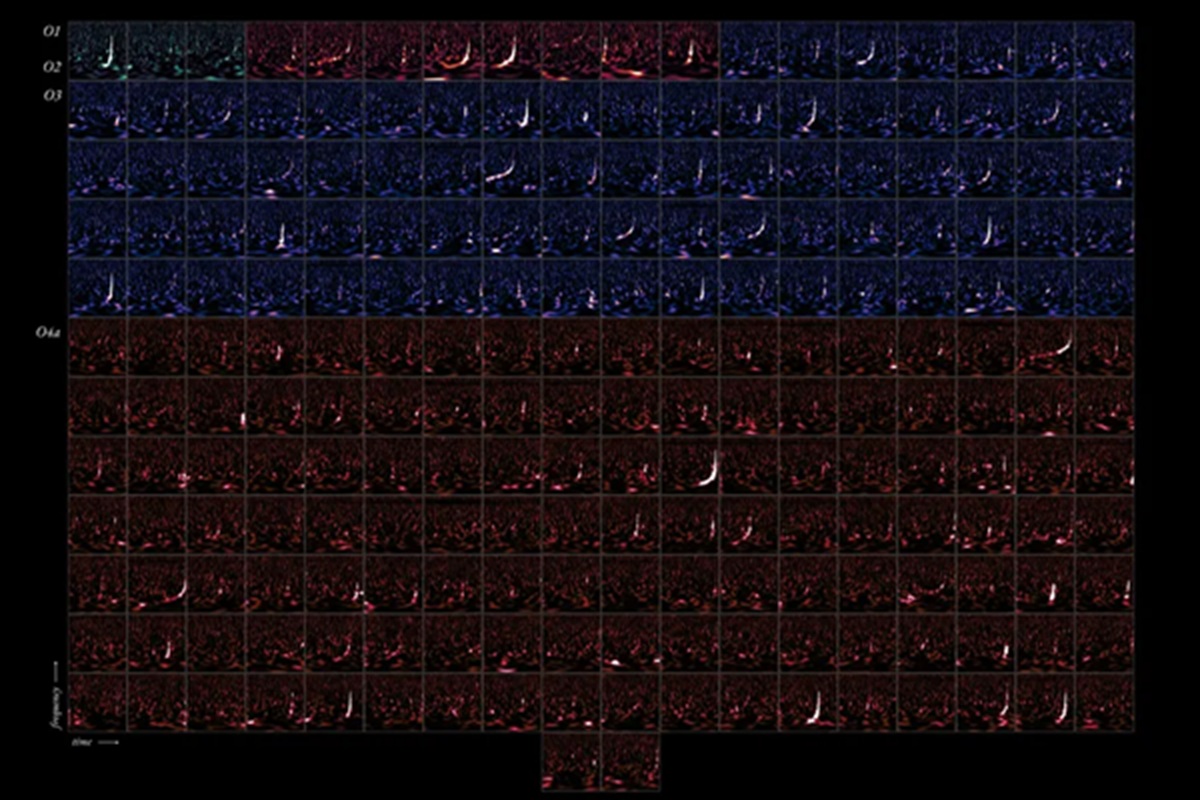
Over a century ago, Albert Einstein predicted that the collisions of the universe’s most massive objects would ripple space-time. Now, that prediction has proven to be far more dramatic than imagined. Scientists have released a new catalogue showing that our universe is effectively humming with gravitational waves from a range of cosmic mergers.
The catalogue, named the Gravitational-Wave Transient Catalog-4.0 (GWTC-4), records 128 new gravitational-wave sources, a sharp rise from the previous period which logged 90 sources. Data were collected by the LVK collaboration—LIGO (USA), Virgo (Italy), and KAGRA (Japan)—during the observing run from May 2023 to January 2024.
GWTC-4 stands out for the diversity of extreme events recorded. The catalogue includes the mergers of binary black holes that are the heaviest ever detected, each with masses around 130 solar masses. Scientists have also found black holes spinning at extraordinary velocities, reaching about 40 per cent of the speed of light. This extreme character is thought to be the result of a ‘hierarchical mergers’ process, in which black holes that have collided previously continue to grow into gigantically massive objects.
‘The message from this catalogue is that we are extending our reach into a new region of what we call the parameter space and into a variety of newly discovered black-hole types,’ said Daniel Williams of the University of Glasgow. ‘We’re really pushing the boundaries, seeing more massive, faster-spinning, as well as more astrophysically interesting and unusual objects.’
Beyond black holes, the catalogue records neutron-star mergers that occur out to distances of up to a billion light-years, and black-hole collisions at distances as vast as ten billion light-years. This expansive observational scale allows scientists to test General Relativity in the most extreme environments.
‘Therefore, so far the theory has passed all of our tests,’ said Aaron Zimmerman of the University of Texas at Austin. ‘But we have also learned that we must craft more accurate predictions to keep pace with all the data the universe provides.’
With each new detection, researchers are beginning to understand how massive stars collapse and how the cosmological evolution of the universe is shaped. Lucy Thomas of Caltech added that every detection opens pieces of the universe’s puzzle in ways that would have been unimaginable a decade ago.
The comprehensive results are scheduled for publication in a special issue of Astrophysical Journal Letters. The discovery also confirms that gravitational-wave astronomy has evolved from merely testing theories to becoming a primary tool for mapping the dark and dynamic history of our universe.