
The Strait of Hormuz and the Regional Conflicts Shaking the Global Order
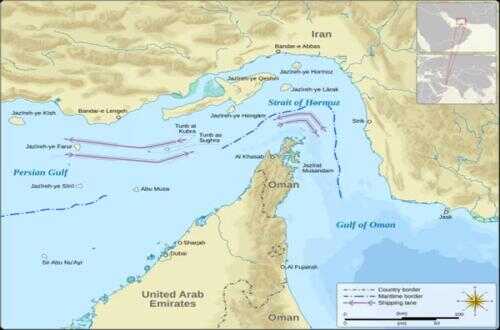
On the world map, the Strait of Hormuz appears as a slender line that can easily be overlooked by a hurried eye. It is merely a narrow stretch of water that separates Iran’s northern coast from Oman’s southern coast. But, as with many places in human history, spaces that seem narrow often bear burdens far greater than their size. Along this waterway, almost a fifth of the world’s oil moves every day. Giant tankers sail slowly from ports in the Persian Gulf to global energy markets. They carry fuel for factories in Asia, vehicles in Europe, and the modern economic system that can no longer function without fossil energy in large quantities. The route is so vital that even small tensions there are felt quickly in global energy markets. But the Strait of Hormuz is not only about oil. It carries history. For centuries, the region has been a crossroads of great powers. The Persian Empire once regarded the area as part of its geopolitical space. Merchants from various civilizations crossed the seas around the Persian Gulf long before modern nations emerged. In a sense, the region has long been a place where trade, power, and history meet. Today, that intersection feels increasingly tense. To the north stands Iran — a country that sees itself not only as a modern political actor but also as the heir to a long Persian civilisation. Such historical consciousness often gives a nation a different sense of timing. The United States, on the other hand, remains a principal military power ensuring the stability of global shipping lanes. Its navy has long patrolled the Gulf to ensure that the Strait of Hormuz remains open for international trade. Yet such stability has never been wholly simple. The relationship between Iran and the United States has long been sharpened by tensions since the 1979 Iranian Revolution. Economic sanctions, proxy conflicts across the Middle East, and a sequence of military incidents have kept the relationship far from stable. Amid that tension, Israel also views Iran as a long-term strategic threat to its security. For Israel, Iran’s influence in the region—particularly through its network of regional allies—becomes an indispensable factor in the calculation of national security. As these three actors operate in the same geopolitical space, the Strait of Hormuz becomes one of the most sensitive points in the international system. But what makes this situation more complex is the fact that the world surrounding it is also changing. For decades after the end of the Second World War, global stability largely rested on American dominance. The world’s main trade routes, including the Strait of Hormuz, were within a security architecture ultimately guarded by the American military. But such dominance has never lasted forever in history. The rivalry between the United States and China is increasingly evident in economics, technology, and geopolitics. Russia has also begun to play a more active role in various international conflicts. In such a situation, regional conflicts often have meanings broader than what is visible on the surface. Tensions around the Strait of Hormuz are not only about Iran and the United States. It also concerns how great powers read changes in the order of the world. The strait becomes a small stage where diverse global interests meet. On the one hand, it is a vital energy route for the world economy. On the other, it is a geopolitical space where great power rivalries can take concrete form. What makes this situation more intriguing is the reality that stability around the strait for decades has often been treated as almost automatic. Yet history seldom moves according to assumptions. If tensions in the region rise, the Strait of Hormuz could shift from a trade route to a global crisis flashpoint. Disruptions to energy flows from the Gulf could trigger economic shocks felt far beyond the Middle East. It is here that we begin to see that this narrow strait actually bears a far larger significance than its map size suggests. And perhaps it is precisely in places like this that we can observe how the world is changing. For history often does not move through dramatic events that immediately shake the world. Often it moves slowly — through narrow channels like the Strait of Hormuz — where economic interests, geopolitical ambitions, and long memories of nations meet and shape the future.