
The Story of the Collapse of the Salim Business Empire After Three Decades of Prosperity
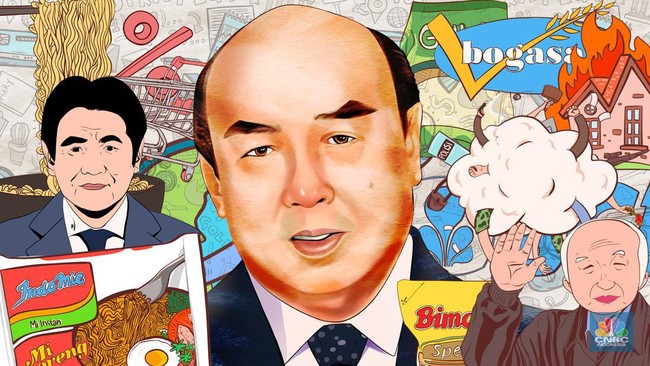
Jakarta, CNBC Indonesia - Sudono Salim, also known as Liem Sioe Liong, is recognised as one of Indonesia’s major conglomerates with a long track record in business. He also had a close relationship with Suharto since the time the president held the rank of colonel.
In the early period of Indonesia’s founding, Sudono Salim was known as an entrepreneur operating in the import of cloves and providing logistics for military needs. His extensive business network attracted the attention of Colonel Suharto to establish cooperation.
Their relationship was forged through Suharto’s cousin, Sulardi. From then on, Salim served as a logistics supplier for Colonel Suharto’s troops during Indonesia’s War of Independence.
“After Suharto seized power in Indonesia in the mid-1960s and became president, he was supported by a group of crony businessmen, the largest and strongest of which was Liem Sioe Liong,” wrote Richard Borsuk and Nancy Chng in Liem Sioe Liong and the Salim Group (2016), quoted on Sunday (3/12/2023).
The two were involved in a mutually beneficial relationship for three decades. Suharto protected Liem and ensured his businesses ran smoothly. Liem, through the Salim Group business empire, channelled funds to Suharto, his family, and other cronies.
As a result, both parties prospered in their respective paths. Salim succeeded in being listed as Indonesia’s richest person. Meanwhile, Suharto also succeeded in holding power in the country. However, their prosperity suddenly collapsed in just a few days in May 1998.
Salim successfully built three business empires in three sectors, namely banking (Bank Central Asia, BCA), construction (Indocement), and food (Bogasari and Indofood). However, all of that slowly deteriorated as it entered the 1998 crisis. BCA was the worst affected.
Historian M.C. Ricklefs in A History of Modern Indonesia (2009) states that during the crisis, customers withdrew funds en masse and on a large scale. Hundreds of people queued for hours to drain all their savings. This situation left BCA, which was no longer trusted by the public, on the brink of bankruptcy. The chain of crises peaked in May 1998.
The closeness to Suharto apparently became a disaster for Salim at that time. The emergence of anti-Suharto sentiment, stemming from the widespread economic crisis turning into political turmoil, dealt a severe blow to Salim. The public, aware of their closeness, made Salim a target. This occurred after demonstrations turned into racial riots on 13 May 1998.
That day, Jakarta and its surroundings were hit by riots, looting, and arson against houses, shop buildings, and many vehicles (Kompas, 14 May 1998). This action was carried out by provoked masses. They targeted buildings and vehicles owned by Chinese people, even targeting the Chinese individuals themselves.
Jemma Purdey in Anti-Chinese Violence in Indonesia 1996-1999 (2013) explains that the emergence of racial sentiment against the Chinese was caused by stereotypes that they deserved to be hated simply for being wealthy and close to the Suharto regime. And the central figure associated with that description was Sudono Salim.
“The companies of the cukong and Suharto’s family were the main targets of burning and looting. Bank Central Asia, owned by Liem Sioe Liong, was the primary object of attack,” wrote Ricklefs.
Richard Borsuk and Nancy Chng in Liem Sioe Liong and the Salim Group (2016) reveal that although targeted by the mob’s fury, Sudono Salim, his wife, and several children were in the United States accompanying Salim for eye surgery. In Jakarta, only Anthony Salim was working at Wisma Indocement on Jl. Sudirman.
Anthony at that time did not dare to go home to his father’s house in the Roxy area. Because the mob riots also targeted Chinese residential areas. It was feared that if Salim stayed at home, he could be killed.
That prediction then came true. In the morning of 14 May, Anthony received news that his father’s house was visited by a group of threatening-looking youths, armed with jerry cans of fuel and tools. They wanted to enter Liem’s luxurious home.
Anthony was helpless. He immediately ordered the security guards to allow the mob to enter and vandalise the house, rather than resisting and causing bloodshed.
“In an instant, all the cars in the garage were burned, including the contents of the house. They burned the furniture, removed paintings, and ransacked the rooms. They even scrawled inappropriate words on the house,” Anthony told Richard Borsuk and Nancy Chng.
After a few minutes of doing that, black smoke quickly rose high from Salim’s residence. On the streets, Salim’s photos were pelted with stones and burned by the angry mob (Kompas, 15 May 1998).
Seeing the dire situation in Jakarta, Anthony immediately thought of leaving his office. He feared that his office would suffer the same fate as his house. He then went to Halim Airport to head to Singapore using a private jet. From there, Anthony monitored his business developments after those difficult times.
After the riots subsided and Suharto finally stepped down, BCA suffered the most severe losses. There were 122 damaged branches, consisting of 17 offices completely burned, 26 branches damaged and looted, and 75 branches damaged but not looted. Then, there were 150 ATMs damaged and their cash taken, resulting in losses of Rp 3 billion.
Besides BCA, Indofood also came under attack. Its factory in Solo was looted and burned, incurring losses of Rp 42 billion. Its distribution centre in Tangerang was also destroyed by the mob. Only Indocement managed to hold out.
Nevertheless, the severe blow occurred in the banking business empire. A week after Suharto stepped down on 21 May 1998, BCA was taken over by the government because its financial condition was increasingly bleeding and unsalvageable. The government through the National Banking Restructuring Agency (BPPN) officially made BCA a BTO (Bank Take Over).