
The Story of KH Ahmad Dahlan's Correction of the Qibla Direction at Langgar Kidoel in Yogyakarta
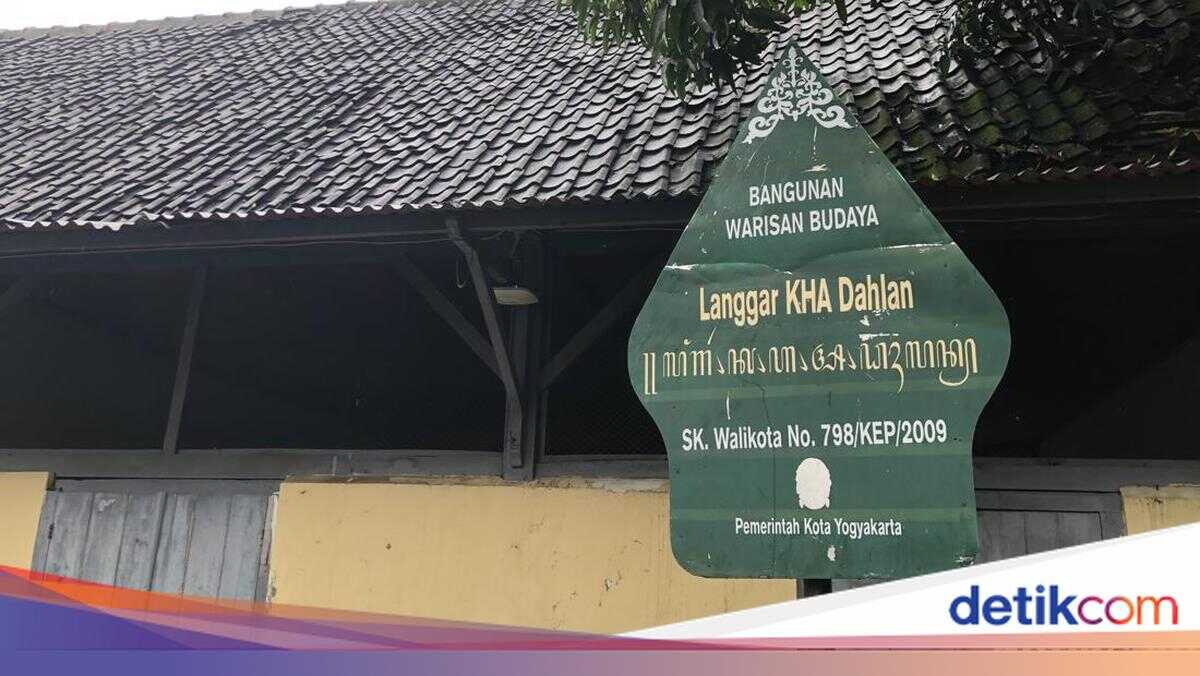
Langgar Kidoel, or Langgar KH Ahmad Dahlan, located on Jalan Nyai Ahmad Dahlan in Ngampilan, Yogyakarta, stands as a historical witness to the qibla direction correction undertaken by the founder of Muhammadiyah, KH Ahmad Dahlan. This langgar, or prayer house, became the first place of worship to have its qibla direction corrected.
Ahmad Paramasatya, one of the langgar’s caretakers, explained that the langgar was built by Ahmad Dahlan’s father, KH Abu Bakar, who was also a court official (Abdi Dalem). He stated that there is no clear written record of the year the langgar was constructed. However, the building was already standing when Kiai Dahlan was born in 1868.
“The langgar building was very simple, constructed using wood and bamboo materials, and resembled a semi-open pavilion,” Ahmad said when interviewed at Langgar Kidoel on Friday, 27 February 2026.
“As for when the langgar was built, there is still no valid and convincing source documenting the exact date,” he added.
After KH Abu Bakar’s death, the langgar was inherited by his only son, Ahmad Dahlan. Dahlan revitalised the langgar by delivering Islamic sermons and lectures.
As an active trader, Dahlan developed a concern. During his business travels, he frequently stopped to pray at various mosques and noticed that Javanese mosques consistently faced due west. This observation prompted a critical question: if one travelled due west from Yogyakarta, would one actually reach Mecca?
“When he stopped to pray, he observed that Javanese people always faced west. Then a critical question arose: was it actually correct that if you travelled due west from Yogyakarta, you would reach Mecca,” Ahmad explained.
“He then calculated the direction himself using a compass and world map. And it turned out that if you drew a straight line due west, it actually deviated and did not lead to Mecca,” he continued.
Upon discovering this discrepancy, Dahlan felt an urgency to correct the qibla direction. He began by dismantling the langgar and reconstructing it according to the corrected qibla direction he had calculated.
Ahmad noted that this account is based on notes recorded by one of Dahlan’s students. The same literary source was used as a reference for the 2010 film “Sang Pencerah” (The Enlightener).
“The langgar, which was tilted after being rebuilt, then became more popular than the Grand Mosque of Kauman at that time, attracting more worshippers,” Ahmad said.
“A figure emerged who thought this had gone too far—the Chief Islamic Official of the Keraton Yogyakarta at that time. He judged that Kiai Dahlan’s langgar and Islamic message had overstepped boundaries,” he continued.
Dahlan was warned by this official to cease the langgar’s activities. However, Dahlan remained undeterred. After receiving three warnings, the langgar was demolished.
“Once the final warning came, the langgar was indeed demolished by the Chief Islamic Official’s people,” Ahmad clarified.
Subsequently, the langgar was rebuilt. However, according to Ahmad, there is still no valid written record of the year it was reconstructed. The langgar that stands today is the rebuilt version.
Inside Langgar Kidoel, the qibla direction correction remains visible due to the building’s westward orientation. Ahmad explained that according to oral tradition within the Ahmad Dahlan family, the marks Dahlan made to correct the qibla direction are still visible inside Langgar Kidoel. The marks appear within a rectangular designation in the imam’s position.
“The rectangle is the most ideal place for the imam to lead prayer. Inside that rectangular marking, there are actually Kiai Dahlan’s marks serving as a reference for the qibla direction in this langgar,” Ahmad said.
“So there are two lines: one running from north to south, then a correction line running from east to west that is angled. The angle is 22-24 degrees,” he concluded.