
The Spirit of Modern Kartini: This Woman Chooses to Resign for Human Rights Education in Bali
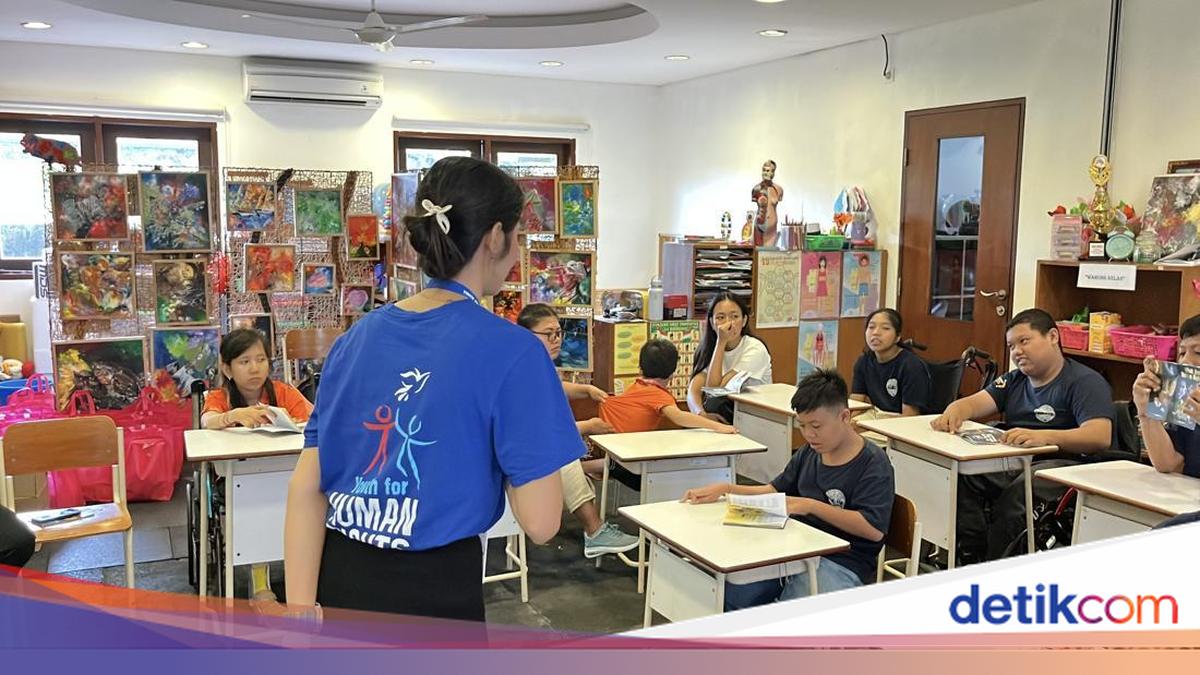
In the midst of a comfortable career as a teacher at a private school, a young woman in Bali made an unusual decision: to resign and build a human rights education community for vulnerable groups.
This step was taken by Fransiska Gabriella, an international relations alumna who now resides in Bali. She felt that human rights knowledge had not yet reached those who needed it most.
The momentum came on 10 December 2025, coinciding with International Human Rights Day. That day marked the establishment of the We Know Human Rights community.
“The idea and concept came from me, but this community is supported by Youth for Human Rights International in California,” said Founder of We Know Human Rights, Fransiska Gabriella, when interviewed by the detikBali team on Sunday (19/4/2026).
“They will help support the delivery of books, clothes, so the needs are supported by them,” Gabriella added.
The journey to establish the community was not short. Gabriella admitted to spending nearly nine months since March 2025 designing the concept and building networks.
“But designing the idea and choosing the network took quite some time. So from Youth For Human Rights International, her name is Emma. At that time, I was on the phone with her for four hours to discuss my ideas, the problems that actually occur in Indonesia that I want to highlight,” Gabriella recounted.
Chooses to Resign and Focus on Building the Community
Previously, Gabriella worked as a teacher delivering human rights education at a private high school in Bali. However, she felt the material did not reach the groups that needed it most.
“Many of them do not understand human rights. Ignorance about human rights makes people unaware of their rights as humans. Human rights do not consider ethnicity, race, religion, or anything other than the fact that we are born as humans. The school is good, but I felt the knowledge wasn’t reaching them. Because the students I taught were privileged children, their lives are comfortable,” Gabriella explained.
“Similar to people who don’t want to bother with politics, they feel policies don’t affect them, so why bother with politics, even though it does. So for them, it requires self-awareness,” she said.
From there, she decided to leave and focus on building We Know Human Rights. The community targets vulnerable groups, such as women, children, and people with disabilities.
Many Children Think Poverty is Fate
In her journey, Gabriella observed a recurring pattern of ignorance turning into acceptance of injustice.
“Many children think poverty is fate. They can’t go to school, can’t eat, so it’s fate because they were born poor. And they normalise it,” Gabriella explained.
“People assume they are poor because they are lazy, but that’s not true. There is something called structural poverty, where no matter how hard you work, you remain poor because the system sustains it that way, not because of laziness. You can’t escape, like a vicious circle,” she added.
According to her, the understanding that human rights are inherent from birth is still not widely comprehended, especially by vulnerable groups.
Human Rights, Art, and Literary Gallery Project
To make education more accessible, Gabriella packaged it through a simple approach: art and stories.
She designed the ‘Human Rights, Art, and Literary Gallery’ project, which combines art and literacy in teaching human rights, particularly to children.
We Know Human Rights has collaborated with several shelters, including Rumah RUTH Bali (Yayasan Rumah Tumbuh Harapan), which assists women with unwanted pregnancies (KTD), and Yayasan Peduli Kemanusiaan (YPK) Bali for people with disabilities.
“At Rumah RUTH, many of them leave their children to be raised there. At YPK, it’s generally children with disabilities with cerebral palsy,” Gabriella said.
“For the project, I usually take the human rights issue closest to them; there are 30 points of human rights based on the Universal Declaration of Human Rights. So because there are many children, I take child marriage, for example. It can lead to child grooming, sexual violence. At YPK, it can lead to discrimination,” she explained.
The drawing method is chosen so children can tell their stories without pressure. She only gives one simple question.
“If you imagine a peaceful life in the future, what would that life be like?”
“Their answers are very simple. No one wants to be president or get rich. For them, having a small shop, living in the village. Being able to fly kites. Or wanting to be a farmer, in the countryside, living happily. Some want to have a café, live happily with their children, happy. That’s it, nothing extravagant. So things we consider ordinary can be dreams for others,” Gabriella said.
From Introvert to Learning to Open Up
Behind her role, Gabriella admits she is not someone who easily appears in public spaces. She describes herself as an introvert.
“But actually, I’m very socially awkward, very introverted. At first, I didn’t want to make social media because the goal is purely for education. But then I made a website. I don’t like publicity, but Emma said we need it too, so more people know, the better,” she explained.
She then created the site weknowhumanrights.wixsite.com, opened social media accounts, and opened volunteer registrations to expand the community’s reach.
We Know Human Rights also began involving teachers, social workers, and other communities so that human rights education does not stop at one point.
“Initially, it was suggested to do a march, but after consulting, they had difficulties gathering in public places. Because they were asked for permits. Even though it’s a public park. So I was afraid it would be difficult. Then I thought of making murals,” she explained.
She then designed mural activities at schools or shelters featuring the 30 articles of human rights, hoping they can be read by future generations.
Human Rights Education Often Overlooked
Amid various cases of slow