
The Silence Born from the Noise
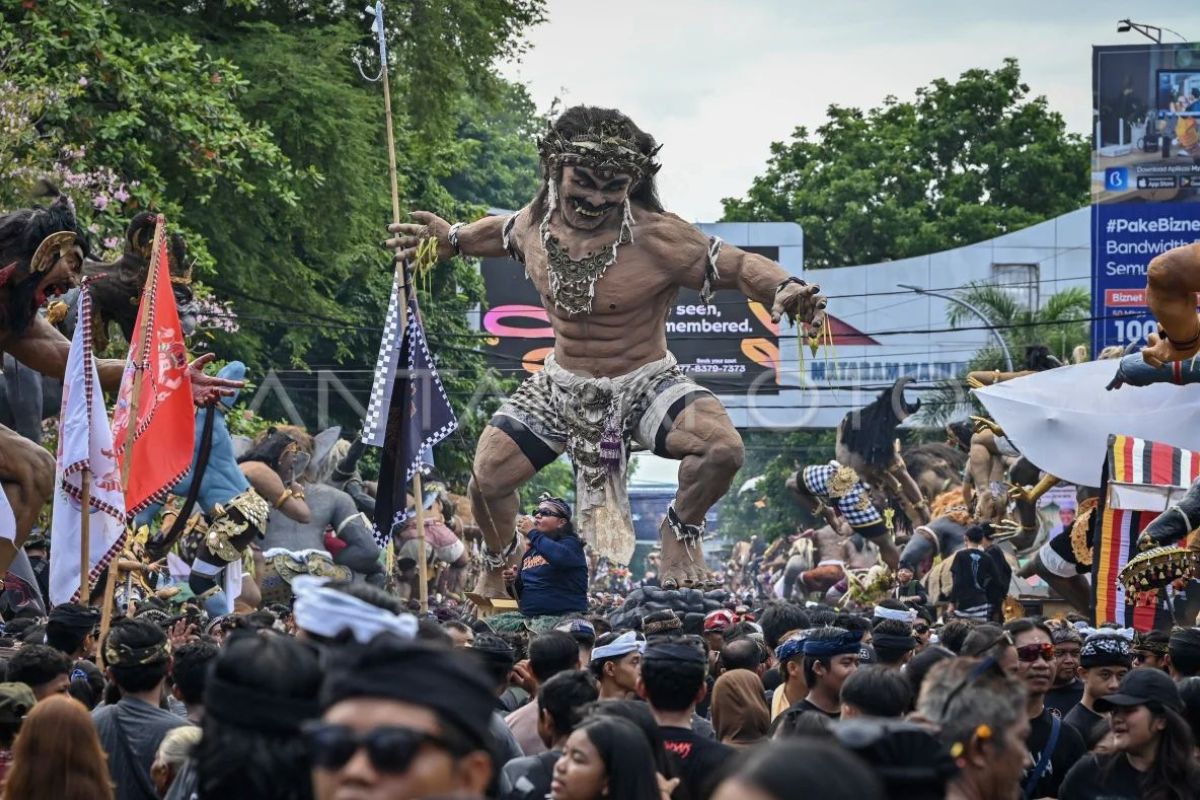
Ogoh-ogoh in Mataram is not merely about giant statues paraded through the streets. It is a narrative about how society manages differences, balances tradition and modernity, and nurtures shared spaces. Mataram (ANTARA) - The afternoon in the city of Mataram in mid-March was not only adorned with an orange sky, but also with the clamour of drumbeats, cheers from residents, and the rhythmic steps of hundreds of youths carrying ogoh-ogoh.
Along Jalan Pejanggik, 105 massive artistic creations moved slowly, blending imagination, spirituality, and collective effort across generations.
This parade is not just an annual tradition ahead of Nyepi Day, but has evolved into a social stage that showcases the face of tolerance in West Nusa Tenggara (NTB).
This year’s event felt particularly special. The ogoh-ogoh parade took place while Muslims were observing Ramadan worship. Two religious rhythms ran parallel in the same space, without negating each other.
This is what makes the ogoh-ogoh phenomenon in Mataram worthy of deeper examination, not only as a cultural event, but as a mirror of social maturity rarely found in many other regions.
Spiritual Culture
Ogoh-ogoh is fundamentally a symbol. In Hindu teachings, it represents bhuta kala, negative energy that must be neutralised before entering the silence of Nyepi.
Philosophically, the parade is the “noisy” phase before the “quiet” one, an inner journey from bustle to reflection.
However, in practice, ogoh-ogoh has now evolved far beyond its original meaning. The creativity of banjar youths has produced increasingly complex forms, from mythological figures to modern social critiques.
Inter-group competitions, social media spotlight, and the presence of tourists have turned ogoh-ogoh into a highly anticipated public attraction.
Data shows that 105 banjar participated in this year’s parade. This figure not only reflects high participation, but also indicates how this tradition has become a space for collective expression.
On the other hand, security involved around 850 combined personnel, showing the growing scale and complexity of the event.
It is at this point that a dilemma arises. As ogoh-ogoh becomes more vibrant, does its spiritual meaning remain intact? Or is it overshadowed by entertainment and existential orientations?
This phenomenon is not new. In many cultural traditions, commercialisation and popularity often go hand in hand with the dilution of meaning.
However, in Mataram, the situation is somewhat different. The vibrancy of ogoh-ogoh does not stand alone, but exists within a strong social context, namely interfaith tolerance.
The parade, scheduled to end before breaking the fast, serves as a concrete example of how public spaces are managed with social sensitivity. Even potential clashes with takbiran night were anticipated through route engineering and cross-community communication.
This demonstrates that ogoh-ogoh is not merely a cultural celebration, but also a social mechanism for nurturing togetherness.
Test of Tolerance
Mataram in recent years has often been referred to as a miniature of Indonesia. Diversity in religion, ethnicity, and culture thrives in relatively harmonious spaces. Yet harmony is never born without tests.
This year, the test came from the overlap in timing between Nyepi and Ramadan. Two sacred moments that demand different spaces for expression. Nyepi is synonymous with total silence, while Ramadan is coloured by dynamic worship activities, especially ahead of Eid al-Fitr.
In this context, ogoh-ogoh becomes a point of convergence as well as potential friction. Thousands gather, traffic is diverted, city activities change. Without proper management, this situation could spark tension.
Facts on the ground show the opposite. The city government, security forces, and community leaders managed the situation through a collaborative approach. Traffic diversions along 1.5 kilometres, closure of strategic routes, and adjustment of event timings were carried out in a planned manner.
Not only that, environmental aspects also received attention. The Environmental Agency prepared 325 personnel to anticipate a surge in waste estimated at 6 to 7 tonnes from the ogoh-ogoh parade. This figure indicates that cultural celebrations have non-trivial ecological consequences.
On the other hand, the granting of remission to 77 Hindu inmates in honour of Nyepi shows another dimension of the celebration. The state is present not only in the form of security, but also in fulfilling the rights of inmates. Nyepi becomes a moment of reflection, even behind the walls of correctional institutions.
The entire dynamic illustrates one important thing. Tolerance in Mataram is not merely a slogan, but a practice carried out through policies, coordination, and collective awareness.
Preserving Meaning
Nevertheless, future challenges are not light. The increasing popularity of ogoh-ogoh has the potential to shift its orientation from spiritual to spectacular. Young generations may be more interested in competitions and exposure than philosophical understanding.
If left unchecked, ogoh-ogoh risks becoming just an annual festival without depth of meaning. Yet the strength of this tradition lies precisely in its symbolic values.
This is where non-rigid but strategic policy interventions are important. Education is key. Each banjar is not only encouraged to create, but also to understand the philosophy of ogoh-ogoh. Curation of works can be directed not merely to chase aesthetics, but also moral messages.
Local government can play a more active role by making ogoh-ogoh part of cultural education. For example, through workshops, discussions, or integration into the local curriculum. This approach will maintain a balance between creativity and meaning.
In addition, environmental aspects need to be strengthened. Ogoh-ogoh production using various materials has the potential to add to the waste burden. Innovations in eco-friendly materials and waste management systems must become part of the event standards.
On the social side