
The Right to Water in Indonesia and the State's Responsibility
When the state is able to fulfil its role completely—respecting, fulfilling, and protecting—then water will truly become a flowing source of life for all, without exception.
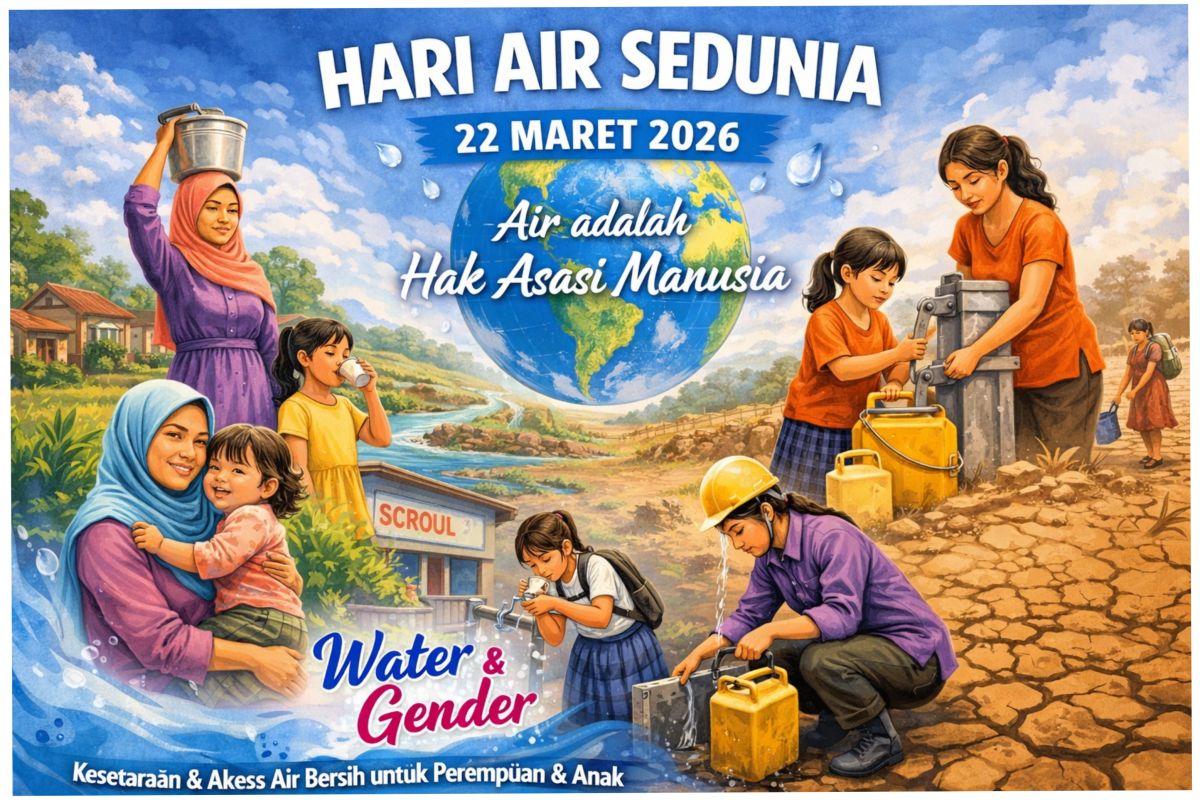
Jakarta (ANTARA) - World Water Day, 22 March 2026, once again serves as a global reminder that water is not merely a natural resource, but a fundamental right inherent to every human being.
With the theme of water and gender, this year’s commemoration emphasises that the water crisis is not only an environmental issue but also touches on aspects of social justice and equality, particularly for vulnerable groups such as women and children.
Amid such global commitments, reality shows that access to clean water remains a serious problem. More than two billion people worldwide do not yet enjoy safe water services, while in many regions, water is becoming increasingly difficult to access due to distribution inequalities, climate change, and weak governance. This situation underscores that the fulfilment of the right to water is still far from ideal.
In Indonesia, the right to water has a strong constitutional foundation. Article 33 of the 1945 Constitution states that water is controlled by the state and used for the greatest prosperity of the people. Moreover, through various Constitutional Court decisions, the right to water has been positioned as part of human rights that the state must respect, protect, and fulfil.
Nevertheless, the gap between norms and reality remains palpable. Various conflicts in water resource management, limited access in certain areas, and the impact of policies that do not fully favour society show that the state’s responsibility does not end with normative recognition. Therefore, concrete and sustainable steps are needed so that the right to water truly exists in the daily lives of the people.
Strengthening the right to water in Indonesia’s legal system cannot be separated from the role of the Constitutional Court as the guardian of the Constitution.
Through Decisions Number 058-059-060-063/PUU-II/2004 and Number 008/PUU-III/2005, the Constitutional Court has affirmed that the state’s control over water resources is not merely an administrative authority, but a constitutional mandate to ensure the fulfilment of the people’s right to water in a just and sustainable manner.
The pinnacle came in Decision Number 85/PUU-XI/2013, where the Constitutional Court explicitly annulled Law Number 7 of 2004 on Water Resources. The Court assessed that the norms in that law opened too much room for the privatisation and commercialisation of water, thus potentially sidelining the people’s right to water. This decision became an important milestone in affirming that water must not be treated solely as an economic commodity.