
The Pattern of Pharaoh: A Study of Narcissistic Leadership Through History and Scripture
By Ahmadie Thaha, Columnist
Friday often makes people suddenly wish to become more religious than usual. Some begin diligently quoting hadith, others suddenly want to make peace with their neighbours, and some even suddenly remember Pharaoh. Not because they want to drown anyone in the sea, but because the story of Pharaoh is indeed one of the most frequently repeated stories in the Quran.
If counted, the word “Pharaoh” appears approximately seventy-four times in the Quran. That is a considerable number for an antagonistic figure whose reign spanned approximately three thousand years—thirty centuries. In cinema, if a villain appears seventy-four times, it means the director truly wants the audience to learn something from that character.
Interestingly, Pharaoh was not a single person. In the book Chronicles of the Pharaohs by English historian Peter A Clayton, it is noted that throughout approximately three thousand years of ancient Egyptian history, there were roughly 180 rulers bearing the title of Pharaoh. So “Pharaoh” is not actually the name of one person, but a political office—something like “a president for life with a golden crown and a pyramid as headquarters”.
Following the chronology in Clayton’s book, the ruler who confronted the Prophet Moses was in the final phase of ancient Egypt’s empire. Several researchers connect this with the 19th dynasty, often called Ramses II or his successor. Here emerges the question that always intrigues people: if Pharaoh drowned in the sea whilst pursuing Moses, how could his mummy be found and now displayed in the Egyptian museum?
This fact makes some people doubtful about whether the sea truly parted so that Pharaoh did not drown and disappear within it. This doubt is actually unnecessary, as the Quran itself provides a rather unique explanation. In Surah Yunus, verse 92, Allah says: “This day We shall preserve thy body that thou mayest be a sign to those who come after thee.”
This verse is often understood as explaining why Pharaoh’s body remained preserved as a historical artefact. There is yet no explanation of how Pharaoh was “preserved” and in what form. Some say that mummification itself was one form of his preservation. Pharaoh thus became a monument of warning about the arrogance of power that ultimately ended tragically.
However, what is far more important than the identity of that Egyptian king is not who exactly that Pharaoh was, but the pattern of leadership he represented. A writer named Richard Diamond attempted to reread this pattern within the context of modern politics. Diamond is a former technology executive who later became a writer on Jewish philosophy, ethics, and public life.
In a recent piece in the Times of Israel titled “This Week, as Pharaoh Reappears, It’s Worth Naming Trump’s Pathology,” he invites readers to view the story of Pharaoh not as an ancient myth, but as a model of power psychology that still emerges today. Notably, he draws a direct line between Pharaonic leadership and United States President Donald Trump.
Diamond is not making a religious interpretation, but rather doing what he calls pattern recognition—recognising patterns. For him, the story of Pharaoh shows how a leader’s personal pathology can become a principle of organising public life. In modern psychological terms, this is often called “narcissistic leadership.”
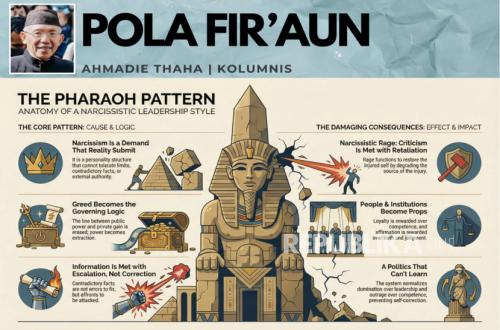
Below is the account following directly the structure of the Pharaonic leadership pattern as shown in the diagram: the left side as “cause & logic” (causes and logic of leadership), and the right side as “effect & impact” (the impacts produced).
On the left side of the diagram, the pattern of Pharaonic leadership begins with three “psychological roots and logics of power”. The first is “narcissism that demands reality submit to it”. In this pattern, a leader not only has a massive ego, but demands that the world conform to his self-image. Facts that contradict this are considered personal attacks. Criticism is considered rebellion.
In the Quran, this attitude is reflected when Pharaoh says to his people: “I know not that ye have a god other than me” (Qur’an 28:38). This statement shows that the highest authority is placed in himself alone. In modern psychological language, this is a form of extreme narcissism incapable of accepting limits.
The second root is “greed as the logic of governance”. In this pattern, power is not understood as a trust, but as a means of accumulating wealth and domination. Everything can be converted into profit: office becomes wealth, influence becomes transaction, even public anger can be turned into a source of political mobilisation.
Ancient Egyptian history shows how Pharaoh’s power was used to forcibly and tyrannically mobilise the people’s labour for giant projects, including the construction of large structures such as the Pyramids. The Quran depicts this structure of power as a system that oppressed part of the people and enslaved certain groups (Qur’an 28:4).
The third root is “narcissistic rage when the ego is threatened”. In psychology, Heinz Kohut calls this phenomenon narcissistic rage. When a leader with a massive ego feels humiliated or challenged, his reaction is not reflection but counterattack. Anger becomes a mechanism to restore his dominance.
In the story of Moses, every time Pharaoh was confronted with signs of truth, his reaction was not policy evaluation, but increased pressure against Moses and his people.
From these three basic logics then emerge the “political impacts” shown on the right side of the diagram. The first impact is “other people are treated as tools or property of power”. In a narcissistic system, human beings are no longer seen as independent subjects who possess their own value and rights. They merely function as means to serve the leader’s self-image and ambitions.