
The Origins of the Dispute and Jusuf Hamka's Lawsuit Against Hary Tanoe
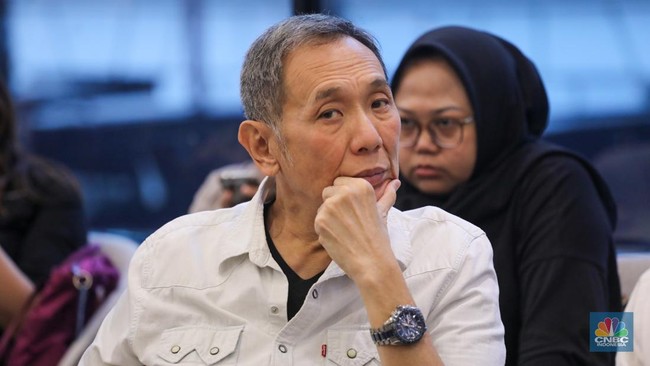
Jakarta, CNBC Indonesia - The listed company owned by toll road entrepreneur Jusuf Hamka, PT Citra Marga Nusaphala Persada Tbk (CMNP), has won part of its lawsuit against Hary Tanoesoedibjo and PT MNC Asia Holding Tbk (BHIT). The case has spanned decades and has finally reached a turning point this year.
The spokesperson for the Central Jakarta District Court, Sunoto, stated in an official release that Hary Tanoe and MNC Asia Holding must pay material damages of US$28 million or Rp484 billion (at an exchange rate of Rp17,300) plus 6% annual interest from 9 May 2002 until fully paid.
In addition, the panel of judges has ruled that Hary Tanoe and MNC Asia Holding must pay immaterial damages of Rp50 billion jointly and severally, as well as court costs of Rp5.02 million.
“The panel of judges is of the opinion that the transaction on 12 May 1999 was substantively an exchange of securities as meant by Article 1541 of the Civil Code, not a sale,” Sunoto wrote in the official release, quoted on Friday (24/4/2026).
This ruling is a first-instance decision, so the parties who do not accept it have the right to appeal to the Jakarta High Court within 14 days from the date the decision is lawfully notified, in accordance with the applicable civil procedure law.
So, how did the dispute between these two conglomerates begin?
For information, this case emerged and became widely discussed last year. However, the events occurred in May 1999. CMNP conducted a negotiable certificate of deposit (NCD) transaction worth US$28 million with PT Bank Unibank Tbk.
At that time, BHIT acted as the arranger. Hary Tanoe’s company was established in 1989 as a securities firm before expanding into the media business in 2001.
Unibank itself was a bank that operated in Indonesia from 1967 until it was frozen in 2001. The bank was previously owned by conglomerate Sukanto Tanoto.
Meanwhile, BHIT’s legal counsel Hotman Paris Hutapea believes that in this case, CMNP as the plaintiff should have sued Unibank or the party that received the funds from the issuance of the securities. Because the transaction was between CMNP and Unibank, and BHIT was only an intermediary in the securities transaction.
The Panel of Judges’ Considerations
The panel of judges assessed that Hary Tanoe and MNC, as the parties who initiated, offered, and delivered the NCD to CMNP, should have known that the NCD did not comply with Bank Indonesia Circular No. 21/27/UPG dated 27 October 1988, as also emphasised in the Supreme Court’s Judicial Review Decision No. 376 PK/Pdt/2008 dated 19 December 2008, which has final and binding legal force.
The panel of judges applied the piercing the corporate veil doctrine (a legal doctrine that pierces or lifts the corporate veil, so that legal responsibility that should be limited to the company shifts to the personal assets of shareholders, directors, or commissioners) as meant by Article 3 paragraph (2) of Law No. 40 of 2007 on Limited Liability Companies to the defendants, with the consideration that the actions in question were not merely corporate management actions, but reflected bad faith that exploited the corporate name.
Use of Funds from Winning the Lawsuit
Conglomerate Jusuf Hamka claims to be satisfied with the legal process and the court’s decision stating that Hary Tanoesoedibjo and PT MNC Asia Holding Tbk have committed unlawful acts against PT Citra Marga Nusaphala Persada Tbk (CMNP).
Jusuf Hamka revealed that although satisfied, the interest amount is far lower than it should be if referring to the 1999 Bank Indonesia Circular.
“It should be according to the 1999 Bank Indonesia Circular, the interest is 27% per year,” he said when contacted by CNBC Indonesia on Thursday (23/4/2026).
Jusuf Hamka explained that regarding the interest amount, it is the panel of judges’ decision which is considered reasonable. His side will consider taking further legal steps.
“It’s possible that the lawyers will take further legal steps,” he revealed.
Jusuf Hamka disclosed that the funds will be used not only to pay the rights of employees and parties harmed by the case, but also channelled to charity or utilised for the broader community in need.
MNC Asia Holding Responds
PT MNC Asia Holding Tbk (BHIT) has responded to the lawsuit by PT Citra Marga Nusaphala Persada Tbk (CMNP) regarding the decision in case number 142/PDT.G/2025/PN.JKT.PST at the Central Jakarta District Court on 22 April 2026.
MNC Group’s Legal Counsel Chris Taufik stated that the court decision is not final, does not have binding legal force, and cannot be enforced because an appeal to the high court is still possible, followed by cassation and even a review if any party is dissatisfied.
“The company will appeal the decision due to many irregularities in the ruling,” he said in a written statement on Friday (24/4/2026).
He explained that the irregularities include the party directly responsible for the NCD payment, namely PT Bank Unibank Tbk along with its board of directors, commissioners, and shareholders as the issuer of the NCD and the party guaranteeing the NCD payment, not being sued, but the decision instead burdens the defendants who were only brokers or arrangers.
According to him, if Unibank had not been declared a frozen business bank on 29 October 2001, or 2 years and 5 months since CMNP received Unibank’s NCD, then payment would certainly have been made by Unibank.
“There was no involvement from the defendants in the process of Unibank becoming a frozen business bank because they were not managers or shareholders of Unibank,” he stated.
In addition, he continued, actually CMNP had already received payment from the State be