
The Night-Time Train Tragedy Between Jakarta and Bekasi Should Not Have Happened
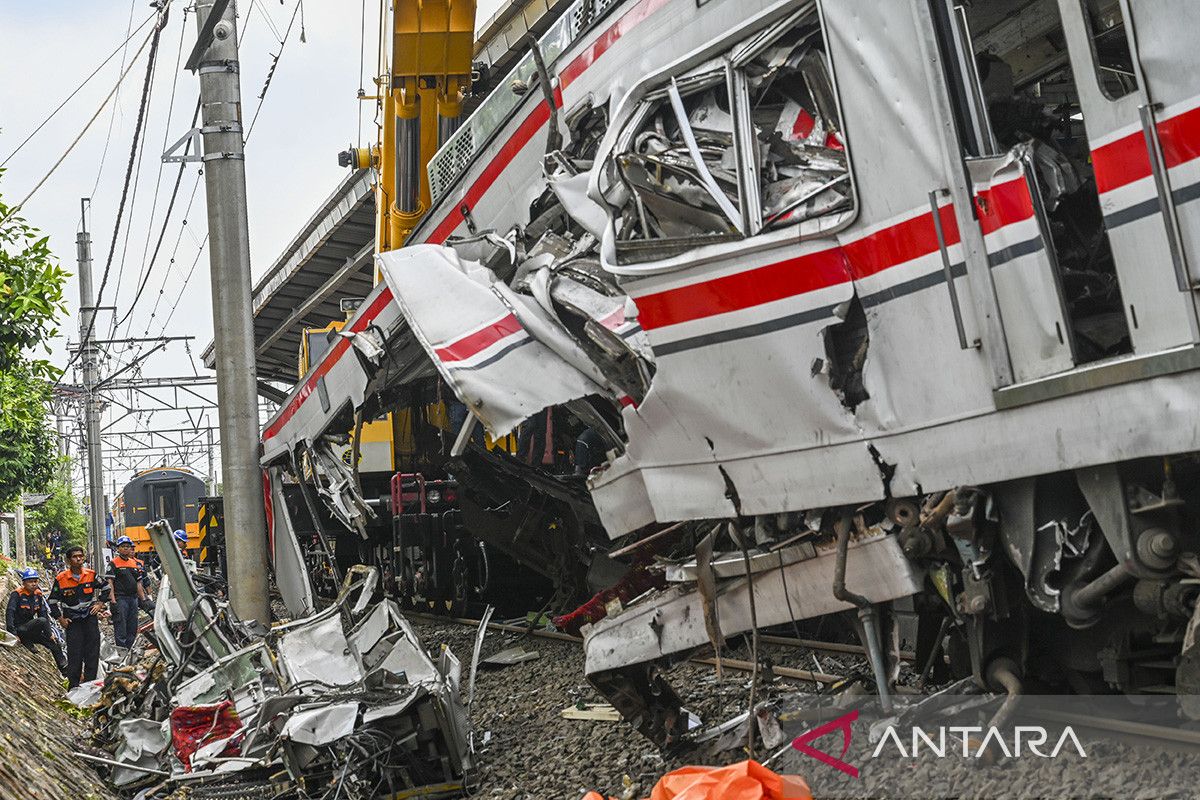
The responsibility to ensure such incidents do not recur lies squarely on the shoulders of policymakers. The safety of citizens must remain the highest law, transcending all bureaucracy and budgetary limitations.
Jakarta (ANTARA) - The weary faces grew increasingly pale and resigned. They were forced to breathe with the aid of oxygen tanks, struggling to endure extraordinary pain as shards of steel from the train carriage pinned nearly their entire bodies and legs.
They were seven passengers, the last victims trapped in the wreckage of the women-only carriage of the electric rail train (KRL) on the Jakarta–Cikarang route, following a collision with a long-distance train at Bekasi Timur Station, Bekasi, on Monday, 27 April.
That night, the situation grew ever more tense. Basarnas’ assessment indicated that the only way to save them was through heavy extrication. This effort offered scarcely any alternative but to lift the carriage with a crane. Cutting and lifting techniques were performed with high precision using hydraulic cutters to create space from the crushing materials without shifting the carriage’s position, which risked worsening the survivors’ injuries.
Cutting the steel shards of the train carriage into sections was clearly no easy task, even with equipment available. Moreover, those metal pieces were pressed directly against the bodies of the victims, all women. One can imagine the excruciating pain as the shin bones of their legs faced vibrating iron, occasionally sparking from the friction of the cutting machine.
Even experienced and internationally certified personnel like the Basarnas Special Group (BSG) found the situation that night profoundly challenging and exhausting. It was not only their physical strength that was drained, but their mental resilience was tested as they confronted the victims’ cries and the oxygen-scarce conditions inside the destroyed carriage.
Indeed, one trained Basarnas personnel had to be carried out of the carriage with laboured breathing. He slumped weakly, occasionally inhaling oxygen from an aid tank to recover his depleted energy after hours of crawling in the unstable, confined space.
The rescue operation was conducted with a strict rotation system. Basarnas personnel, assisted by firefighters, took full responsibility for the extrication process. Meanwhile, paramedics and volunteers ensured the victims’ conditions remained stable, and medical equipment—from oxygen supplies to IV fluids attached to their wrists—functioned properly. Outside the station, dozens of volunteer ambulances stood ready to transport the victims to the nearest hospitals.
One by one, the victims were successfully evacuated with utmost care and immediately rushed to hospitals for treatment. The last of the seven victims was finally extracted in a stable condition. She was identified as Nurul (26).
The entire process lasted approximately 10 hours. Finally, on Tuesday morning, 28 April, the Head of Basarnas and operation commander, Mohammad Syafii, announced that the rescue operation was officially closed.
This bloody tragedy was the culmination of a chain of events at the level crossing (JPL 85) in the Ampera Road area, not far from Bekasi Timur Station. Around 20:55 WIB, a KRL on the Tambun–Cikarang route collided with an electric taxi that suddenly stalled in the middle of the tracks. That incident triggered a domino effect that paralysed train travel in parts of Java that night.
The KRL train that struck the taxi then had to be evacuated and designated as an extraordinary journey (PLB) with code 5181, as it stopped service and operated outside the regular schedule. As a result, officials halted another KRL with code PLB 5568 heading to Cikarang at the platform of Bekasi Timur Station.