
The Mystery of Toko Nam's Collapse: Why Must Surabaya's Legendary Landmark Disappear in the Middle of the Night?
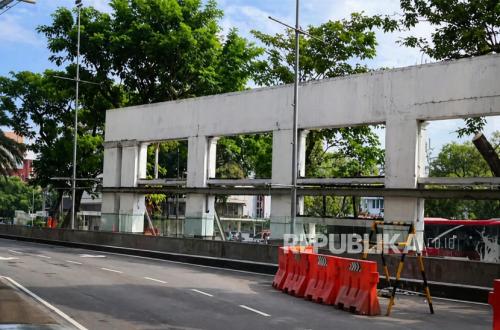
In a bustling street corner that never truly quiets, pedestrians’ steps once halted by something oddly out of place. Pillars stand on the pavement, like half-present, half-vanished memories. People pass by; some recognise it, others wonder. The name Toko Nam lives in a space that’s not entirely clear, between history and its shadow.
Now, as that facade begins to be dismantled at night, the city seems to be reopening an old chapter. Some things crack, others are straightened. Surabaya, with all its pulse of modernity, is negotiating with its own past.
The dismantling of the former Toko Nam facade on Embong Malang Street is not merely a technical job targeted to finish in a matter of days. It is a symbolic event. A meeting point between the city’s ever-moving needs and the effort to care for memories that are never truly complete.
In its time, Toko Nam was not just a space for buying and selling. It was a sign of the era. Standing since the early 20th century, this shop pioneered the concept of modern retail in Surabaya, even in the Dutch East Indies. While many shops still relied on direct transactions, Toko Nam had introduced delivery services—something that now feels ordinary but was a major leap in shopping habits back then.
Its strategic location in the Tunjungan and Embong Malang area made it the centre of the city’s economic and social pulse. Within a decade, it grew rapidly, moving to larger spaces to accommodate the increasingly complex needs of society. From the 1960s to the 1980s, its glory reached its peak, becoming a department store deeply embedded in residents’ memories.
However, like many city icons, time never stops. Modern shopping centres arrived with new faces, bringing different consumption patterns. Toko Nam slowly lost its place until it was finally demolished in the late 1990s. In its stead, a commercial complex rose, reflecting Surabaya’s new direction.
To preserve the memory, a facade resembling the front of Toko Nam was built. A well-intentioned effort, but one that harbours issues. That facade is not a full reconstruction based on historical data, but a symbol standing in the same spot without clear context. Over time, it has created ambiguity: what is truly history, and what is mere interpretation.
This ambiguity is not just narrative. In practice, the facade has begun to clash with the needs of the modern city. Standing on the pavement, it obstructs pedestrian space that should be a priority. Visually, it no longer blends with the evolving city landscape.