
The Mount is Lost, Ready to Die
There was a time when resistance did not begin with shouts, but with patient sitting together, from long meetings that sometimes lasted until late at night. In early 1930s Minangkabau, traces of this can still be read today through manuscript notes of ulama meetings. Simple pages that record how a great stance was formulated calmly, yet with full conviction.
There, we see that courage does not always appear in a harsh form. It can grow from deliberation, from writings, from agreements born in shared awareness.
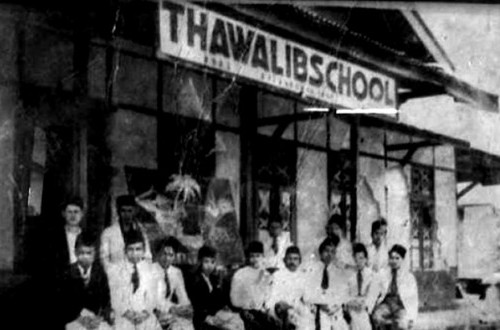
It all began with the colonial policy known as the Wild Schools Ordinance. For the Dutch government, this was an effort at regulation. However, for the Minangkabau people, this policy felt like a threat to the educational spaces they had built themselves. Schools that grew from community initiatives—Sumatera Thawalib, Diniyah School—were suddenly placed in a position of having to submit or be considered violators.
Yet, from those spaces emerged a generation that began to understand religion as well as the world, learning not just to read scriptures, but also to read the times.
It is no surprise that the policy quickly sparked a reaction. But what is interesting is that the reaction did not erupt into wild anger. It was structured. It was thought through. It was formulated in ulama meetings that brought together various groups, including those who previously often differed in views.
In one manuscript note, the time and place of the meeting are mentioned in detail: Thursday evening, Friday night, 10–11 Syaban 1351, at Surau Adam, Balai-Balai, Padang Panjang. There, the ulama gathered, discussing the newly enforced ordinance. They did not just complain, but began to devise steps.
Those meetings were not brief. In one note, the gathering lasted until 2 a.m., closed before dawn, then continued the next morning. All costs were borne together. There were no luxurious facilities. What existed was the awareness that they were safeguarding something greater than personal interests.
Even more interesting, the notes do not reveal plans for violent resistance. On the contrary, the ulama agreed to fight with writings. They were required to compose articles containing rejection of the ordinance, accompanied by arguments based on the Quran, Hadith, and considerations of common sense. Those writings were then read, evaluated, and refined together.
Here, we see the face of a distinctive resistance: calm, measured, but unwavering.
However, every movement still needs a figure to stand at the forefront. And at that point, Haji Abdul Karim Amrullah alias Inyiak Rasul took on a not insignificant role. He was willing to become Chairman of the Committee Rejecting the Wild Schools Ordinance—a position recognised from the start as a responsibility laden with risks.
Hamka in Ayahku records clearly that the position was not grandeur, but a danger that had to be shouldered. In a situation where the colonial government was increasingly vigilant and repressive, standing out meant being ready to face consequences.
Those close to him understood this. They reminded him not to stand out too much. However, Haji Rasul was not shaped by considerations of safety. He was shaped by the conviction that safeguarding truth cannot be delayed merely because of risks.
With firmness, he stated that as long as ulama still lead the community to the right path, power that does not align with those values will never feel comfortable. This statement is not just a personal stance, but a reflection of a deeper view: that the responsibility of ulama is not only to teach, but also to safeguard the dignity of the community.
From here, the motto “Tunggang hilang, berani mati” finds its meaning. It is not an incitement to recklessness, but a reminder that there are times when one must be ready to lose in order to defend what is more essential.
This exemplary conduct did not arise suddenly. It was the result of long forging. Inyiak Rasul once studied in Mecca under Sheikh Ahmad Khatib Al-Minangkabawi, a great ulama known for his steadfastness in principles. From there, he brought home not only knowledge, but also the courage to act.
And that had been evident before. In 1928, when the Teachers Ordinance was enforced, he was also at the forefront of rejection and succeeded in uniting ulama with differing views. What happened in 1932 was a continuation of the same stance: safeguarding community spaces from weakening interventions.
History then records that this stance did not come without a price. In 1941, Inyiak Rasul was arrested and exiled. However, that event actually affirmed one thing: that power may limit a person’s movements, but it is not easy to extinguish ideas that have grown amid society.
Today, when we look back at those meeting manuscript notes—with simple Jawi script, with agenda and decision notes that seem ordinary—we are actually seeing something extraordinary. We see how a resistance was designed not with anger, but with knowledge, patience, and unity.
There, Inyiak Rasul’s exemplary conduct finds its deepest meaning. He teaches that safeguarding community dignity does not always mean fighting harshly. Sometimes it means enduring patiently, thinking clearly, and acting measuredly. However, when that boundary is truly threatened, he also shows that courage must not be compromised.
In today’s life, we may no longer face ordinances like in colonial times. However, challenges remain, in more subtle forms. The temptation to compromise, to choose safety, to remain silent when one should speak, often comes without us realising. There, that motto regains its relevance.
“Tunggang hilang, berani mati.”