
The Mosque That Lost Its Adhan
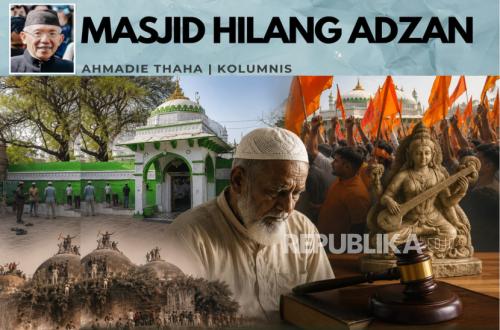
His name is Mohammad Rafiq. At 78, his voice is faint and his body frail, yet for decades he has faithfully climbed the stairs of the ancient Kamal Maula Mosque in Dhar, Central India, to call the adhan. For fifty years, he served as the muezzin. Before him, his grandfather, Hafiz Naziruddin, had maintained the mosque since India was still under British rule. But today, they weep bitterly, unable to perform Eid al-Adha prayers there. Imagine a family preserving the call to prayer across generations, like safeguarding the flickering flame of history. Then Friday arrives like a hammer not on a courtroom table, but on the chest of humanity. The Madhya Pradesh High Court recently ruled that the Kamal Maula complex is no longer merely a medieval mosque, but a Hindu temple site dedicated to Goddess Vagdevi—a title for Saraswati in Hindu tradition—from the Paramara dynasty era around the 11th to 13th centuries. In a courtroom reinforcing Islamophobia in India, the case has evolved far beyond a dispute over an old building. Hearings have become a battle over who has the right to rewrite India’s history. Muslims presented official 1935 colonial government documents explicitly identifying Kamal Maula as a mosque and confirming Friday prayers were permitted there. They also recalled a 2003 agreement with the Archaeological Survey of India (ASI), which had divided site usage: Hindus worshipped on Tuesdays, while Muslims conducted Friday prayers. For Dhar’s Muslim community, this arrangement was imperfect but at least acknowledged the site as a living mosque, not a dead ruin. However, the trial’s tone shifted when the ASI survey report became the cornerstone of Hindu nationalist claims. The court accepted arguments that structures at the Bhojshala complex bore traces of an ancient Hindu temple dedicated to Goddess Vagdevi. Notably, the name “Bhojshala” is linked to King Bhoja, a Paramara ruler revered in Hindu tradition as a patron of knowledge and literature. A narrative of a “goddess of knowledge temple” was constructed, becoming the basis for political and legal claims to reclaim the site. From here, the debate grew fiercely heated. Muslim lawyers questioned the survey’s methodology: how artefacts were interpreted, inscriptions read, and historical conclusions drawn. They accused the ASI of no longer being an independent scientific body, but succumbing to dominant Hindutva political pressures. Several academics also criticised the survey for failing international historical research standards and being laden with ideological assumptions. The drama intensified when Hindu groups requested the court support repatriating a white marble statue of Goddess Vagdevi from London’s British Museum, claiming it proved Bhojshala was once a major Hindu temple. Muslim lawyers countered by citing the museum’s own records stating the artefact was found in Dhar’s palace ruins, not at Kamal Maula Mosque. Colonial-era maps further showed “Kamal Maula Mosque” and “City Palace” were distinct locations. One Muslim lawyer angrily called the opposition’s claims “blatant lies polished into history.” What was most chilling, however, was not the legal arguments but the emotional atmosphere. In the courtroom, historical evidence seemed deliberately overshadowed by collective conviction. Phrases like “Hindu honour,” “civilisational restoration,” and “ancestral heritage” repeatedly outweighed archival readings or academic caution. The court appeared caught between two pressures: positive law on one side, and political majoritarianism on the other. When the judge ruled the site a Hindu temple and suggested Muslims find alternative land for a new mosque, many felt the decision was not just about a building’s status, but about the place of Muslim minorities in modern India’s imagination. At this point, the court ceased to be merely a legal arena—it became a stage for national memory battles. Ultimately, the Madhya Pradesh High Court delivered a ruling favouring the powerful.