
The Middle Class, Poverty, and the Reorientation of Economic Policy
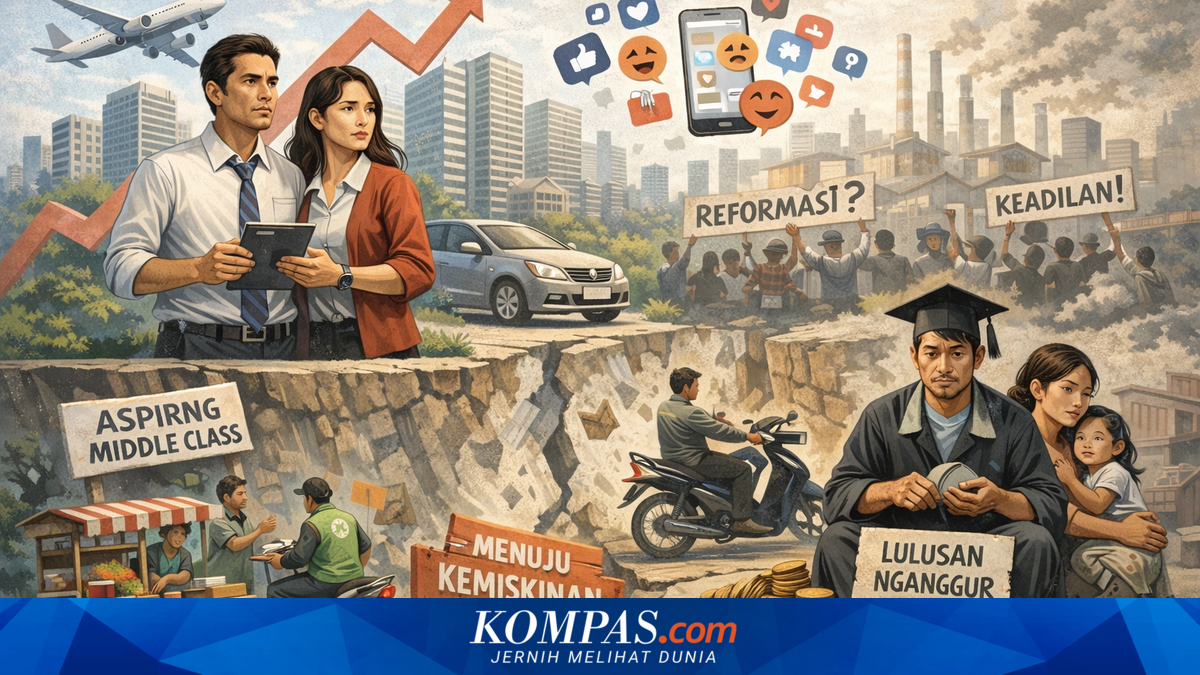
The middle class is not merely an income category; they are the engine of domestic demand, a source of educated professional manpower, and supporters of the state’s legitimacy and fiscal capacity through taxes and consumption.
In the Indonesian context, the dynamics of the middle class over the past decade have directly influenced growth patterns, the resilience of domestic consumption, and the direction of industrial and social policies.
In 2024, the middle-class group (and those approaching middle-class status) numbers around 66.35% of Indonesia’s total population.
Moreover, the Central Statistics Agency (BPS) records that this group contributes up to 81.49% of total national household consumption. These figures affirm the strategic position of the middle class as the main pillar of the domestic economy.
However, in aggregate, the middle class (including those ‘heading towards’ it) holds a large share of national consumption and serves as a buffer for domestic demand, but its size according to income thresholds remains vulnerable to economic shocks, rising job informality, and inflation that erodes real income.
Over the past decade, the middle class has been regarded as the backbone of economic growth. However, its contribution to rising consumption figures has recently shown a quite significant downward trend, relatively impacting economic performance in several countries.
Concerns about the declining middle-class population have recently become a main topic of discussion, both among governments and academics. This is not only in Indonesia but also a concern in several other countries.
In fact, according to Forbes business magazine in April 2023, facts and data show that the existence of the middle class in the United States (US) has experienced a sharp decline over the past 50 years from 1971 to 2023.
This decline is reflected in the decreasing average income of the middle class from 61 percent shrinking to 51 percent.
It is exacerbated by data showing that the aggregate income share obtained by the US middle class has shrunk from previously 62 percent to only 42 percent.
At the same time, the aggregate income of those considered high-income has increased from 29 percent to 50 percent.
This is despite the reality that the growing high-income class is still less than half the size of the middle class in the US.
Anxiety over the shrinking middle-class group is also experienced in China.
Although previous predictions by the latest study from World Data Lab estimated that more than 1 billion people in Asia would join the global middle class by 2030, due to the blow of the COVID-19 pandemic in 2020–2022, that prediction has undergone significant changes.
In addition to the pandemic factor, the main cause, though not the only one, is the property crisis that hit the Bamboo Curtain country.
The economic bubble in the property sector has disrupted China’s economy and finances since 2021, when the giant residential real estate developer, Evergrande, announced that it could no longer meet its financial obligations (default).
The financial tensions caused by the failure of this property sector and several others that followed in subsequent years have pressured the pace of housing construction and home purchases.
China’s middle class has been one of the backbones in this sector. Thus, when the main source of wealth and income for China’s middle-class group faces pressure, the impact will trigger a decline in their population.
Yet, China once enjoyed the golden era of the middle class.