
The Legacy of Try Sutrisno: From the Independence Revolution to the Peak of State Power
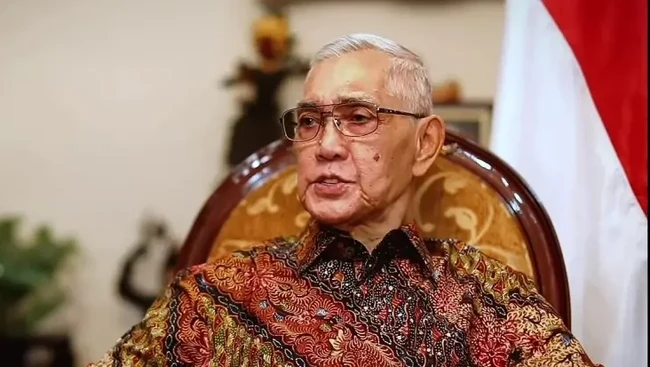
General Sutrisno, Indonesia’s 6th Vice President, passed away on Monday, 2 March 2026, at 06:58 WIB at the Gatot Soebroto Army Hospital in Jakarta, at the age of 90.
Early Life and Background
Try Sutrisno was born on 15 November 1935 in Bandar Genteng Lor, a densely populated and modest santri neighbourhood in Surabaya. His father, Subandi, worked as an ambulance driver, whilst his mother, Mardiyah, was a homemaker. His childhood coincided with the turbulent period of Indonesia’s independence revolution. When the Netherlands launched military aggression following the 1945 Proclamation of Independence, his family fled Surabaya to Mojokerto. During this period, young Try was forced to abandon his schooling and became a street vendor selling cigarettes and newspapers to support the family. Following Dutch recognition of Indonesian independence in 1949, the family returned to Surabaya.
Education
Try Sutrisno completed his primary and secondary education in Surabaya from the late 1940s until 1955. He subsequently enrolled at the Army Technical Academy (Atekad) from 1956 to 1959, where he graduated and was commissioned as a junior officer in the Indonesian Army. Throughout the 1960s, he pursued various specialised military courses, and in 1972 he attended the Army Staff and Command School (Seskoad) as part of his preparation for senior command positions. This comprehensive military education provided the foundation for his subsequent advancement through various strategic positions within the Armed Forces.
Military Career
Sutrisno began his military career following his graduation from the Army Technical Academy in 1959 as a commissioned officer. Early in his service, he was posted to combat engineer units before transitioning to territorial command positions. His career progressed through progressively senior roles, including unit commander, staff chief of regional military commands, and regional military commander. In 1984, he was appointed as Regional Military Commander (Pangdam), and in 1986 he became Chief of the Army Staff (KSAD).
The pinnacle of his military career came when he was sworn in as Commander-in-Chief of the Armed Forces (Panglima ABRI) in 1988, serving until 1993. This position served as a significant stepping stone to his election as Vice President of the Republic of Indonesia for the 1993–1998 term.
Vice Presidency
On 11 March 1993, Try Sutrisno was officially sworn in as Indonesia’s 6th Vice President, serving alongside President Suharto following the 1993 General Session of the People’s Consultative Assembly. His appointment reflected the substantial influence of the military within the political configuration of the New Order period, given his background as Commander-in-Chief of the Armed Forces before assuming the second-highest civilian position in Indonesia.
During his tenure, Sutrisno was known for conducting his vice-presidential role in a formal and institutional manner, maintaining political stability and governmental prestige amid strengthening domestic dynamics in the latter part of the 1990s. His term ended on 11 March 1998, when BJ Habibie succeeded him precisely two months before Suharto himself was toppled by the student-led reform movement in May 1998.
Death
Try Sutrisno’s passing has been confirmed by his family and the government, with State Secretary Minister Prasetyo Hadi expressing deep condolences and assuring that the government would provide full attention to the funeral arrangements. The family has urged the public to offer prayers for the acceptance of his deeds in the sight of Allah.