
The Kalam of a Madura Kyai
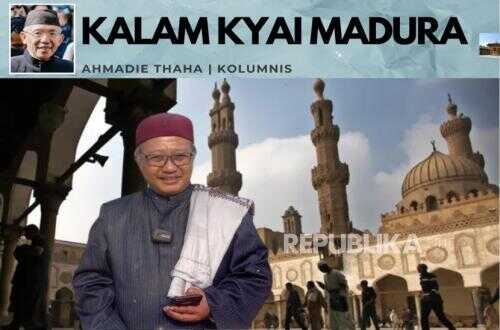
Late January 2026, at the Imam Akbar Syaikh Abdul Halim Mahmud Auditorium, Faculty of Usuluddin, Al-Azhar University, Cairo, a pondok pesantren supervisor from Torjun, Sampang, was conferred with a doctorate with a verdict that nearly left academic language exhausted. His dissertation spans 847 pages in two volumes and was conferred with the status Martabat Syaraf al-Ula ma‘a tawshiyah bi thab‘i ar-risalah wa tadawuliha baynal jami‘at — summa cum laude with the highest honour and a publication recommendation. This is not merely an “excellent” grade, but excellent plus. The Madura kyai’s name is Dr. KH. Muhamad Aunul Abied Shah, Lc., M.A., caretaker of the Darus Salam pondok pesantren in Torjun, Sampang — described as the first Madura person to earn a doctorate from Al-Azhar with such a high academic distinction. It is an “excellent” with an extra flourish, like a noble title that won’t fit on a business card. His dissertation is titled Arab: Al-Ittijāh an-Naqdī fī al-Khiṭāb al-Kalāmī ’inda Najm al-Dīn al-Kātibī. The study examines the tendency toward critique in kalām discourse through the thought of Najmuddin al-Kātibī, a seventh/13th-century Persian logician from Qazvin, whose era was a nexus of intellectual exchange between Central Asian traditions and the Islamic world. The topic may sound heavy, but in the modern age—when one can order food via app yet hesitate to order belief in God—such a study is timely. We may move away from logic and theology; classical scholars, by contrast, made it the foundation. The promovendus investigates how al-Kātibī formulates belief rationally while keeping it contextual. He studies the methodology of critique in classical issues: the existence of God, His attributes, creation, human action, prophethood, eschatology, the status of Muslim and non-Muslim, and political leadership. The methodology is then applied to modern philosophy and to the Indonesian Islamic context, including the thought of Syaikh Nawawi al-Bantani. In other words, he does not merely open an old book; he shines a bright light into the living room of contemporary times. The examining panel, led by Prof. Dr. Hassan Muharram al-Huwaini and comprising senior Al-Azhar professors, offered flamboyant praise. Prof. Abdel Ghani Thaha judged the dissertation strong in concept, scientific approach, and references, while emphasising the importance of balancing rationality with textualism. Prof. Ragab Mahmud Khedr offered 31 annotations — enough to make a typical student consider changing majors. Yet he reaffirmed the work’s high quality and suitability for Islam-kaji study students. He even joked that the breadth of the discussion left him exhausted reading two thick volumes, a remark that drew laughter from the examining audience. Najmuddin al-Kātibī al-Qazwīnī (d. 675 H/1277 CE) was a Persian scholar, logician, and theologian who lived at a time of intensive convergence between Greek philosophy, Islamic theology, and rationalism. He became a prominent figure in the tradition of logic (mantiq), philosophy, and kalam in the post-Ibn Sina period—an era when Muslim scholars sought to reorganise the relation between reason, revelation, and philosophical argument. By day, scholars taught logic; by night they studied theology. In the classical Islamic scholarly tradition, logic was not merely a formal subject but a methodological tool for understanding creed, law, interpretation, and theological debate. al-Kātibī’s work became a primary reference for madrasas and pesantrens for centuries. His work taught in pesantren, al-Risālah al-Shamsiyyah fi al-Qawā‘id al-Mantiqiyyah, became a standard text of logic throughout the Islamic world—from Egypt and Turkey to Persia, India, and Nusantara. It covers concepts and definitions (tasawwur), propositions and logical validation (tashdiq), syllogisms (qiyas), deductive and inductive reasoning, and logical fallacies. This text not only explains Aristotelian logic but also simplifies and structures it so that it can be taught easily. Consequently, many commentaries and glosses were written on it. It became the “grammar of thinking” for scholars. Just as nahwu preserves language, logic preserves the mind from errors in thinking.