
The Illusion of Air Victory: US Trapped in Cycle of Prolonged War
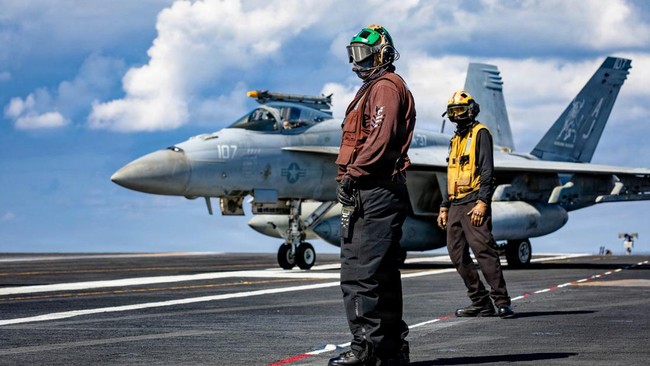
Jakarta, CNBC Indonesia - The United States’ (US) military strategy, which once again relies on air superiority, is deemed at risk of repeating an old pattern: promises of swift victory that end in prolonged conflicts.
Referring to an analysis in The Guardian, this approach is nothing new. Its roots can be traced back to 1921 through the theory of Italian general Giulio Douhet in his book The Command of the Air. He believed that victory in war could be achieved through massive bombing, including against civilian infrastructure, to cripple the enemy’s morale.
“Far more important is destroying logistics and infrastructure than attacking the front lines,” Douhet wrote in his theory, quoted by The Guardian on Friday (27/3/2026).
This thinking subsequently influenced various modern military strategies, including in major wars involving the US. In the current context, the aggressive rhetoric of US Defence Secretary Pete Hegseth regarding air operations against Iran is seen as reflecting a similar pattern.
Hegseth even described air strikes as the deadliest and most precise approach in history. “Quantity has a quality of its own… this will be the highest volume of attacks ever conducted by America,” he stated.
However, according to defence analyst Winslow Wheeler, such claims are more about communication style than substantive new strategy.
“What they fail to appreciate is that human nature does not change,” Wheeler said. He assessed that bombing often provokes resistance rather than surrender.
“The German attacks on Britain did not weaken their resolve; instead, it united them,” he added.
History records that air dominance often fails to deliver absolute victory. In the Vietnam War, for example, the US’s advanced sensor technology to disrupt the Ho Chi Minh logistics route was outmanoeuvred in simple ways, including using animal urine to fool detectors.
Meanwhile, in the 1991 Gulf War, claims of high success from the stealth F-117A aircraft proved exaggerated. A study by the US Government Accountability Office (GAO) found a success rate of only around 41%-60%, far from the initial 80% claim.
NATO’s air campaign in Kosovo in 1999 also showed similar limitations. Based on reports quoted by The Guardian, thousands of strikes only succeeded in damaging a small portion of Serbian military targets.
This phenomenon continued in the 2003 Iraq invasion through the “shock and awe” strategy. Although it began with thousands of precision bombs, the air strikes failed to topple Saddam Hussein’s regime without ground intervention.
The Guardian’s analysis emphasises that claims of advanced technology, including the use of artificial intelligence (AI), do not necessarily change war outcomes. Although Hegseth mentioned that autonomous systems and AI are now integrated into military operations, their effectiveness remains questionable.
“Technology is becoming more advanced, but it does not change how humans react on the battlefield,” Wheeler stated.
Thus, dependence on air power is seen as potentially becoming an old illusion that repeats itself. Rather than bringing quick victory, this strategy risks dragging the US into more complex and prolonged conflicts.