
The House Without Pillars of Trust
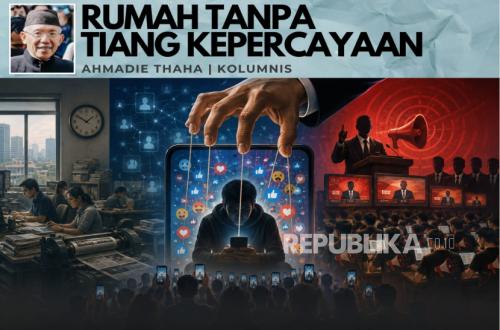
As soon as Muhamad Qodari was appointed as Head of the Indonesian Government Communication Agency (Bakom), he began acting like a Minister of Information from the New Order era. His bold moves echoed the sound of an auctioneer’s gavel in the algorithmic marketplace: the state intends to embrace “homeless media.”
Yes, homeless media. The term sounds dramatic, as if there’s a horde of digital accounts sleeping on the sidewalks of TikTok, shivering under a blanket of engagement. Then someone quips, isn’t “homeless” just another word for vagrant?
They have no newsrooms, no editorial offices, no editors, and sometimes not even a fixed address beyond their bio column and affiliate links. But they possess something now more valuable than a towering office building: public attention.
Thus, the state arrives with winks and even embraces. The reasoning sounds modern, progressive, even academic: the people no longer read newspapers while sipping bitter coffee on the veranda.
People now wake up and open TikTok before fully opening their eyes. Information is no longer sought; it finds humans. Algorithms have become the new postmen of civilisation.
On paper, the state’s logic in embracing dozens of these homeless media outlets seems reasonable. But the major problem arises when the state becomes too tempted by reach and forgets the trust that underpins media.
For in the world of media since ancient times, the primary foundation is not followers. Not viewers. Not subscribers. And certainly not the blue tick, which is sometimes easier to buy than fried snacks from a roadside vendor.
The main pillar of media is trust. And history has repeatedly shown: when trust collapses, media becomes nothing but an empty building filled with the echo of its own voice.
Media may have studios as advanced as NASA’s spacecraft. They may have drones, AI, virtual anchors, even presenters with jaws as firm as characters from Korean dramas.
But once the public feels that the media is merely a loudspeaker for haphazard power, its moral legitimacy slowly ends. Readers will leave quietly, like invited guests who discover the complimentary meal has gone stale.
This is what many modern media managers often fail to understand: people come for the information, but they stay because of trust.
In communication theory, the foundation of media trust is no mystical commodity. It has been seriously studied in academic research for decades.
The Social Responsibility Theory of the Press by Siebert, Peterson, and Schramm emphasises that press freedom can only be maintained if media fulfils its social responsibilities: accuracy, fairness, verification, and advocacy for the public interest.
This is where media differs from mere loudspeakers. The press is not state public relations. The press is not policy sales. The press is not a perception broker. The press was born precisely to maintain a critical distance from power.
Bill Kovach and Tom Rosenstiel in The Elements of Journalism even describe the discipline of verification as the heart of journalism. Without verification, media becomes an industry of rumours dressed in modern graphic cosmetics.
Therefore, professional media is built on processes: there are editors, corrections, rights of reply, legal accountability, ethical standards. All of this may seem slow in the era of 30-second videos. But democracy was never built on microwave logic.
The Reuters Institute has repeatedly found that public trust in media is heavily determined by perceptions of editorial independence. As soon as the public feels a media outlet is too close to the government, a party, oligarchs, or certain sponsors, trust levels plummet.
In many countries, declining media trust correlates directly with rising social polarisation and conspiracy theories.
This is not about old media versus new media. Don’t be mistaken. Many mainstream media outlets have long transformed into advertorial showrooms disguised as news. The headlines criticise, but the content is brochures. The interviews appear sharp, but the questions are as soft as sponsored cotton.
There are media outlets that proclaim independence every morning, but by afternoon, they queue up for ministry collaboration proposals like citizens lining up for subsidised cooking oil. So the illness is not the platform. The illness is the loss of integrity.
The major problem emerges when the state embraces media solely based on algorithmic distribution capabilities. When quality is measured by reach. When followers are deemed more important than credibility. When virality is considered more sacred than verification.
Yet algorithms have no conscience. Algorithms only recognise emotional engagement. The angrier people get, the higher the distribution. The more sensational the headline, the wider the spread.
In the eyes of algorithms, lies and truth are just two contents competing for CTR (click-through rate).
Thus, modern digital democracy faces a great paradox: information is increasingly abundant, but trust is becoming ever scarcer.
Ironically, many people today view media critical of power as problematic media. Conversely, media that continuously praises the government is seen as “positive,” “constructive,” even “nationalist.”
Yet world press history shows: media that is too intimate with power usually does not last long. It may be full of state advertising today, but it dies slowly in the eyes of the public tomorrow.