
The High Cost of 'Hedging'
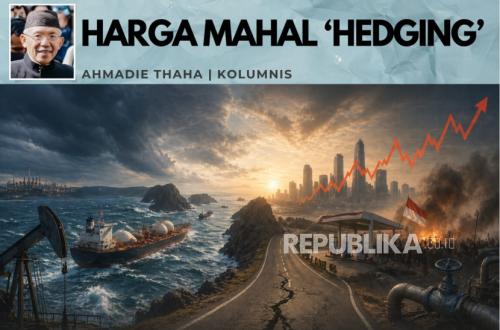
Every grand strategy has its dark side. And in Indonesia’s case today, that dark side is not hidden behind a fog. It stands glaringly, right in front of our eyes, in one sentence that sounds cold but haunting: “diplomatic choices will narrow.”
Robert Pape, a professor of political science from the United States, was not waxing poetic when he wrote it. He was issuing a warning—about a world that is slowly losing its room to breathe.
Seven weeks of disruption in the Strait of Hormuz due to the US-Israel war against Iran have been enough to prove that the world does not need a major war to be shaken. A single chokepoint blockage is sufficient for oil prices to skyrocket, with effects rippling everywhere.
Inflation creeps like fire in the dry season. Logistics costs surge. Currencies weaken. And countries, one by one, begin to lose options. Like a person running out of oxygen, decisions no longer become rational. They turn into survival reflexes.
And it is at this point that Indonesia stands—not on the sidelines, but right in the middle of two “world throats”: Hormuz and Malacca. If Hormuz is the global oil tap, then Malacca is its distribution pipe.
Both have been shaken in close proximity. One is strangled by war. The other is quietly being armed—with the supersonic BrahMos missiles that are now beginning to form part of Indonesia’s defence calculations.
The problem does not stop at geopolitics. It descends directly into the kitchen.
Indonesia is not a clean energy exporting country. It still imports, and even more sensitively—it subsidises. This means that every rise in global oil prices is not just a number on the economic screen, but a potential social fracture on the streets.
We do not need to look too far back. In 2022, a fuel price hike alone was enough to trigger a wave of national demonstrations. Now imagine an oil scenario above $150 per barrel—not just protests, but systemic pressure that could shake the foundations of policy.
At this point, the hedging that previously seemed like an elegant game of chess turns into a survival game with a high cost.
On the other hand, contradictions are piling up like debts falling due at the same time. Indonesia is strengthening military cooperation with the United States, while deepening economic relations within BRICS—within which is China, Indonesia’s largest trading partner.
The logic is simple, but uncomfortable: it is difficult to build a defence posture that potentially leans towards one power, while still hanging economic growth on the same power, without creating tension that will one day seek an outlet.
Not to mention one issue that seems technical, but is actually highly political: the discourse on broad access for US military aircraft to cross Indonesian airspace.
If this truly happens, the line between hedging and alignment will no longer be blurred—it could disappear altogether. In the world of strategy, there is a point that, once crossed, cannot be retracted. Like ink that has fallen on paper—it cannot return to clarity.