
The Heroic Tale of Ramadan 1947: Indonesian People Battle the Dutch While Fasting
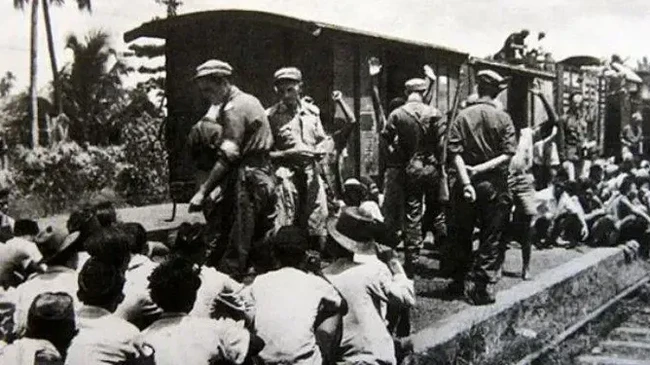
Ramadan is not only a special month for Muslims around the world but also a witness to several historical events in Indonesia. At least two important events occurred in Indonesia during the month of Ramadan.
- Proclamation of Independence
Everyone knows that Indonesia proclaimed its independence on 17 August 1945. However, not many realise that according to the Islamic calendar, this historic event took place on 9 Ramadan 1367 Hijriah. Thus, if calculated based on the Islamic calendar, Indonesia is now 79 years old.
Nevertheless, the situation leading up to the proclamation was tense, and the nation’s leaders at the time still observed the fast. In the early hours of Friday, 17 August 1945, key figures, including Soekarno and Hatta, who were engaged in intense discussions about the timing of the proclamation, still made time to have suhoor.
Their suhoor menu at the time consisted of nasi goreng, egg sandwiches, and canned sardines. After eating together, the nation’s leaders agreed that the proclamation of independence would be carried out at Jl. Pegangsaan Timur No. 45 at 10:00 WIB.
Under the scorching sun and while fasting, the Indonesian people enthusiastically witnessed the proclamation ceremony. Soekarno, on behalf of the Indonesian nation, read the proclamation text, marking the establishment of Indonesia as a sovereign state. The following day, Soekarno was officially inaugurated as President of Indonesia.
- Dutch Military Aggression
The decision to proclaim independence enraged the Dutch. The windmill country sought to regain control of Indonesia by launching attacks known as Dutch Military Aggression I in 1947.
Many people are familiar with various aspects of Dutch Military Aggression I, but not many realise that this event occurred in the month of Ramadan 1366 Hijriah.
As Indonesian society had just rested after performing tarawih prayers on the second day of Ramadan, 20 July 1947, the situation suddenly changed drastically. That night, Dutch Governor-General H. van Mook decided to end the ceasefire and violate the Linggarjati Agreement that had been agreed upon a few months earlier.
This decision marked the beginning of Dutch Military Aggression I, when Dutch forces launched a large-scale military operation to seize important cities controlled by the Republic of Indonesia.
Around 23:00 WIB, various vital buildings in Jakarta were successfully captured by Dutch forces consisting of NICA and KNIL. Fortunately, a few months earlier, the President and Vice President of the Republic of Indonesia had moved to Yogyakarta, so the central government did not fall into Dutch hands.
In a short time, the Dutch also managed to control several strategic port cities in Java and Sumatra. In Central Java, Semarang and its surrounding areas were then turned into a Dutch military base.
The attacks continued. On 7 Ramadan 1366 H or 25 July 1947, Dutch Kittyhawk fighter planes took off from Semarang and launched several air attacks on the Maguwo airbase in Yogyakarta, which at the time was one of the Republic’s defence centres.
These attacks destroyed several captured Japanese aircraft used by the Indonesian air force.
The Dutch exploited the condition of the Indonesian people who were fasting and enduring hunger and thirst throughout the day as a weakness. Therefore, they chose strategic attack times, namely in the morning, shortly after suhoor.
Although the Dutch considered the Indonesian people weak because of fasting, the reality was otherwise. In the Chronicle of the Indonesian Revolution 3 (1947), it is recounted that the majority of the people remained steadfast in their struggle and did not see fasting as an obstacle to expelling the Dutch again.
In Aceh, for example, ulama called on the entire population to take up arms against the colonisers. They even emphasised that the fasting month should be a momentum to strengthen faith and the spirit of struggle, so that the Dutch would not view them as weak.
However, history proves that even though the Indonesian people were fasting, the Dutch still failed to regain control of the country. Dutch Military Aggression I finally stopped on 15 August 1947, although a year later they launched another attack on Indonesia.