
The Expanding AHWA
As evening approached, the Bahrul Ulum Islamic Boarding School complex in Tambakberas, Jombang, transformed into a bustling small town. Congress participants moved from the assembly halls to their lodgings, discussing organisational governance matters until late into the night at the historic pesantren founded by Kiai Wahab Chasbullah.
A few days earlier, a solemn atmosphere had enveloped the Congress arena through a grand istighotsah. Prayers, remembrance, and hopes for the unity of Nahdlatul Ulama soared skyward, before the arena turned into a space of fierce debate over rules of procedure, leadership election mechanisms, and the division of organisational authority.
Elsewhere, long before the Congress took place, a number of senior clerics at the PBNU office on Kramat Raya in Jakarta had actually discussed the idea of strengthening the role of the Ahlul Halli wal Aqdi (AHWA). They proposed that this clerical body should not cease its duties after electing the Rais Aam.
However, the proposal was ultimately not adopted as an official Congress decision. The AHWA was confirmed to remain ad hoc in nature. Although the body remains temporary, the 35th Congress nevertheless produced a decision that significantly expanded the scope of the AHWA’s authority.
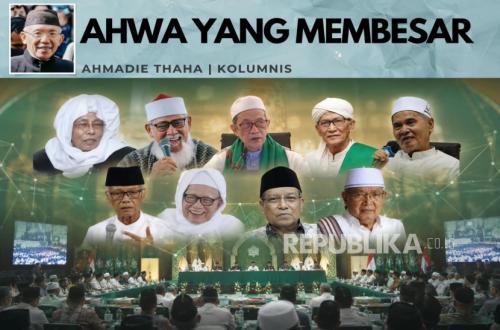
On Sunday, 30 August 2026, the Congress officially appointed nine senior clerics as members of the AHWA for the 2026–2031 term of service. They represent the pinnacle of religious scholarship and the core of NU leadership. The nine clerics span from Aceh, through the cities of Java, to Makassar.
They are KH Nurul Huda Djazuli from Ploso, Tgk KH Nuruzzahri Yahya from Aceh, KH AG Baharuddin HS from Makassar, KH Miftachul Akhyar from Surabaya, KH Afifuddin Muhajir from Situbondo, KH Anwar Iskandar from Kediri, KH Anwar Manshur from Lirboyo, KH Said Aqil Siroj from Jakarta, and KH Abun Bunyamin from Purwakarta.
These nine clerics were given the mandate to deliberate and elect the Rais Aam from among themselves, while also holding a crucial role in determining the Chairman of PBNU.
Herein lies a very interesting dynamic in the consultation process. Before the Congress was held, public debate often simplified the matter as though NU were being forced to choose dichotomously between two extreme models: a direct election system or direct appointment by clerics.
However, after the gavel of the official Congress decision was struck, the picture that emerged proved far more complex and not as simple as that dichotomy. Election from below was not abolished, but rather its function and position within the decision-making structure were altered.
Congress participants from regional levels and NU autonomous bodies still retain the right to vote in screening candidates for Chairman of PBNU. Each regional board (PWNU), branch board (PCNU), special branch board (PCINU), and autonomous body is entitled to propose up to five names.
All proposals from below are then tabulated openly to produce the five names with the most support. However, these five names are not immediately pitted against one another in an open vote by all Congress participants.
They are first presented to the elected Rais Aam from among the nine AHWA members, for technical approval and clerical consideration. And finally the AHWA decides and appoints one name as Chairman of PBNU.
Thus, the shape of NU’s new system is not a total replacement of the congress participants’ voting rights with the AHWA. This model is more accurately described as a combination of bottom-up nomination and scholarly selection at the final stage.
This represents a substantive shift in organisational governance, although it cannot yet be called a radical institutional revolution.
In the previous Congress model, participants determined the Chairman of PBNU directly through voting in an open arena. In this new mechanism, the participants’ votes serve to determine which figures are entitled to advance to the AHWA’s negotiating table.
The centre of gravity of the final decision has shifted from open competition (election) towards measured filtering (selection). Candidates no longer consolidate to pursue a majority of votes in the open arena, but must secure screening support at the grassroots level while simultaneously convincing the senior clerics.
This hybrid system brings fairly clear advantages. The potential for open political friction can be dampened, although it does not close the possibility of such friction occurring before the final determination stage.
The election of the highest leadership of a religious organisation need not turn into a practical political contest with all its divisive consequences.
The five names screened from grassroots aspirations become objective material for consideration, while the authority for final determination is entrusted to a forum of clerics regarded as possessing spiritual clarity and communal judgement.
However, this design also carries constitutional consequences that must not be ignored. The burden of authority on the nine AHWA members has now become very great. They not only elect the Rais Aam from their own internal circle, but also hold the key to determining the Chairman of the Tanfidziyah from the names put forward by the grassroots structures.
The AHWA is no longer merely an ad hoc instrument for Syuriyah succession, but has become the primary determinant for both of the highest leadership positions of PBNU at once.
This matter demands a proper understanding of the term Ahlul Halli wal Aqdi. In classical Islamic political civilisation, ahl al-hall wa al-’aqd was not the name of a formal committee limited to nine people.
It is a qualitative concept concerning a group of clerics and community figures who meet the requirements of depth of knowledge, moral integrity, and social influence to make strategic decisions for the benefit of the ummah.
NU then adopted this philosophical concept and transformed it into a measurable organisational mechanism. Therefore, evaluation of the AHWA can no longer be adequately read through the lens of clerical tradition alone, but must be tested through the lens of modern governance.
Regarding its term of office, the decision of the 35th Congress has provided certainty: the AHWA remains ad hoc as before. The nine clerics elected by the Congress forum are not tasked with forming a permanent institution standing outside or above the official PBNU structure.
After the succession task is completed, they return to merge into the Mustasyar and Syuriyah structures of PBNU for the 2026–2031 term of service.
This decision reflects the compromise position taken by NU. On one hand, the Congress expanded the AHWA’s authority in determining the pinnacle of Tanfidziyah leadership. On the other hand, the Congress refused to extend its institutional lifespan into a permanent body.