
The Essence of Victory is Tolerance
Malang, East Java (ANTARA) - Since Friday (20/3) until Saturday (21/3), and even for the week ahead, Muslims throughout Indonesia are celebrating Eid al-Fitr 1447 Hijriah, which corresponds to 2026 in the Gregorian calendar.
This year can also be described as the “year of religious communities in Indonesia”. One month after the Chinese community ushered in the Lunar New Year, followed a month later by Hindus observing Nyepi, it is now the turn of Muslims to celebrate Eid al-Fitri.
We may differ in beliefs, but in essence, we are humans united as one nation. Tolerance is the attitude of mutual respect, even when facing differences.
Holidays in Indonesia are not merely celebrations; they carry a broader meaning as they offer the choice to accept one another. This mutual acceptance, encapsulated in tolerant behaviour, is the primary strength in maintaining Indonesia’s unity amidst diverse ethnicities, languages, cultures, and religions.
There is a social media video showing the lively ogoh-ogoh parade in Bali ahead of Nyepi, which suddenly falls silent upon hearing the call to prayer from a nearby mosque. Once the adhan concludes, the ogoh-ogoh parade resumes.
This phenomenon is just one example, but it illustrates that Indonesian society always upholds the values of mutual respect as fellow humans and highly honours religious freedom.
Elsewhere, in Malang city, for instance, the spirit of tolerance during the day of victory is profoundly felt. As Muslims perform Eid prayers, the presence of Catholics from the Hati Kudus Yesus Parish on Jalan MGR Sugiyopranoto becomes evident.
The Catholics gladly open the doors to their church courtyard to serve as a venue for Eid prayers, which are centred at the Masjid Agung Jamik in Malang.
With thousands of prayer participants, while the mosque’s capacity is insufficient, the church courtyard is also used as a prayer space.
One by one, even family groups arrive to pray in front of the church. There, smiles of fellow humans shine through. They may not know each other, but the bond of brotherhood as children of the nation acts as the glue.
Not only providing access, the church administrators also escort and ensure the smooth and sacred conduct of their fellow humans’ worship.
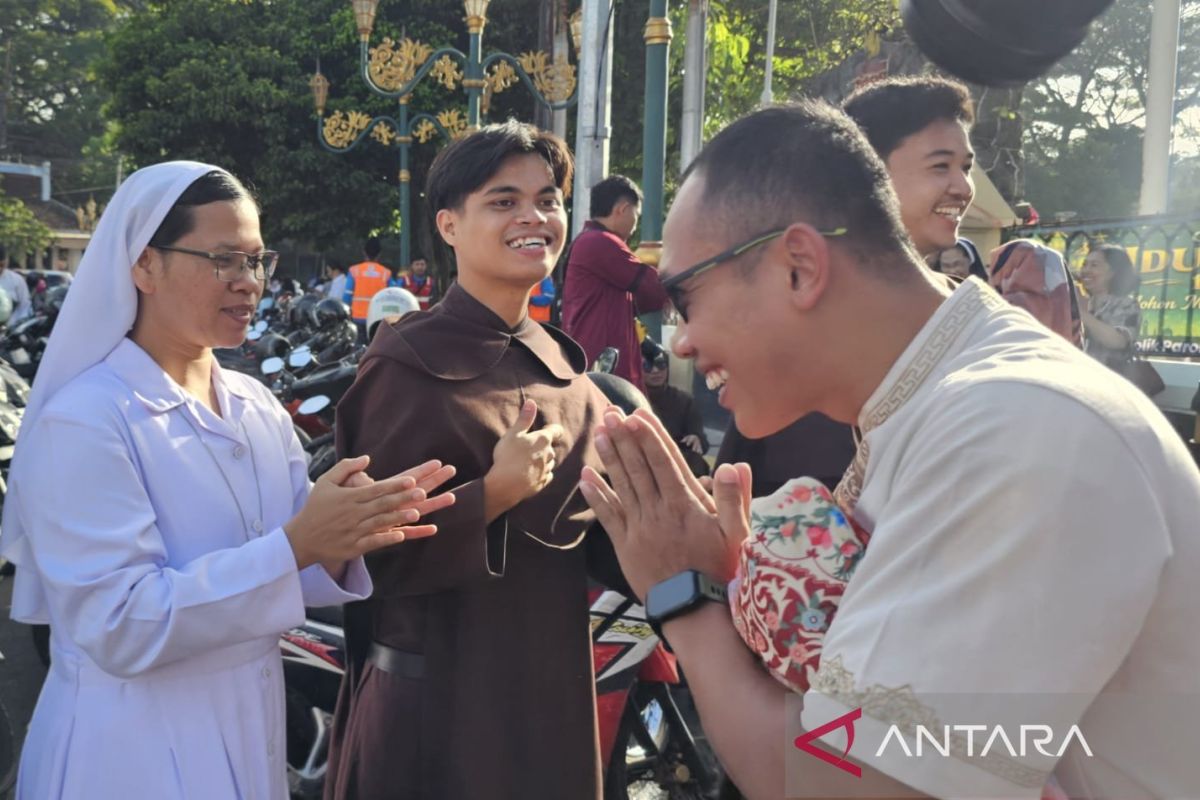
After the prayers conclude, the church administrators line up in front of the courtyard, waiting for the congregation to exit. They shake hands, exchange Eid al-Fitr greetings, and ask for forgiveness in body and soul.
This fact demonstrates an awareness of tolerance values that deserves appreciation. The scene is not merely a victory celebration day but a symbol of mutual respect and appreciation for differences.
Father Henrikus Suwaji of Hati Kudus Yesus Parish in Malang stated that the tradition of providing space for Eid prayers in the church courtyard has been ongoing for quite some time. The clearest archive is photographic documentation from 1993.
“I found photos from 1993 showing it was already like this; we welcome everyone,” he said.
What has been practised is maintained to this day. This step is to preserve tolerance and bonds of friendship.