
The Essence of Moral Signalling in Fiscal Discipline for State Officials
Jakarta (ANTARA) - Today, Indonesia’s fiscal challenges are no longer merely about keeping the deficit below safe limits. They have now developed into a moral test, whether this nation can demonstrate that the burden of development can be shouldered together, starting from its state officials.
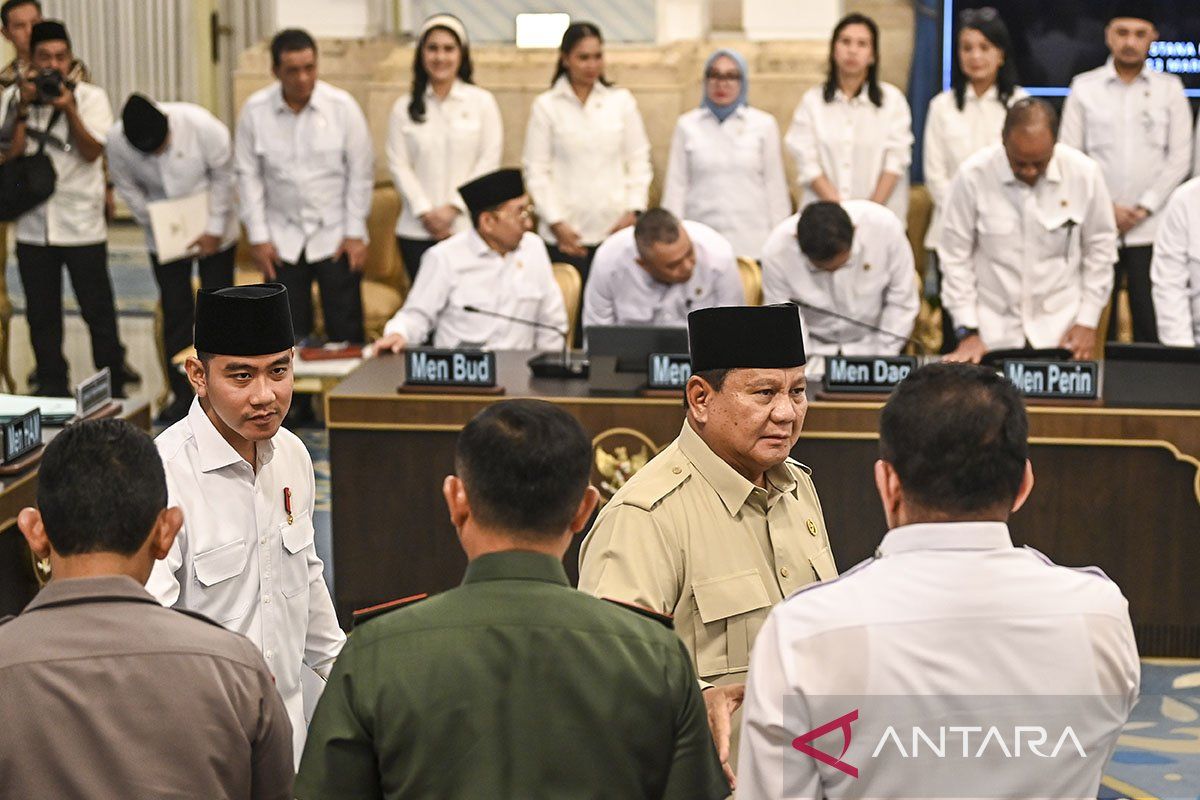
In this context, President Prabowo issued signals during the Full Cabinet Plenary Session at the State Palace in Jakarta in mid-March 2026. In that forum, the President discussed anticipatory steps to address the impact of the Middle East conflict on Indonesia’s economy and fiscal situation.
Indeed, President Prabowo did not directly decide on salary cuts, but provided policy guidance on measures that could be taken to tackle the state financing deficit, including extreme austerity steps such as salary reductions for ministers and members of parliament, and subsequently requested that this option be studied as part of the strategy for efficiency in the State Revenue and Expenditure Budget (APBN).
In this context, salary cuts for officials are not merely viewed as a savings measure, but as a moral message that touches on public notions of justice. It speaks to how the state is managed, not just with numbers, but also with empathy.
In practice, fiscal discipline is not only realised through macro policies, such as deficit control or tax revenue optimisation, but also through micro-level steps that are symbolic yet strategic. Salary cuts for officials fall into this category, as a step that may be insignificant in nominal terms relative to total state expenditure, yet has strong resonance.
The policy in question is also in line with the principles of fiscal savings, where the government seeks to reduce spending to maintain economic stability. In the Indonesian context, this approach needs to be interpreted adaptively, not merely as a crisis response, but as an effort to build a more integrity-based culture of state financial management.
Moreover, this policy is also understood as symbolic fiscal discipline, namely a moral signal that reflects a condition where government elites also contribute through a burden-sharing mechanism that mirrors fair distribution of crisis burdens, while also providing an important picture because its impact is not only related to fiscal matters, but also to legitimate public trust.
Fiscal Discipline
Indonesia’s fiscal journey up to 2025 shows that budget consolidation continues to be maintained, despite pressures, particularly from global geopolitical conditions, which continue to affect domestic fiscal stability.
The Ministry of Finance records that the APBN deficit, which fell to 1.65 percent of GDP in 2023, rose again to around 2.3 percent in 2024, and approached 2.9 percent in 2025 or equivalent to about Rp695 trillion. This figure is still below the 3 percent threshold, but clearly indicates that fiscal space is increasingly narrowing.
At the same time, the government debt ratio is in the range of 39–40 percent of GDP. Although still relatively safe, global dynamics make this position not to be taken lightly. Conflicts in the Middle East region, for example, have driven spikes in global energy prices. In the Financial Note of the 2026 RAPBN, it is stated that every increase in oil prices by 1 US dollar per barrel can add to the subsidy burden by up to Rp3 trillion to Rp4 trillion per year. With high price trends, energy subsidies could potentially exceed Rp400 trillion, up from around Rp339 trillion in 2024.
An International Monetary Fund study states that one of the keys highlighted for strengthening fiscal discipline in developing countries is the importance of credibility signalling, namely policy signals that demonstrate the government’s commitment to sound fiscal management.
It is here that salary cuts for officials find their relevance. It may be small in numbers, but significant as a signal that fiscal discipline starts from the top.
Moral Signalling
Amid fiscal constraints, public trust becomes a factor no less important than budget figures. A 2022 World Bank study shows that fiscal policies involving elite sacrifices can increase public acceptance of tightening measures by 15–20 percent. Meanwhile, the OECD notes that increased public trust can impact state revenues by up to 2–3 percent of GDP in the medium term.
In the Indonesian context, the tax ratio, which remains in the range of 10–10.4 percent of GDP in 2024–2025, indicates that there is still wide room for revenue increases, but that room is highly dependent on public trust in the government.
Salary cuts for officials gain meaning here as a moral signal. It is not merely a fiscal step, but a message that sacrifice starts from the top. That the state does not only ask, but also sets a direct example from the officials entrusted to manage the country.