
The 'Conductor's' Commands Behind Prabowo-Gibran's Cow Slaughter
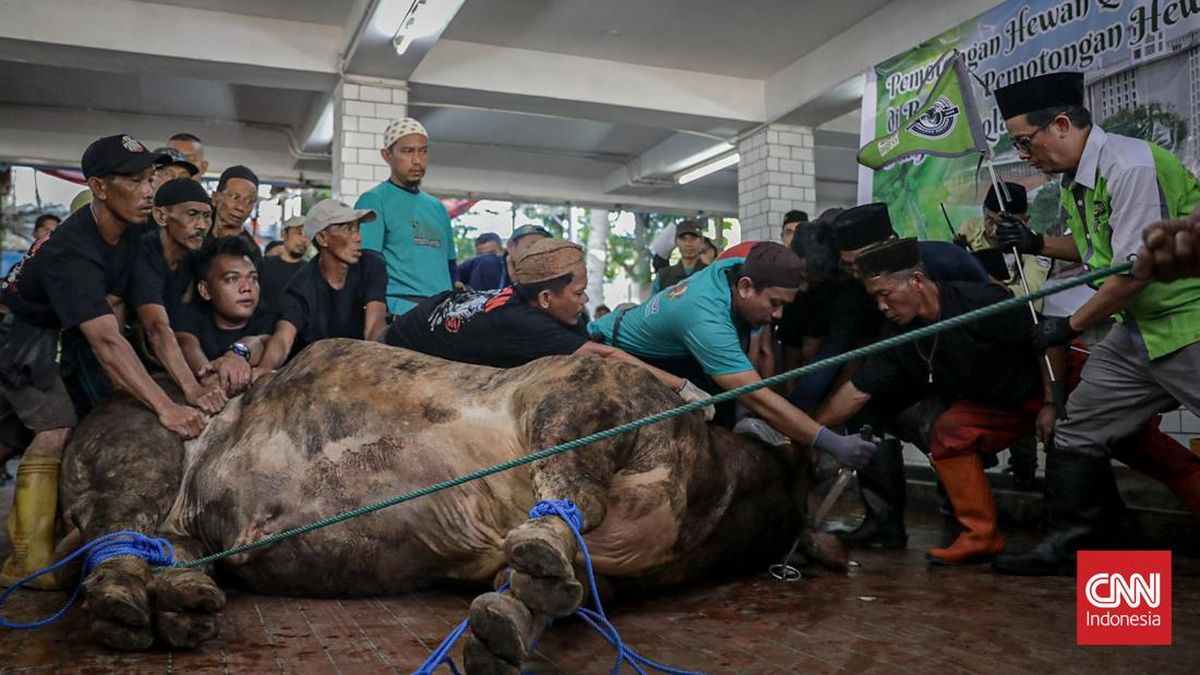
That evening, Nurdin’s face was streaked with blood. Deep red mixed with black clung to his cheeks, temples, and ears. The splatters of sacrificial animal blood on his T-shirt, from slaughtering at Istiqlal Mosque during this year’s Eid al-Adha, had dried by the time he spoke to journalists, including CNNIndonesia.com, on Thursday, 28 May. Earlier, amidst the chaos of the sacrificial slaughter process at Istiqlal Mosque, Nurdin stood as if he knew exactly where to move. He was not the one wielding the long knife for slaughtering, yet critical decisions rested in his hands. Nurdin is the head slaughterer for Amanah Bersama, the organisation handling this year’s sacrificial animal slaughter at Istiqlal. He was also part of the slaughtering team responsible for the two most prominent sacrificial cows: those donated by President Prabowo Subianto and Vice President Gibran Rakabuming Raka at the mosque. His role is in the restraint team. A simple-sounding title, but the work is far from easy. His task is to ensure the cow is properly positioned before slaughter. He directs those pulling ropes, holding the body, securing the legs, and keeping the head still as the knife cuts the throat. For cows weighing over a ton, Nurdin explained, the ropes must be layered. ‘Big cows need special handling,’ he said while speaking to journalists outside the Istiqlal Mosque slaughterhouse. ‘The ropes on the legs must be doubled up.’ As Si Loreng, President Prabowo’s sacrificial cow, was laid on the slaughterhouse floor, Nurdin positioned himself closest to the head. Wearing a brown peci (traditional cap), he held the head firmly, his right hand just inches from the slaughtering knife. ‘If the head moves even slightly, it could hit the hand doing the cutting,’ he said. As the first cut hit the neck, blood gushed in all directions—splattering the floor and his clothes—but Nurdin remained motionless. He held the cow’s head tightly while watching the slaughterer’s movements, raising his hand to signal a stop. In that arena, Nurdin was like a conductor. Unlike a concert conductor in a black suit, he stood on the slaughterhouse floor with blood-smeared hands. He repeated the same role during the slaughter of Wirabumi, the cow donated by Gibran. Once again, he controlled the rhythm, ensuring the legs were securely tied. Moving to the head, Nurdin monitored the slaughter process. When the cutting time was right, his hand gesture became the final command, instantly obeyed. Both cows—from RI 1 and RI 2—were slaughtered smoothly. Nurdin’s expertise did not come overnight. He has been in this line of work since 1993. Over three decades of handling animal slaughter, he knows exactly how to restrain a cow. ‘Back then, three people were enough. Now it’s not possible,’ he said with a small laugh. Cows are now much larger. Five quintals (500kg) used to be considered big. Now many exceed that. For jumbo cows, at least six people are needed just to control the body. Years of experience are what led him to become head slaughterer. This year, Nurdin noticed a surge in the enthusiasm for sacrificial slaughter compared to previous years. Amanah Bersama’s team was tasked with handling nearly 500 animals across various locations, a sharp increase from last year. Despite this, Nurdin did not dwell on earnings. For him, money was not the priority. ‘We’re grateful as long as we’re safe. Money isn’t the measure,’ he said. Within a slaughtering team, he explained, many roles work together: the restraint team, the slaughterer, the skinning crew, those separating the head, and those removing the legs. All move like a single, well-oiled machine. As evening approached, the blood on Nurdin’s face dried darker, some clinging to his shirt collar. The two main cows had been slaughtered. The long day’s work was finally done. At the end of the conversation, Nurdin shared a simple hope. One day, if given the chance, he wants to be the main performer—not holding the cow’s head at the front, but wielding the knife himself. ‘Boss, if next year you’re asked to slaughter the President’s cow, would you? Maybe you’re the one to slit the throat,’ we journalists asked. ‘Insha’Allah,’ he replied with a smile.