
The Colouration of Stripes on the Tiger
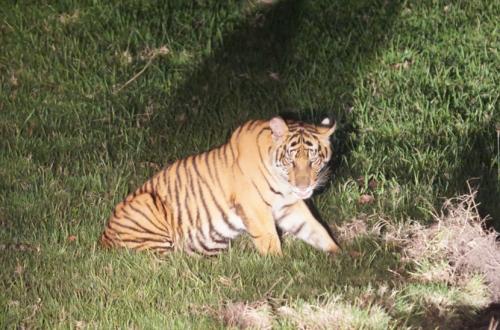
On the forest floor of Sumatra, light does not fall directly but fractures into refracted rays through gaps in leaves, stems, and soil. Within this fragmented light space, the Sumatran tiger (Panthera tigris sumaterae) conducts its daily existence. The tiger is designed by nature to adapt and undergo natural mitigation. Every hair, every colour contrast on its body, is the result of prolonged evolution between genes, light, and vegetation (Mazák, 1981). Black stripes form a dark orange visual colouration.
Scientifically, the orange colour in the Sumatran tiger occurs because of the dominance of pheomelanin pigment in its fur—a type of melanin that produces yellow to red colours—whilst black stripes form from higher concentrations of eumelanin in certain areas of the fur (Slominski et al., 2004). The production and distribution of these two pigments are controlled by genetic mechanisms from the embryonic phase, including the regulation of genes controlling the melanin synthesis pathway that determines whether hair will develop in light or dark colours (Kaelin et al., 2012).
From an evolutionary perspective, orange colouration is maintained because it provides camouflage advantages: many mammalian prey species such as deer and wild boar possess dichromatic vision incapable of clearly distinguishing red and green, so orange appears to them as a dull greenish or brownish tone that merges with forest vegetation (Jacobs, 2009).
Furthermore, mammals biologically lack natural pigments to produce green or blue colours, so their body colour spectrum is limited to variations of black, brown, yellow, and red, making orange the optimal result within these biochemical constraints and serving as an effective visual adaptation in the Sumatran rainforest environment. For human eyes, orange appears striking. However, human vision is not the ecological standard on the forest floor. Many mammalian prey species such as deer, muntjac, and wild boar possess dichromatic vision incapable of distinguishing the red and green spectrum as humans do (Jacobs, 2009). Within their visual perception, the orange colour of a tiger’s body does not appear as bright orange, but rather as a dull tone that blends with leaf litter, wet soil, and decaying wood.
In other words, what appears “bright” to humans becomes “neutral” in its prey’s visual world. This principle explains why a tiger’s body colour need not resemble green leaves to be concealed; it only needs to accord with how its prey perceives the world (Allen et al., 2011).
Black stripes on a tiger’s body function through a mechanism known as disruptive colouration—a pattern that breaks up the distinct outline of the body so that its biological silhouette loses definition (Cott, 1940). In the conditions of Sumatran rainforest, where sunlight is filtered by a thick canopy layer, shadows fall as irregular lines and patches. Ferns, rattan, shrubs, and vines form a complex vertical-horizontal network. The tiger’s stripes imitate this complexity. When it remains still, the broad shoulders and round head are no longer readable as the form of an animal, but rather as a shadow pattern that happens to be arranged like a body.
Compared with its northern relatives such as the Siberian tiger (Panthera tigris altaica), the Sumatran tiger’s stripes tend to be closer together and thinner (Mazák, 1981). This difference is not morphological coincidence, but rather an ecological response to habitat. The Siberian tiger inhabits snowy landscapes and boreal forests with more open sightlines, so the need for visual disruption differs.
Conversely, the Sumatran rainforest has short viewing distances and high vegetation complexity. Evolution has responded by refining the stripe pattern, increasing line frequency, and deepening the base colour to match low light intensity and the dominance of brown–green tones in the forest substrate (Seidensticker & McDougal, 1993).
This camouflage is crucial because the tiger is an ambush predator. It is not a long-distance pursuer like canids that rely on collective stamina. Its body is designed for short bursts of energy: thick thigh muscles, flexible spine, and retractable claws to seize prey within a fraction of a second (Sunquist & Sunquist, 2002).