
The Bantargebang Tragedy: Evidence of Indonesia's Fragile Waste Management System
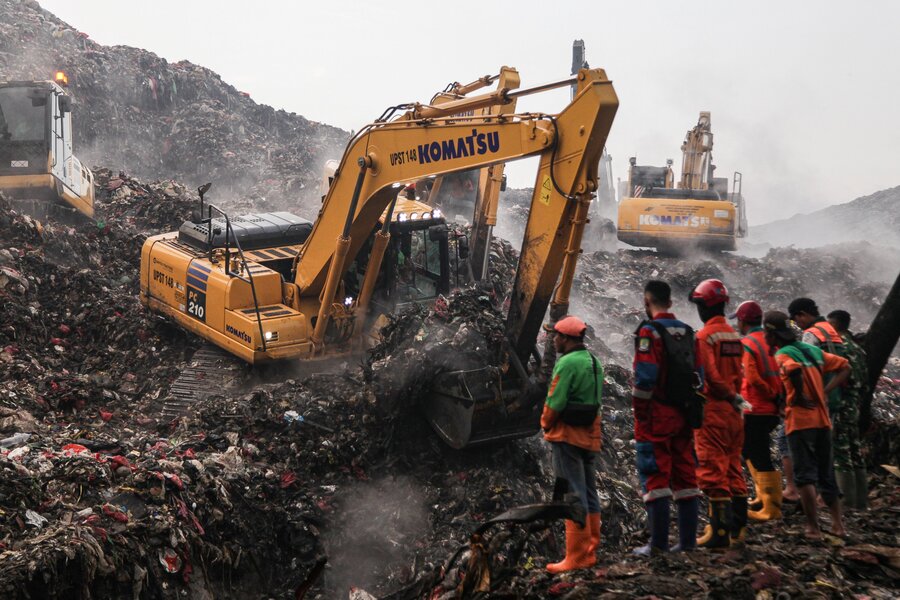
The collapse of a waste pile at the Bantargebang Integrated Waste Processing Centre (TPST) that claimed seven lives on 8 March demonstrated that waste management is no longer merely an environmental issue. The problem has now become a matter of human safety.
Large-scale waste accumulation at open dumping sites presents significant risk when not managed with adequate systems. This situation has prompted various stakeholders to reconsider the need for a fundamental shift in how urban waste is handled.
Professor Wiratni, Professor of Chemical Engineering at Gadjah Mada University and environmental advocate, identified the root cause as a flawed conceptual approach to waste management. According to her, current practice remains oriented towards waste disposal rather than processing. Consequently, waste volumes continue to accumulate at landfill sites without adequate reduction processes. An ideal waste management system requires reduction efforts upstream and proper processing downstream.
“The fundamental problem is that waste management is still viewed as disposal, not as a processing effort,” she stated on Thursday, 12 March.
Wiratni further explained that landfill operations do retain a role in modern waste management systems. However, landfills should only be the final stage after various processing stages have been completed. Processing can begin with waste sorting at source, composting for organic waste, and thermal processes for inorganic materials. Under such a system, only a small residue ultimately enters the landfill.
“In ideal waste management, landfills are still necessary but only as the final stage in the waste processing system,” she explained.
According to the Professor of Bioprocess Engineering, current practices at many landfill sites across Indonesia fall far short of proper management standards. Waste is often deposited without regard to safe landfill design principles. Yet proper landfill management requires careful slope gradient regulation, height limitations for waste piles, and sound leachate management systems. Without such management, landslide risk and environmental contamination increase substantially.
“What happens in Indonesia is that landfills are merely used to pile up waste without observing the required standards,” Wiratni stated.
Wiratni expressed regret that many view waste problems as purely technological challenges. However, if examined carefully, the root issues relate to society’s behaviour in generating and managing waste. Therefore, social and humanities approaches become critical factors in finding effective solutions. Each region possesses different socio-economic conditions, so technological approaches must be adapted to local community contexts.
“The waste problem becomes prolonged because public behaviour has not changed,” she emphasised.
She noted that waste processing technology implementation is frequently hindered due to inadequate social engineering support. Without behavioural change and proper management systems, available technology struggles to produce meaningful impact. This explains why various waste processing technologies have not been fully successfully implemented across many regions.
According to Wiratni, integration between technology and social engineering represents the key to successful waste management. She stressed that in preventing similar disasters in the future, universities hold an important role as testing grounds for various innovations. Campuses can function as living laboratories that integrate technology development with social approaches. The results can then form the basis for policy recommendations to government.
She believes that methodologies developed by Gadjah Mada University enable more contextual and implementable solutions.
“For example, UGM has developed community-based waste management models at the Centre for Agro-technology Innovation (PIAT),” she explained.
Located in Berbah, Sleman, PIAT processes approximately 8 to 10 tonnes of waste from the campus and surrounding residential areas. The system integrates waste processing with a social approach to encourage behavioural change. According to Wiratni, such micro-scale approaches can reduce dependence on large landfills.
“At PIAT we built an integrated waste management ecosystem linked with various applications of processed products,” she said.
As part of system development, UGM constructed an integrated waste management ecosystem within the campus environment. Internet of Things-based weighing technology monitors waste generation whilst documenting campus community behaviour in producing waste. Processed products such as compost, maggot, and building materials are then connected with various other campus innovations, adding value. According to Wiratni, this approach serves as a learning platform for communities in developing more sustainable waste management systems.
“Overall, what UGM has developed is not merely waste processing technology, but a circular economy ecosystem serving as a showcase for the integrated contributions of UGM’s various fields of expertise,” she concluded.
Both central and regional governments are blamed for failing to comprehensively implement waste management policies, allowing the Bantargebang waste collapse disaster to recur. Jakarta Provincial Government announced strategic measures to reduce pressure on Bantargebang TPST in Bekasi. Jakarta Regional Parliament member Josephine Simanjuntak urged the Provincial Government to increase resident participation in addressing the problem. The National Disaster Management Agency (BNPB) warned of risks of secondary landfill collapse at Bantargebang.