
The Bagong Mogok Fatwa
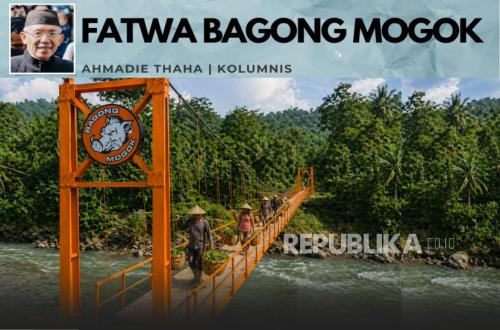
The logo stares at us unblinking. A wild boar’s head—its snout protruding, teeth bared as if ready to gore anyone attempting to tame its interpretation. On either side, pointed ears stick upwards. The colours are contrasting, bold, simple, leaving no room for aesthetic compromise. Surrounding it, capital letters—“Bagong Mogok”—are written plainly, without embellishment or additional metaphors. Two words. Concise. But like a firecracker tossed into a religious study hall. In parts of Java, those who see it might smile. “Ah, Bagong…”—the loquacious wayang puppet character, honest, sometimes eccentric, but respected precisely for that. There, Bagong is Semar’s son, a critic of power, a defender of truth who never took a diplomacy course. Even, if stretched a bit further to the Middle East, the word can be traced to the Arabic root bagha–yabghi–bughat: to rebel, to resist injustice. There, Bagong almost feels sacred—impolite, but sincere. But we are not sitting through an all-night wayang performance. We are standing in West Java. In this region, “bagong” is not Semar’s son. It is a wild boar. A feral creature, impure, with teeth that are not mere symbols, but real goring tools. And this community—with full awareness—chooses bagong as its face. Here is where interpretations start to run wild, even to unravel. But before we rush to touch it, let us hear the explanation from their own kitchen. The official clarification is given by the chairman of the Bagong Mogok community, Inspector General Asep Guntur Rahayu. This Deputy for Enforcement and Execution at the Corruption Eradication Commission emphasises that Bagong Mogok is a purely non-profit organisation, not connected to any legal matters, and all its activities are based on social efforts and mutual cooperation. The General Secretary of the Bagong Mogok Community in Majalengka Regency, Eka Setiawan, explains that the community was born from a simple vision: to help those in difficulty, then developing into a social movement with broad impact. Their jargon, “Satengkah Polah Ngabela Anu Susah”, is not just a slogan, but an operational intent—every step directed towards defending the weak. The philosophy of “bagong” itself, according to him, refers to the wild boar that is cornered and wounded, which will fight to the death to survive. From there, they draw inspiration: helping marginalised communities without fear and without surrender. This explanation is featured in a report by KabarCirebon media. That explanation, if read with a heart not overheating, actually makes quite a bit of sense. It is not a glorification of the pig. It is a metaphor for resilience. On one other side, the social facts are also hard to deny. The community engages in humanitarian activities: aid for orphans, assistance for poor residents, bridge construction, house renovations. There are no strange rituals, no deviant teachings. Even, if we are a little honest, their activities are often more concrete than many sermons that just spin through loudspeakers. Yet it is precisely because of that the issue becomes interesting. When the substance is already good, then what is wrong? The answer: the symbol. I also hear—and this is not rumour—that the Indonesian Ulema Council, starting from MUI West Java, has already received complaints of public unease. A study has been conducted. Even reportedly, the results have gone up to the Central MUI and are now in the hands of the Research, Study, and Development Commission. There is no final decision yet. But clearly: this is not just about “a unique name that happens to go viral”. Indeed not. This is about how religion works not only in the heavens of creed, but in the realm of the ummah’s perceptions. In terms of creed, let us be honest. There is no serious deviation in Bagong Mogok. No shirk, no superstition, no deviant rituals. If measured by the ten criteria for deviant sects according to MUI, this community does not even make the waiting list. It does not deny the pillars of faith, does not interpret the Al-Qur’an arbitrarily, does not make the forbidden halal. The meaning is simple: this is not a deviant sect. Nevertheless, you know, Islam does not only work with a checklist of laws. It also lives in feeling—natural feeling guided by revelation: the feeling of disgust towards what is foul, the feeling of shame towards what is inappropriate, and zeal to guard the honour of faith. And here is where the pig enters not merely as an animal, but as a symbol that disturbs that feeling—not because the evidence is unclear, but because natural instinct still operates.