
The Bad Leader Trap
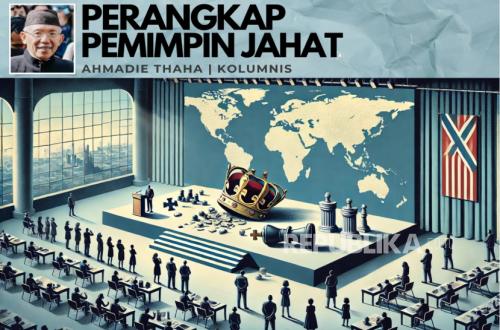
In international politics, there is one narrative that invariably sells well. This story is simpler than a television drama, more dramatic than a war film, and easier to digest than postgraduate international relations theory.
Its title: “the evil leader finally falls.” Once the protagonist falls, everyone immediately stands up, applauds, and feels the world has just been saved. Victory music plays. Newspapers write “freedom wins.” Politicians deliver speeches with solemn faces, as if history has just reached an age of enlightenment.
Yet often what actually happens is merely one old chapter changing its cover. An academic from the University of Pretoria, Somdeep Sen, calls this pattern by a compelling term: “the bad leader trap.”
This trap is actually quite simple. In some country, a leader emerges whose reputation is considered, perceived, or accused as bad with various labels: authoritarian, repressive, corrupt, oppressing opposition, silencing media, and beating demonstrators.
His track record is discussed everywhere. Social media corners sit in judgment simultaneously. Everything is bad, as though the world has become dark. Democratic institutions are eroded. Criticism is silenced. Protests are suppressed. The press is censored. All allegedly by the leader accused of being evil.
Then one day that leader is challenged, overthrown, arrested, or killed. And the world immediately says: freedom wins. This narrative feels morally very clear. Rather like a superhero story. The villain falls. The world is saved.
The problem is that in international politics, simple stories almost always hide far more complicated issues: international law, geopolitical interests, and the future of the societies left behind.
Consider the latest incident: the death of Iran’s second Supreme Leader, Ayatollah Ali Khamenei, in a military attack by the United States and Israel. Previously, Western media had narrated that his 36-year governance was repressive.
It was stated that Iran dealt harshly with opposition. Western media reported that since late December, security forces suppressed national demonstrations demanding structural change towards a democratic system that respects human rights.
Human Rights Watch, which is pro-Western, also reported that security forces used tear gas, batons, and metal pellets from shotguns against unarmed demonstrators. Even military-class weapons were used. Hospitals were raided to capture injured demonstrators.
In the Western narrative, Khamenei fits the classical description of “evil leader.” Yet the real problem is not that track record. The problem is what happens afterwards.
In Western political discourse, the figure of the evil leader has a very specific function. Especially if he comes from the Global South. He becomes a symbol of everything considered wrong with the world outside the West.
The repression narrated by the West then becomes a convenient contrast for building a narrative about who “we” are: defenders of democracy, freedom, and human rights.
Curiously, when problematic leaders emerge within the West itself, they are often treated as deviations, not part of this pattern. Hungary’s Prime Minister Viktor Orbán, for instance, is frequently portrayed as deviating from “European values,” as though European history itself never produced illiberal regimes.
Or Donald Trump. His xenophobic rhetoric and attacks on democratic norms are often regarded as merely an accident of American history, not part of the long tradition of exclusive politics in that country.
In other words, the story about evil leaders is not merely condemning authoritarianism outside the West. That story also helps the West maintain its own moral image, which is constructed with a double standard.
And when the time is deemed right, that same narrative makes the evil leader an easy target. March 2003 is a classic example, so powerful in historical memory and impossible to erase from America’s dark history.
President George W. Bush launched an invasion of Iraq aimed at toppling Saddam Hussein. The Bush administration spent months convincing the public that Iraq possessed weapons of mass destruction and was connected to the 11 September terrorist network.
Both claims ultimately proved unsubstantiated. But when those reasons crumbled, one argument remained available: Saddam Hussein was indeed brutal. The image of Saddam’s statue falling in Firdos Square in Baghdad became a symbol of moral victory.
Bush’s “Mission Accomplished” speech on the aircraft carrier USS Abraham Lincoln reinforced that narrative. The problem was, that victory turned out to be merely an illusion. Iraq did not transform into a stable democracy.
Instead, years of chaos, sectarian conflict, and violence emerged. The invasion created conditions that gave birth to ISIS. Civilian casualties exceeded 200,000 people. The evil leader fell. But new geopolitical consequences had barely begun.
The same pattern has reappeared recently. Early this year, the Donald Trump administration launched a military attack on Venezuela. President Nicolás Maduro and his wife, Cilia Flores, were even kidnapped from Caracas and brought to New York to be tried on charges of narcoterrorism.
Many observers questioned the legality of that action. But the debate quickly returned to one thing: Maduro is an evil leader. One commentator called him a combination of arrogant incompetence and brutal repression.
British politician Priti Patel even said, “We did not shed a tear.” No one may indeed mourn Maduro. But the lack of sympathy does not resolve questions of international law or the geopolitical impact of such actions.