
The Arithmetic of War 2.0
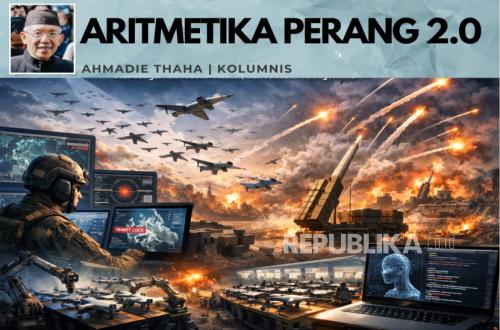
In the past, we were taught that war was about courage, strategy, and a bit of luck—like a national exam with the risk of life at stake. But now, according to CNN host and columnist Fareed Zakaria, war has become something colder, more mathematical, and—most disturbingly—cheaper. Yes, cheap. A word we usually use for year-end discounts has now become the key term in efficient killing. In the first week of Iran’s retaliatory attacks, around 71% of the strikes were carried out by drones. The United Arab Emirates alone received more than 1,400 drones and hundreds of missiles from Iran in eight days. This is not just war; it is a running spreadsheet. Every number is not merely a statistic, but a projectile with an address. This is where the concept that Fareed Zakaria calls “precise mass” becomes reality. Precision is no longer the exclusive domain of major powers with Tomahawk missiles or stealth jets. Now, precision can be mass-produced, like cheap, quick, and plentiful fritters from a roadside stall. Let us talk numbers, because this is where tragedy turns into logic. One Iranian Shahed-type drone costs around $35,000. Meanwhile, one US and Israeli Patriot interceptor costs around $4 million. That means, to shoot down one cheap drone, they must spend enough money to buy more than a hundred new drones. This is not just an imbalance. It is an economic trap. The US and Israel, as aggressors against Iran, are burning millions of dollars, while Iran, as the defender, is burning thousands. Even their success in defence feels like a slow loss. Like someone who manages to put out a fire, but whose house is already gone. However, this revolution does not stop at drones. Zakaria emphasises something far larger regarding the “new architecture of war”. War now is a complex orchestration between cheap autonomous systems, artificial intelligence for targeting, commercial satellite imagery, disruption-resistant communication networks, integrated sensors, and cyber devices. War is no longer about one superior weapon. It is about an ecosystem. Like the human body, where it is not just muscles that determine strength, but also nerves, blood, and reflexes. And those reflexes are now accelerated brutally. In US military experiments, machines can generate recommendations in less than ten seconds, with 30 times more options than a human team. Imagine a war general replaced by a dashboard, and life-and-death decisions determined by processor speed. At this point, humans start to feel like a bottleneck hindering a system that demands absolute speed. It is no wonder that the US Pentagon itself is changing direction. Through the Replicator programme, they are now promoting systems that are “small, smart, cheap, and plentiful.” This is a tacit admission that the era of expensive and exclusive weapons is wavering and being questioned. That weapons in the form of “a few that are very powerful” can now be defeated by weapons in the form of “many that are good enough”. Ironically, America, which has long been the symbol of military technological supremacy, is now developing cheap drones that imitate the Iranian model. History has a cruel sense of humour, when the once-dismissed student now becomes the unofficial teacher.