
Terror Against Activists: An Alarm for Indonesian Democracy
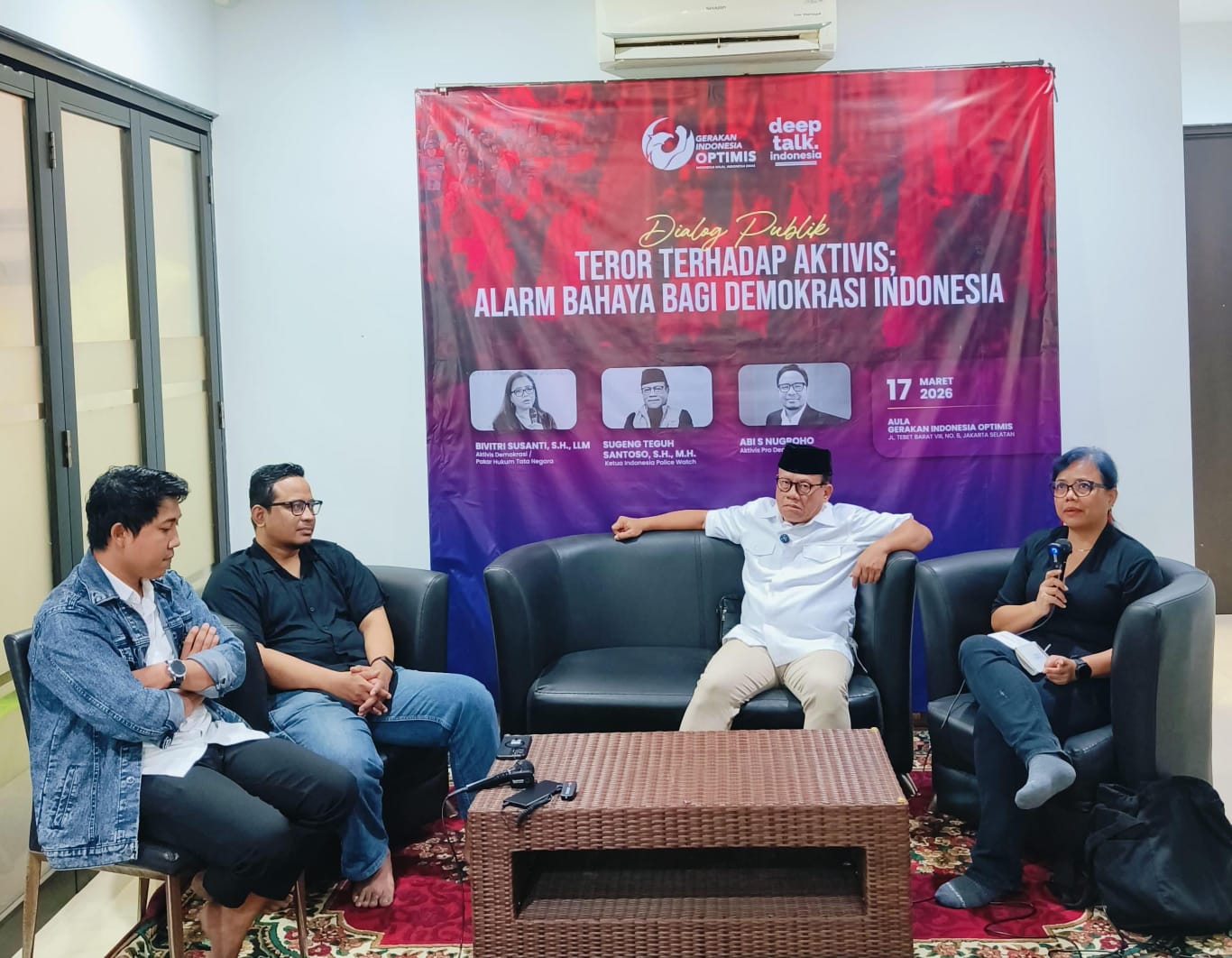
A wave of terror targeting pro-democracy activists has shaken Indonesia’s public sphere once again. Attacks against activists who are critical of state policies are not ordinary crimes. These are stark signals—indeed alarms—that Indonesian democracy faces serious threats from systematic political intimidation practices that threaten to erode civil liberties.
During a Deep Talk Indonesia forum held jointly with the Optimistic Indonesia Movement, speakers emphasised that attacks on activists like Andrie Yunus cannot be understood in isolation.
This is not merely about individual security, but about the future of democracy, the rule of law, and civil freedoms. After all, expressing opinions is protected by our constitution.
Constitutional law expert Bivitri Susanti affirmed that Andrie Yunus became a target because of his courage in being critical and consistently advocating for public policy, particularly regarding the legal examination of the Military Law at the Constitutional Court.
According to her, in a democratic state, legal activism is a legitimate part of citizen participation. However, when activists become targets of violence, what is threatened is not only the individual, but also the fundamental principles of the rule of law itself.
“This is not just about physical assault, but an attempt at silencing. Murder. This is an attack on the space for public deliberation,” she stressed.
Indonesia Police Watch chairman Sugeng Teguh Santoso revealed that police have actually had strong indications about the perpetrators’ movements, including traces pointing to the Bogor and Kalibata regions. However, to date there has been no transparent explanation regarding the perpetrators’ identities or the motivation for the attack.
“The question is, why has the public not been given adequate information? Is there an unresolved political process? Could there be involvement by state apparatus officials that makes this case sensitive?” he asked.
Meanwhile, pro-democracy activist Abi S Nugroho views the terror against activists as part of a broader political strategy.
According to him, fear is often used as a political infrastructure to gradually build an authoritarian climate, without formal declaration, without open coup, but through the normalisation of intimidation. The Ministry of Human Rights should ensure that citizens can exercise freedom of expression without fear.
“Fear is the most effective instrument of power. If citizens are afraid to speak, afraid to criticise, afraid to organise, then democracy dies without needing to be shot. No great nation has ever been built by cowards,” he stressed.
The forum also highlighted that recent trends of violence against activists, journalists, academics, and human rights defenders show an alarming pattern over recent years. The state risks losing moral legitimacy if it fails to protect citizens exercising their constitutional right to express opinions.
Democracy does not collapse overnight. It can be destroyed gradually, beginning with tolerance of terror, criminalisation of criticism, and impunity for perpetrators of political violence.
At this forum, Deep Talk Indonesia and the Optimistic Indonesia Movement called on law enforcement authorities to urgently and transparently uncover the perpetrators and motives of the terror with accountability. They urged the use of digital and scientific forensic methods for greater accuracy and validity.
Meanwhile, they called on the President and Parliament to provide political assurances that the space for civil freedoms cannot be criminalised. The forum also called on civil society to strengthen cross-group solidarity in combating the politics of fear. Media and academia should maintain public sanity by continuing to critically monitor this issue.
If terror against activists is allowed to continue, Indonesia risks entering a phase of procedural democracy that is empty—elections continue to occur, institutions remain standing, but citizens’ courage to correct policy has been paralysed.
And when fear becomes the new norm, authoritarianism will have arrived with a suffocating silence in the public sphere.
Therefore, at this forum, Deep Talk Indonesia and the Optimistic Indonesia Movement urged all elements of the nation to maintain unity and conducive conditions in a democracy that remains sustainable as Indonesia moves towards its golden age of 2045.