
Tensions Rise as US Deploys Fighter Jets and Warships Near Iran
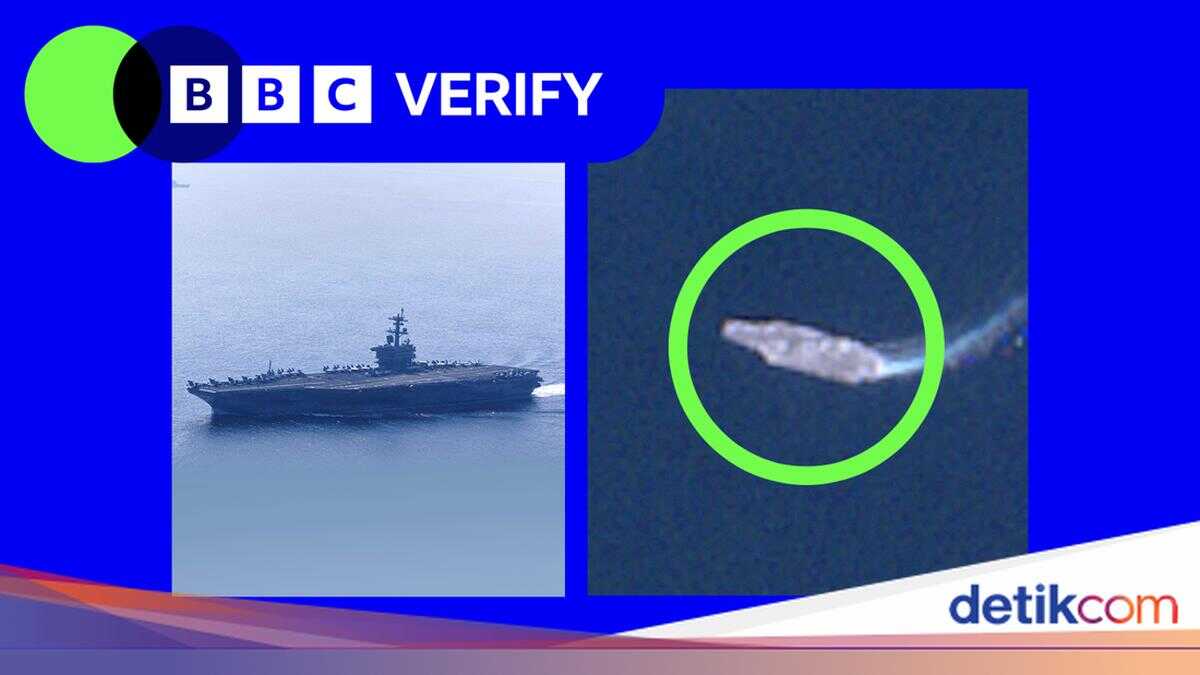
BBC Verify has confirmed that a second United States aircraft carrier has been observed moving towards the Middle East, as Washington continues to pressure Iran over its military programme and its deadly crackdown on recent protesters.
USS Gerald R Ford, the world’s largest warship, briefly broadcast its location for 48 minutes in the Atlantic Ocean on Wednesday (18 February). When the data appeared, the vessel was seen off the coast of Morocco heading towards the Mediterranean Sea.
An aircraft operating from the carrier was tracked returning to the Atlantic Ocean on Thursday (19 February).
US and Iranian officials met for a second round of negotiations in Switzerland on Tuesday (17 February). President Donald Trump said on Thursday that the world would know “perhaps within 10 days” whether the US would reach a deal with Iran or take military action.
On Monday (16 February), BBC Verify identified another aircraft carrier, USS Abraham Lincoln, through satellite imagery taken on Saturday (14 February) off the coast of Oman, approximately 700 kilometres from Iran.
The presence of two of the US Navy’s 11 aircraft carriers adds to evidence of a major military build-up in the Middle East in recent weeks.
During this period, BBC Verify has recorded an increase in the number of destroyers, combat vessels, and fighter jets in the region.
Both USS Gerald R Ford and USS Abraham Lincoln lead carrier strike groups that include several guided-missile destroyers. Each aircraft carrier is operated by more than 5,600 personnel and carries dozens of aircraft.
Why are US military assets moving to the Middle East?
USS Gerald R Ford activated its Automatic Identification System (AIS) on Wednesday (18 February) at 12:30 GMT. This was the first time the system had been activated in 2026.
Through this signal, the carrier was able to broadcast its position to the general public. For 48 minutes, the vessel was visible on the ship-tracking site MarineTraffic, appearing to sail towards the Mediterranean Sea.
A transport aircraft operating from the carrier that landed in Spain on Wednesday (17 February) was tracked moving towards the area where the ship had previously been seen, on Thursday (18 February) at approximately 13:00 GMT.
The appearance of the Gerald R Ford came after BBC Verify identified USS Abraham Lincoln in the Arabian Sea, approximately 240 kilometres from the Omani coast, through European Sentinel 2 satellite imagery on Saturday (14 February).
USS Abraham Lincoln had not been sighted since it was reported entering the area in January. The vessel had been sailing in open waters with limited satellite coverage. Military assets on land are far more visible and more frequently captured by satellite imagery.
BBC Verify has now tracked 12 US vessels in the Middle East.
These 12 ships include USS Abraham Lincoln, a Nimitz-class nuclear-powered aircraft carrier, and three Arleigh Burke-class destroyers forming one carrier strike group.
In addition, there are two other destroyers capable of conducting long-range missile strikes, as well as three vessels specialising in near-shore combat operations currently stationed at the US Naval base in Bahrain.
Two further destroyers have been spotted in the eastern Mediterranean near the US base at Souda Bay, and one more in the Red Sea.
BBC Verify has also monitored significant movements of US aircraft towards air bases in Europe and the Middle East, including:
- F-35 and F-22 fighter jets
- KC-135 and KC-46 aerial refuelling tankers to support long-range aircraft movements
- E-3 Sentry command and surveillance aircraft designed to coordinate large-scale operations
How has Iran responded?
In response to the latest US military movements, Iran has made a show of force.
On Monday (16 February), the Islamic Revolutionary Guard Corps (IRGC) conducted maritime exercises in the Strait of Hormuz, located in the Gulf between Oman and Iran.
During the exercises, IRGC Commander Lieutenant General Mohammad Pakpour was seen inspecting naval vessels at a port. Several missiles were launched from one of the ships during the occasion, according to the IRGC-affiliated Tasnim news agency.
The Strait of Hormuz is considered one of the world’s most important shipping lanes and a critical oil transit chokepoint. Approximately one-fifth of global oil and gas supplies pass through the strait, including from Kharg Island, Iran’s main oil export terminal.
In the report featuring Iran’s latest military manoeuvres, Pakpour was also seen aboard a helicopter flying over the island.
Video footage broadcast on Iranian state television on Thursday (19 February) also showed joint exercises in the Sea of Oman with Russia, including simulated ship rescue operations.
The IRGC-affiliated Fars news agency reported that “operational units from Iran’s regular navy and the IRGC navy” took part in the exercises.
How does this differ from military operations in Venezuela and Iran last year?
Military intelligence expert Justin Crump told BBC Verify that current US military preparations in the Middle East demonstrate “greater depth and endurance” compared with manoeuvres ahead of the capture of former Venezuelan president Nicolás Maduro in January, or the air strike operations against Iranian nuclear facilities in June 2025.
All those operations involved one carrier strike group and several independently operating destroyers. However, the deployment of US assets to Venezuela and Iran was more limited in scale.