
Technological Collaboration Key to Equitable Digital Access in Indonesia
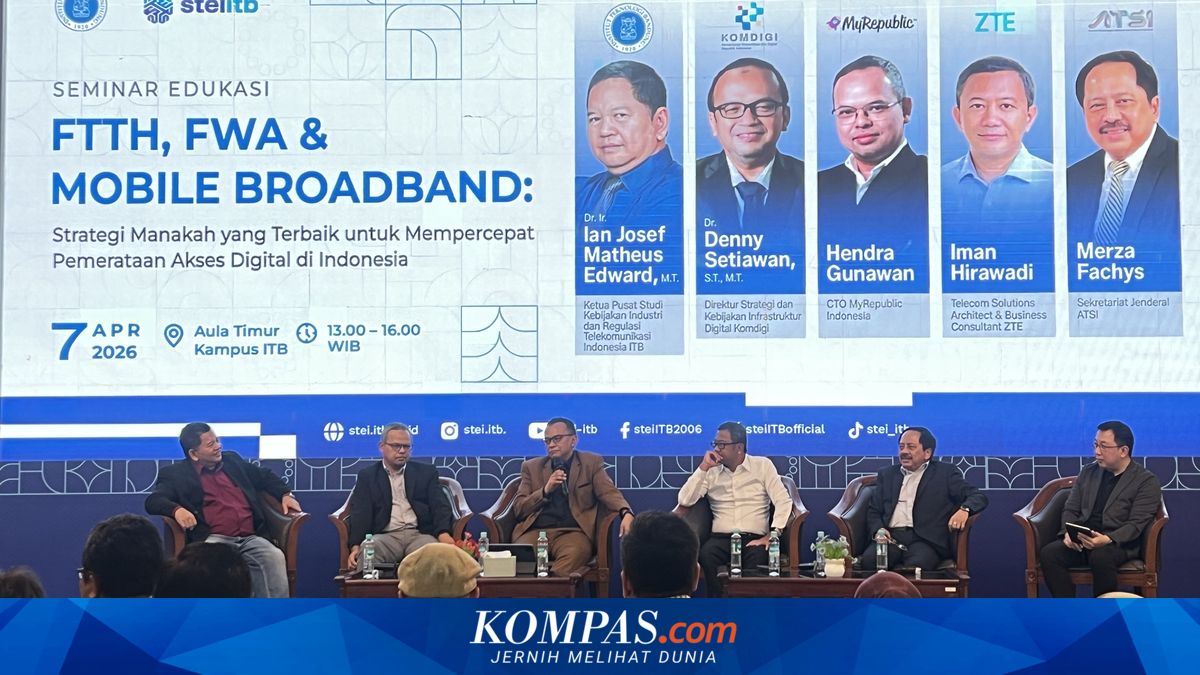
JAKARTA, KOMPAS.com – A strategy combining fibre optic technology (FTTH), fixed wireless access (FWA), and mobile services is considered key to accelerating equitable distribution and improving the quality of digital access in Indonesia, amid increasingly high connectivity needs.
This view emerged at a seminar organised by Institut Teknologi Bandung (ITB) titled “FTTH, FWA & Mobile Broadband: Which Strategy is Best for Accelerating Equitable Distribution and Improving the Performance of Digital Access in Indonesia” on Tuesday (7/4/2026) at the ITB Campus, Bandung.
Ian Josef Matheus Edward, Chairman of the Indonesian Telecommunication Industry and Regulation Policy Study Centre at STEI ITB, emphasised that no single technology can serve as a sole solution in driving equitable digital access in the country.
“FTTH offers the best capacity and stability, while FWA provides flexibility and rapid deployment. Both need to be positioned as complementary solutions in expanding digital access. Each technology has different characteristics and strengths. Wireless technology excels in ease of deployment, while FTTH remains the primary choice for service quality and reliability,” he stated in a written remark.
“We encourage the development of broadband services not only to focus on densely populated areas but also to reach underserved regions. Rollout commitments will continue to be monitored to ensure equitable digital access,” he explained.
Meanwhile, industry players view the combined technology approach as the most realistic strategy to accelerate internet penetration. Hendra Gunawan, Chief Technology Officer of MyRepublic Indonesia, stated that FTTH remains the backbone of services, while FWA acts as an accelerator in areas not yet reached by fibre networks.
“FTTH and FWA are not meant to replace each other but to complement one another. FTTH remains the main backbone, while FWA plays a role in accelerating penetration in areas not yet reached by fibre. This aligns with MyRepublic’s commitment to improving internet access performance and equity through strengthening FTTH in major cities and FWA as an accelerator in regions 2 and 3,” he revealed.
From a technological perspective, Iman Hirawadi, Telecom Solutions Architect & Business Consultant at ZTE Indonesia, assessed that FWA technology readiness is increasingly mature with support from 4G and 5G networks, though it still faces challenges in device affordability.
“FWA technology is now increasingly mature with 4G and 5G support. The next challenge is achieving economies of scale so that devices become more affordable to the wider public,” he explained.
Furthermore, Merza Fachys, Secretary General of the All-Indonesia Telecommunications Operators Association (ATSI), added that each technology has a different role in the national telecommunications ecosystem.
“Each technology has a different role. Fixed broadband excels in stability, while mobile offers flexibility. The most important thing is how policies can create a balanced and sustainable ecosystem,” he stated.
Through this forum, ITB emphasised the importance of collaboration between academics, regulators, and industry players in formulating strategies to accelerate inclusive digital access. These efforts are expected to drive equitable connectivity while improving internet service quality across all regions of Indonesia.