
Tearful Police Commissioner Yogi in the courtroom of the Brigadier Nurhadi murder trial
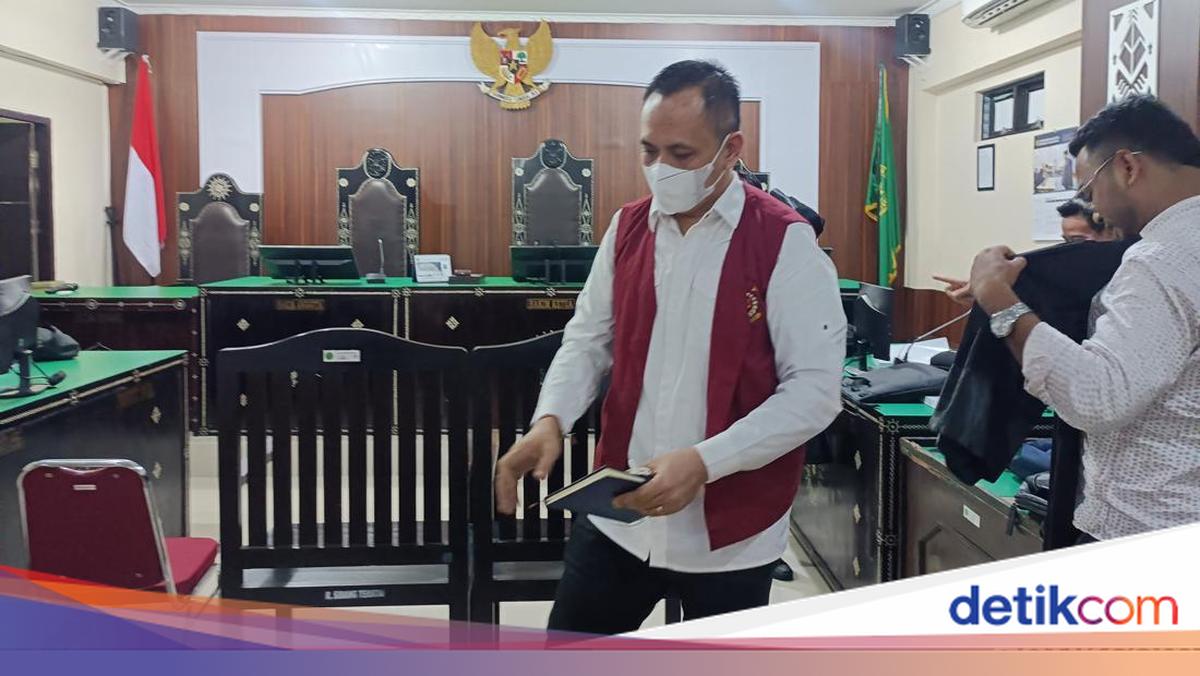
The voice of Police Commissioner I Made Yogi Purusa Utama trembled in the courtroom of the Mataram District Court. The defendant in the murder of Brigadier Muhammad Nurhadi was unable to hold back his tears as he read his plea in defence before the panel of judges on Tuesday, 3 March 2026.
Yogi insisted on denying the murder charge. He also rejected the public prosecutor’s (JPU) demand for a 14-year prison sentence.
“A 14-year prison term is not merely a number. It represents the future of my children, my wife, it is the rest of my life,” said Yogi, his voice quivering.
Yogi said the prosecutor’s indictment was not merely a threat of punishment, but also a destruction of his family’s future.
He said he had come to Gili Trawangan for a holiday with Nurhadi, with no dispute or ill will.
“There is no reason for me to take his life,” he said.
“If I deliberately killed the late Muhammad Nurhadi, would I still be at the scene? Was I the one attempting to perform cardiopulmonary resuscitation in a panic? I did not flee, I did not disappear, I did not hide, because I never committed that murder,” he added.
Singgung Anak dan Istri
Di hadapan majelis hakim, Yogi juga menyampaikan empati kepada keluarga Nurhadi. Namun, ia menilai ada duka lain yang ikut ditanggung keluarganya.
“Your Honour, there is another real sorrow. My children live with questions they cannot yet understand. Is their father truly a murderer? My wife bears social stigma. My family carries shame and pressure,” he said.
“My entire family will bear it for life. Yet what I feel, Your Honour, is that what is being defended is not the truth, but justification,” he added.
Mengaku Ditekan Agar Mengaku
Yogi mengaku mendapat tekanan untuk mengakui bahwa dirinya telah membunuh anak buahnya, Brigadir Nurhadi, di Gili Trawangan, Lombok Utara.
“Thank you for the opportunity to speak my mind and present my defence after almost a year, precisely 11 months since this case began,” Yogi said as he read his plea.
Yogi initially said the death of Brigadier Nurhadi had changed his entire life. Two weeks after Nurhadi’s death, Yogi was placed in a special detention facility (Patsus). At that time, Yogi was still a police officer and held the post of Ps Kasubdit Paminal Bidpropam Polda NTB.
“The communication device in the form of a mobile phone was seized, socialising or communicating with fellow police officers was restricted. I did not even receive clear information about the cause of death of the late,” he said.
“In isolation, without adequate access, I underwent a very heavy process,” he added.
Yogi underwent a police ethics commission hearing (KKEP) in May 2025. He was dismissed with dishonour for drug abuse and zina. Yogi said he accepted that punishment as a consequence. However, he said the ethics case is a different domain from the criminal case.
“In June 2025, I was named a suspect with allegations under Article 351(3) and/or 359 of the KUHP,” he said.
Yogi insisted he was not guilty in the death of Brigadier Nurhadi. After being charged in July 2025, investigators formally detained Yogi at the NTB Police Detention Center.
Since then, Yogi has felt pressure to admit to having taken Nurhadi’s life. Yogi also felt pressured to name Ipda I Gde Aris Chandra as the killer.
“However, I answered firmly. How could I admit to a deed I never committed? How could I name someone I do not know as the perpetrator of that act?” he said.
Yogi Seeks Acquittal
Yogi accused the prosecutor’s indictment of not being based on the legal facts presented in court. As if the indictment had already been concluded by the prosecutors.
“The trial has proceeded, witnesses have been examined, experts heard, evidence reviewed. Yet in the public prosecutor’s indictment, I do not see a meaningful change from the initial indictment. The facts revealed do not shift the conclusion. As if the conclusion has been sealed from the start, the trial has merely become a formal procedure,” Yogi said.
Yogi admitted to using riklona and ecstasy. When Misri Puspita Sari woke me and I saw the victim at the bottom of the pool, my body was unstable and off balance. With a body that was unsteady, I lifted Nurhadi’s body, which was sinking at the bottom of the pool.
“My response at the time was a helping response, not a planned or intentional act,” he said.
Your Honour, he continued, Article 338 of the KUHP requires the element of intent.
“Without proof of intent, the indictment would fail,” he added.
“In the evidence, there were no eyewitnesses, no direct evidence, no recordings, no confession, no proven motive,” he said.
“What exists, in his view, is a medical conclusion about the injuries. However, explaining how the injuries could have occurred is not proof of who the perpetrator is.”
“Experts explain possibility, not certainty. Theory is not proof,” he said.
“If the element of intent cannot be proven concretely, then what remains is conjecture. And no matter how strong the conjecture, it is never sufficient to deprive someone of their liberty,” Yogi continued.
“Under Article 183 of the KUHAP, a conviction can only be imposed if there are at least two credible pieces of evidence and the judge’s conviction. That conviction must arise from clear facts and must not imply any reasonable doubt.”
“If there is still space for doubt about who the actual perpetrator is, then the doubt is real. In criminal law, the principle that doubt should benefit the defendant applies,” he said.
Yogi admitted that using narcotics was a serious mistake. However, that mistake cannot be used to conclude that he is a murderer.
“Each accusation must stand on its own evidence,” he said.
Earlier, the prosecutor urged the judge to impose a sentence of 14