
Targeting 6% Economic Growth, Fiscal-Monetary Synergy and Business World as Key Pillars
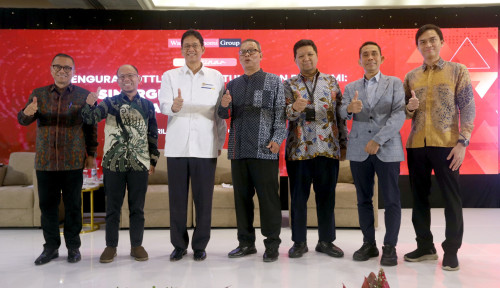
Warta Ekonomi hosted a seminar titled Unravelling Economic Growth Bottlenecks: Fiscal and Monetary Synergy and the Business World Towards Indonesia 6%. The seminar aimed to discuss collaboration between fiscal policies under the responsibility of the Indonesian Ministry of Finance, monetary policies by Bank Indonesia, and the role of the business world. In the 2026 State Budget (APBN), economic growth is projected to be around 5.4 per cent. Additionally, Bank Indonesia estimates Indonesia’s economic growth to be in the range of 4.7-5.5 per cent in 2025, increasing to 4.9-5.7 per cent in 2026. CEO and Chief Editor of Warta Ekonomi, Muhamad Ihsan, emphasised that strengthening the synergy between fiscal, monetary, and the business world is the main key. Moreover, he mentioned that cross-sector synergy is also needed to unravel obstacles (bottlenecks) to national economic growth. “How can we achieve growth of at least 6 per cent, even amidst various turbulences? We should all be proud that our economic growth rate is around 5 per cent,” said Ihsan in his opening remarks in Jakarta on Monday (7/4/2026). Ihsan noted that several economic indicators showing good conditions also support this optimism. S&P Global recorded Indonesia’s manufacturing Purchasing Managers’ Index (PMI) in Q4 2025 at 51.2 in December 2025, down from 53.3 in November. From the monetary side, financial system liquidity is also well maintained, reflected in the annual growth of primary money (M0) reaching 11.4 per cent in December 2025. This condition is strengthened by expansive fiscal policies and close coordination between the government and Bank Indonesia in maintaining stability and encouraging growth. “However, this condition has not yet been able to fully drive economic growth acceleration due to various remaining structural obstacles that hinder the pace of national economic expansion,” he added. There are obstacles such as licensing complexity, overlapping regulations, spatial planning uncertainty, infrastructure and energy limitations, and challenges in law enforcement. These conditions impact high economic costs and slow investment realisation, especially in productive sectors. Without targeted and coordinated debottlenecking efforts, expansive fiscal and monetary policies risk not producing optimal impacts on real economic growth. Therefore, the government must encourage structural reforms through deregulation, simplification of licensing, and strengthening the role of the Strategic Government Programs Acceleration Task Force (Satgas P2SP) to address cross-sector obstacles. Indonesian Finance Minister Purbaya Yudhi Sadewa, on that occasion, stated that through addressing bottlenecks from both regulatory and business activity sides, higher economic growth can be achieved. Purbaya said there is a need to improve policy constraints so that business actors can more easily run their businesses and increase profits. “If the policy isn’t fixed, you’ll struggle half to death, the results will definitely be minimal. But if the policy is fixed, your work should be easier, just be smart about it. A little smart, lots of profit; very smart, even more profit, something like that. We will fix both, the policy and the ease of doing business,” said Purbaya in his keynote speech. Purbaya explained that the government’s development strategy relies on three main pillars: high economic growth, equitable distribution of development benefits, and dynamic national stability. To achieve these targets, the government is optimising various instruments, from fiscal policies, strengthening the financial sector, to improving the investment climate. “This all becomes the basic foundation of President Prabowo’s development programme. Whatever the policy, it will pull towards that. We will strive as optimally as possible to make it happen. How? There is fiscal, fiscal guarding, there is the financial sector, as well as improving the investment climate,” he clarified. In efforts to overcome various investment and business obstacles, the government has formed the Strategic Government Programs Acceleration Task Force (Satgas P2SP) to address cross-sector obstacles under the Ministry of Finance and the Coordinating Ministry for Economic Affairs. This task force is tasked with receiving and following up on complaints from business actors, both domestic and foreign. As of 6 April 2026, a total of 112 complaints have been received, with 52 of them already discussed and followed up in weekly sessions. Purbaya said that the existence of this task force can accelerate the resolution of projects that were previously delayed, such as the Masela Block project. He mentioned that licensing, which had been delayed for years, could be completed in a short time after being reported to the task force. “So I say, if you need permits and all that, just give it to our small task force, then we will invite the ministry to sort it out. So one stop, really one stop service, we sort it out,” Purbaya revealed. Besides Purbaya, the speakers included Dhaha Praviandi Kuantan, Director of the Macroprudential Policy Department at Bank Indonesia; Kamrussamad, Vice Chairman of the Fiscal and Monetary Policy Division of KADIN; and Riyatno, Deputy for Investment Climate Development at the Ministry of Investment and Downstreaming/BKPM. In addition, the discussion moderated by Eko Listiyanto, Director of the Institute for Development of Economics and Finance (INDEF), was also attended by Ajib Hamdani, Economic Policy Analyst of the Indonesian Employers Association (APINDO); Dr. Anggawira, MM, MH, Secretary General of the Executive Board of the Indonesian Young Entrepreneurs Association (HIPMI); and Jahja B. Soenarjo, Chairman of the CEO Business Forum as seminar panellists. This event was made possible with support from PT SCG Indonesia, Triputra Agro Persada, Bank Sinarmas, Bank Mandiri, and IFG.