
Tanah Abang Market Traders Reveal When Fabric Prices Will Officially Rise
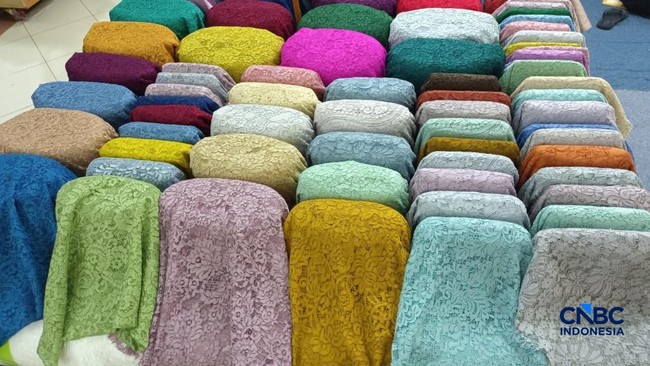
Jakarta, CNBC Indonesia - Fabric prices in the retail market have yet to show any increase, despite predictions of a surge in the near future. Based on observations by CNBC Indonesia at Block A of Tanah Abang Market on Monday (13/4/2026), prices for various types of fabric remain stable.
Rows of fabric shops continue to display rolls of fabric with the same price labels as before. The price boards hanging at each stall appear unchanged, showing no significant price spikes.
Several traders admit that they are still selling old stock at prices that have not yet been adjusted. They are also opting to hold prices to preserve consumer purchasing power amid intense competition among traders.
Lidya, one of the fabric traders, confirmed that the prices she is selling at are the same as last year.
“No, this is still the old price. It’s been the same since last year,” said Lidya when met by CNBC Indonesia at the location.
She explained that the fabric prices in her shop vary depending on the type of material, from the cheapest to the more premium options.
“In my shop, I sell starting from Rp5,000 per metre. This one is Rp10,000 (per metre), this Rp15,000 (per metre). There’s also this one at Rp40,000 (per metre). It depends on what material you’re looking for. But these prices are the same as what I sold last year. No increase yet,” she clarified.
Nevertheless, Lidya acknowledged that there are already signals of price rises from the upstream side, particularly for goods ordered directly from factories.
“I haven’t (raised prices) yet. For PO (pre-order) or orders to the factory now, yes, they’ve gone up. But that will only rise when those goods are sold, maybe in a month or two,” she said.
She estimated that the price increase would be around 10%. “My estimate is, it’ll be about 10%,” she stated.
Once new stock arrives at the stalls of Tanah Abang Market traders, Lidya predicts that fabric prices could rise in line with higher production costs.
“Yes, about 10%. For example, if this is Rp20,000 (per metre), it would become Rp22,000 per metre,” she remarked.
For now, she emphasised that there has been no increase at the retail level.
“Not yet, no one has raised prices. Unless they’re already selling with new production goods. But I think no one is (selling) goods from the current PO production yet, because there’s a process,” she explained.
She estimated that the price rise would only be felt in a few months’ time.
“Well, the fastest is one month, but I think in two or three months, clothing prices will rise. Hopefully not, though. It’s the impact of the war. But my prediction is, in two to three months, clothing or materials here will start rising,” she elaborated.
Feri, another fabric trader at Tanah Abang Market, echoed similar sentiments. He said fabric prices are still stable, although supporting costs like plastic have surged sharply.
“Brocade fabric is Rp50,000 per metre,” said Feri.
According to him, fabric material prices have not risen yet, but there is pressure from operational costs.
“The fabric materials haven’t yet. No increase. But this (plastic) has gone up. Earlier I bought plastic, and it rose 70%, from the usual Rp100,000 to Rp170,000. The one I usually buy for Rp50,000 isn’t even close; earlier I bought for Rp100,000. The plastic increase is really bad,” he revealed.
Although there has been no rise yet, he admitted to receiving information that fabric prices could increase soon.
“But yesterday when I called to inquire about goods, to take stock, I was told that prices are going to rise,” he said.
However, Feri and the shop owners have agreed to hold selling prices for now. “But it seems we’ve agreed not to raise it yet. We’ll fix it at, say, brocade fabric at Rp50,000 (per metre); if it rises, maybe Rp60,000 (per metre), and if they buy in bulk, we can give a discount to Rp55,000 (per kg). We can calculate it later,” he explained.
Feri admitted that this is the first time he has received warnings about potential fabric price increases due to global factors.
“Because this is the first time fabric prices are rising; it’s the first time I’ve felt warned that fabric prices will go up. For other goods, it’s usual, but for fabric, this is new. Yeah, the effect of the war too. Hopefully it ends soon,” he said.
Meanwhile, another trader, Rinda, is also adopting a cautious approach and not hastily raising prices despite hearing similar news.
“Yes, I saw it in the news. When I read it, I immediately asked (my husband), ‘Oh no, this is going to rise, what now?’ It’s the war effect. But my husband said to just see the situation,” said Rinda.
According to her, the competition in Tanah Abang means traders cannot arbitrarily raise prices.
“We sell together in crowds here in Tanah Abang, so we can’t panic and raise prices while other shops hold steady; consumers will definitely go to the cheaper ones,” she explained.
She has chosen to hold prices as long as possible.
“So we’ll see the situation; if we can hold (the increase), we’ll hold it. But if it’s really bad, hopefully the government has a solution,” she said.
Currently, Rinda also admits to still selling old stock at stable prices.
“Not yet. Luckily, this is old stock. Meaning I bought this stock before the (war) turmoil, so the prices are still safe,” she stated.
She sells various types of fabric with a range of prices. “I sell various materials (fabrics), starting from Rp5,000 to around Rp50,000, depending on what you want, the style, or what it’s for,” she clarified.
In fact, she said, these prices have remained relatively unchanged for several years.
“Not just from last year; it’s been like this for years, two or three years, fabric prices haven’t fluctuated much up or down,” she added.
Previously, the Chairman of the Indonesian Filament Fibre and Yarn Producers Association (APSyFI), Redma Gita Wirawasta, predicted that fabric prices