
Take a Breather: IHSG Opens Down 0.56% at 7,238
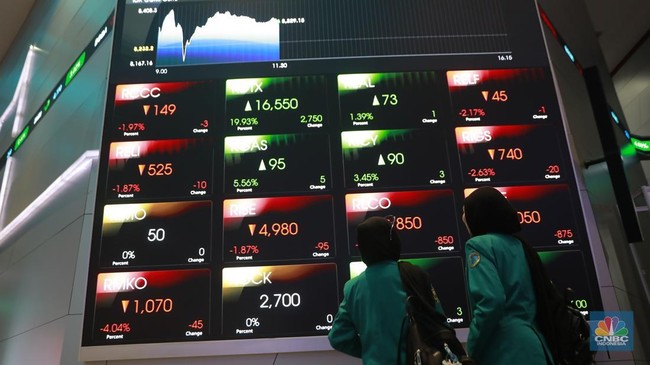
Jakarta, CNBC Indonesia - The Composite Stock Price Index (IHSG) opened down 0.56% this morning, on Thursday (9/4/2026). The index fell to 7,238.46, a decline of 40.74 points. This correction came after the index surged sharply in yesterday’s trading with a rise of more than 4%.
A total of 156 stocks declined, 207 rose, and 300 remained unchanged. Trading value reached Rp 319.62 billion, involving 504.16 million shares in 53,305 transactions.
Market capitalisation also corrected to Rp 12,707 trillion.
A few minutes after the market opened, the index fell even deeper, correcting up to 0.85%.
The most actively traded stocks by investors with the largest transaction values this morning included BUMI, BBCA, BBRI, BMRI, and DEWA.
Indonesia’s financial markets are expected to continue the strengthening trend today, although overshadowed by many negative sentiments. Developments in the war that are not as hoped for, as well as the Federal Open Market Committee (FOMC) minutes showing a hawkish tone, could pressure stocks and the rupiah.
Meanwhile, Asia-Pacific stock markets opened with mixed movements on Thursday (9/4/2026), amid rising geopolitical tensions between Iran and the United States. This occurred after Iran’s parliament accused the US of violating the two-week ceasefire agreement that had previously been announced.
According to CNBC, US President Donald Trump announced a “two-way” ceasefire on Wednesday after more than a month of conflict with Iran. In his statement, Trump said he would halt attacks on Iran for two weeks as a basis for opening negotiation space.
Trump also revealed that his side had received a 10-point proposal from Iran, which was deemed sufficiently viable to serve as a basis for negotiations. However, this agreement depends on Iran’s willingness to reopen the Strait of Hormuz, a vital global energy route.
The Tehran government stated it would halt defensive operations if attacks on its territory were completely stopped. Additionally, Israel is reported to have approved the ceasefire, although the situation in the region remains fragile.
Iran’s parliamentary speaker, Mohammad Bagher Ghalibaf, then accused the US of violating the agreement. He said the violations included denying Iran’s right to enrich uranium, Israeli attacks in Lebanon, and the entry of drones into Iranian airspace.
In the stock markets, South Korea’s Kospi index fell 0.6% while Kosdaq moved flat. In Japan, the Nikkei 225 rose slightly by 0.12% and Topix strengthened by 0.26%, while the S&P/ASX 200 weakened by 0.24%.
Meanwhile, global oil prices jumped amid high geopolitical uncertainty. The May West Texas Intermediate futures contract rose 2.3% to US$96.63 per barrel, while the June Brent contract climbed 1.87% to US$96.50 per barrel.
In the US futures market, S&P 500 and Nasdaq 100 contracts each fell 0.1%. Meanwhile, the Dow Jones Industrial Average contract weakened by 32 points or less than 0.1%.
In the previous trading on Wall Street, the US stock market surged sharply following the ceasefire announcement. The Dow Jones Industrial Average soared 1,325.46 points or 2.85% to 47,909.92, marking the best daily gain since April 2025.
The S&P 500 rose 2.51% to 6,782.81, while the Nasdaq Composite jumped 2.80% to 22,635.00. This rise occurred after a five-week conflict that had temporarily closed key global energy supply routes began to ease.
Another sentiment drawing investor attention is related to the direction of The Fed’s decisions. Several Federal Reserve officials have begun to open the possibility of rate hikes after inflation remains above the 2% target, particularly driven by the surge in energy prices due to the Middle East conflict, according to the March Federal Open Market Committee (FOMC) minutes.
The Fed adopted a “two-way” approach, signalling that interest rates could rise or fall depending on the direction of inflation. Although previously leaning towards cuts since 2024, the number of officials considering hikes has now increased compared to January.
The majority of participants assessed that inflation risks are rising, especially if energy prices remain high and push core inflation. Long-term inflation expectations are also seen as at risk of rising.