
Synergy in School Revitalisation Oversight
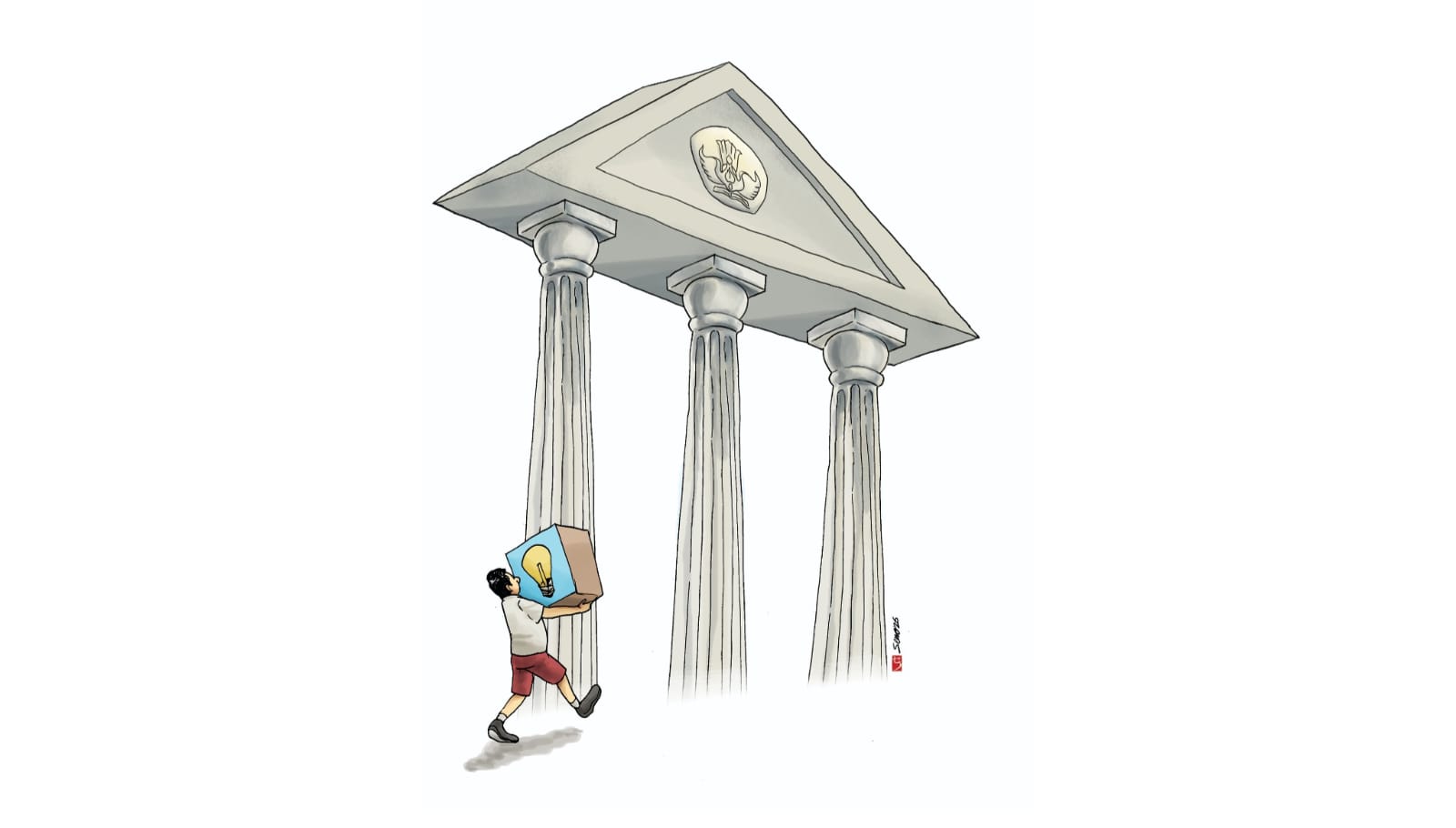
Throughout 2026, the Ministry of Basic and Secondary Education (Kemendikdasmen) is rolling out a school revitalisation programme targeting 11,744 educational institutions. This marks the second year of the programme’s implementation, which is open to both public and private schools. Primary targets are schools in disaster-prone areas, 3T regions (remote, frontier, and outermost areas), and severely damaged schools.
School revitalisation includes building rehabilitation or construction of new classrooms, libraries, health rooms, laboratories, places of worship, sports fields, toilets, and other facilities. Adequate educational infrastructure is expected to enable children to study in a calm, safe, and comfortable environment.
A safe and comfortable environment makes schools a ‘second home’ for children, with their primary home being with parents and family. Encouragingly, President Prabowo Subianto has committed to increasing the number of schools receiving the revitalisation programme by 60,000 institutions.
This brings the total beneficiary schools to 71,744 this year, with increasing quotas ensuring more schools receive repairs.
President Prabowo also stressed the importance of schools being ASRI — safe, healthy, clean, and beautiful — as learning and growth environments. Achieving this would make schools a pleasant ‘second home’ for children.
Direct Aid Transfer
A service-oriented paradigm shift underpins Kemendikdasmen’s commitment to streamlining bureaucracy in the disbursement of school revitalisation aid. The ministry has established a direct fund transfer mechanism to school accounts.
The direct transfer mechanism to school accounts is a significant innovation, as aid previously flowed through local governments. This policy entrusts schools with managing revitalisation funds directly, reflecting central government confidence in their accountability.
This breakthrough teaches that bureaucracy should not be overly rigid. Education Minister Abdul Mu’ti stressed that as public servants, bureaucrats must prioritise service over red tape.
Bureaucrats must avoid rigid, convoluted, slow, and unresponsive systems. The mindset of ‘if it can be delayed, why speed up’ must shift to ‘if it can be expedited, why delay’.
Thus, Kemendikdasmen has adopted a self-management (swakelola) scheme for school infrastructure rehabilitation. Revitalisation funds are disbursed directly to school accounts, with schools managing them independently while involving the community.
Can schools manage revitalisation funds efficiently and accountably? Based on 2025 experience, central government trust has been well upheld, especially as this is the second year of the same disbursement mechanism.
In this context, educational institutions, school committees, and communities must oversee fund usage to ensure targeted delivery. Schools are required to establish a School Development Committee (P2SP), comprising planning, technical, monitoring teams, and community representatives.
Kemendikdasmen also provides university mentorship to ensure construction quality. Multi-stakeholder involvement is crucial for targeted, accountable school infrastructure development.
Self-Management Mechanism
The self-management mechanism offers schools flexibility in handling revitalisation funds. By implementing school-based management principles, institutions optimally plan, execute, and monitor projects while ensuring budget efficiency and construction quality.
To ensure smooth implementation, Kemendikdasmen provides technical guidance. Recipient schools, along with planning, construction, finance, monitoring teams, and principals, receive prior training. Kemendikdasmen, local education offices, and communities also participate in monitoring and evaluation.
Encouragingly, the self-management mechanism boosts local economies. Construction committees purchase building materials from nearby community shops, creating significant economic circulation.
Construction committees also create job opportunities. Kemendikdasmen’s release states over 238,000 workers were involved in the 2025 programme, with more employment expected in 2026 as targets expand.
The self-management mechanism also improves fund efficiency. Contractor-led construction typically incurs 15-20% additional costs as profit margins, whereas swakelola maximises all funds for school construction.
Thus, it is unsurprising that the swakelola policy has increased the number of schools receiving revitalisation aid. Learning from 2025, the programme’s beneficiary count has risen.