
Swift Action by Ministry of Transportation Clears Queues at Gilimanuk Port
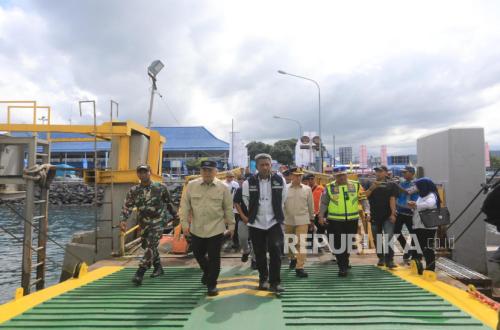
The Ministry of Transportation (Kemenhub) moved quickly to handle the long queues of vehicles during the 2026 Eid homecoming traffic on the Ketapang-Gilimanuk crossing route.
Queues began occurring since Saturday (14/3/2026) and peaked at around 37 kilometres, making the area one of the most critical points in this year’s homecoming flow.
Various efforts were undertaken from the start by KSOP, ASDP, and Polri to alleviate the congestion. By Monday (16/3/2026), the queue had been reduced to around 28 kilometres. Although vehicle flow remained high and congestion started occurring on both sides, both in Gilimanuk and Ketapang.
Entering Tuesday (17/3/2026), Minister of Transportation (Menhub) Dudy Purwagandhi did not remain idle. He directly led the handling on the ground. Amid vehicle queues still ranging from 20-25 kilometres in Gilimanuk, the Minister chose not only to monitor but to be present directly at the critical point.
He first headed to Ketapang and then crossed to Gilimanuk by boarding a ferry as a foot passenger.
Amid the high pressure of the situation, the Minister received spontaneous responses from several service users. However, considering the urgency of handling in Gilimanuk, the Minister chose to continue the journey immediately to accelerate the queue dispersal process.
This step was based on the principle that smoothness on the Gilimanuk side is the main key to alleviating congestion in Ketapang. Moreover, crossing operations will be temporarily halted on 19 March to honour Nyepi day, making accelerated handling extremely crucial.
Upon arriving in Gilimanuk on Tuesday afternoon, the Minister immediately led cross-agency coordination on the ground. All parties—from port operators, ASDP, police apparatus, to technical officers—were consolidated to work in an integrated manner in one rhythm of service acceleration.
Several strategic measures were promptly implemented, including optimisation of buffer zones to accommodate vehicles, acceleration of the arrival-unloading-departure (TBB) process, operation of large-capacity ships such as KMP Prima Nusantara, and traffic engineering on routes to the port together with the police.
These efforts yielded results in a short time. On Tuesday afternoon, the vehicle queue, which previously reached tens of kilometres, was successfully reduced to around 9 kilometres.
Improvements continued. In less than 24 hours, precisely on Wednesday (18/3/2026), the queue decreased significantly again to around 1 kilometre. This marked the return to normal and smooth crossing flow in both Gilimanuk and Ketapang.
“We understand the inconvenience to the public due to these long queues. Therefore, we went directly to the field to ensure all acceleration steps are carried out maximally and coordinately,” said the Minister in a statement on Friday (20/3/2026).
According to the Minister, the success in clearing the queues resulted from the cooperation of all parties, from port operators, ASDP, police apparatus, to the public who helped maintain order during the dispersal process.
This success demonstrates that with quick responses, solid coordination, and direct government presence on the ground, problems can be handled effectively in a short time.
The Ministry of Transportation assures continued monitoring and evaluation at all critical points to maintain smooth Eid homecoming and return flow in 2026.
Flight Facilities Calibration Services
The Ministry of Transportation (Kemenhub) ensures aviation safety at every airport during this Eid transportation period runs well through flight facilities calibration services.
The increase in passenger movement and flight frequency during the Eid period demands that all airport aviation infrastructure be in optimal condition. Therefore, the readiness of aviation infrastructure becomes an important aspect prioritised by Kemenhub.
“Through air calibration or flight inspection carried out by calibration aircraft, the calibration centre ensures that aviation infrastructure and landing facilities function accurately according to aviation safety standards. The operational calibration centre is located at the Curug Calibration Centre, Tangerang,” explained Minister Dudy.
The Large Flight Facilities Calibration Centre (BBKFP) is a technical unit under the Directorate General of Civil Aviation of the Ministry of Transportation tasked with ensuring the reliability of flight facilities at various airports.
BBKFP operates calibration aircraft equipped with navigation testing devices to check the performance of aviation systems and ensure that navigation information received by pilots remains precise during aircraft take-off and landing processes.
According to the Minister, the calibration aircraft owned by BBKFP are state operational fleets used to support aviation safety.
These aircraft are government-owned operational planes used to ensure that both infrastructure and navigation flight facilities work accurately and meet safety standards.
In addition to conducting tests, calibration aircraft support the operational mobility of technical teams to reach various regions quickly. This capability is important given Indonesia’s vast aviation territory with many airports scattered across various islands.