
Sustainable Forest Management Should Consider Ecological, Social and Economic Aspects
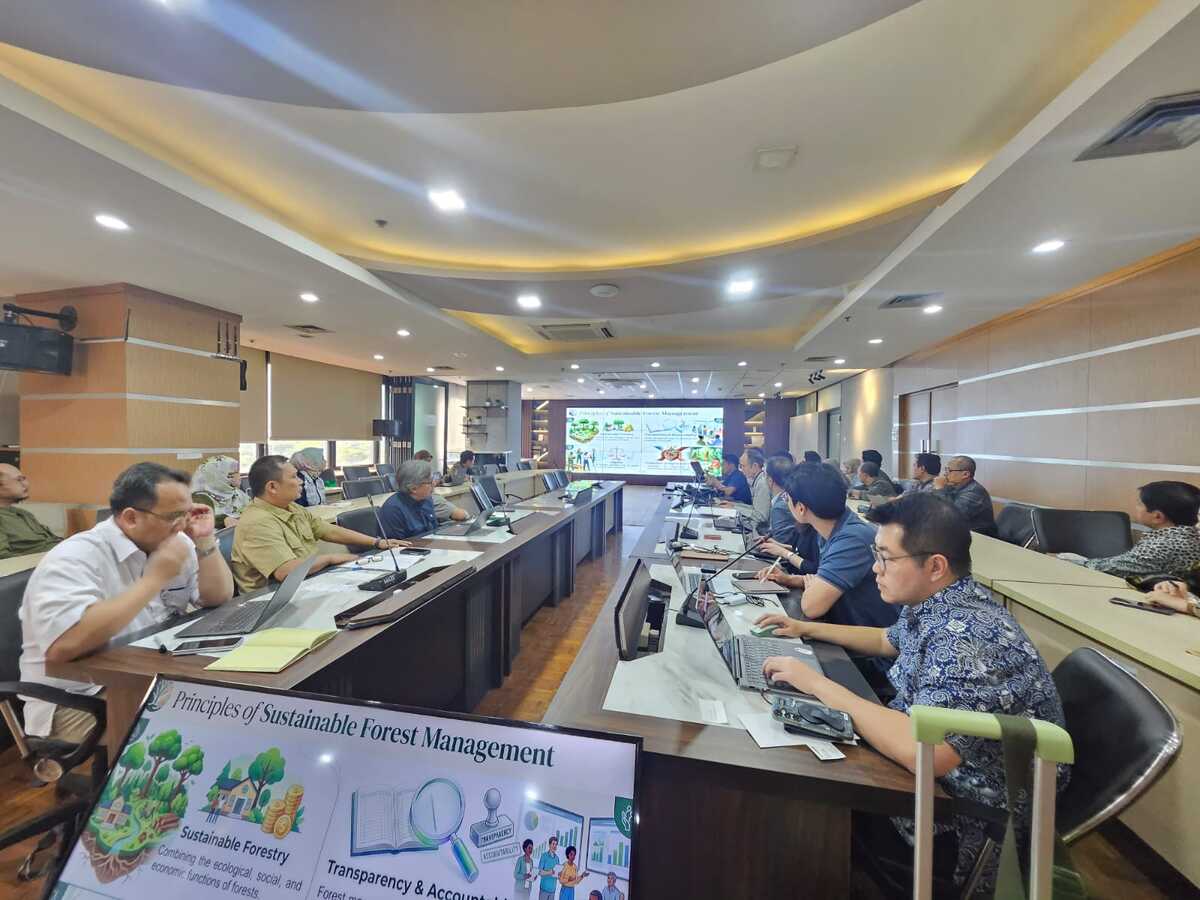
Indonesia’s government has a strong commitment to sustainable forest management. It ensures that forest management is conducted in a sustainable manner while considering ecological, social, and economic aspects. Ade Mukadi, Director of the Directorate for Processing and Marketing of Forest Products at the Ministry of Environment and Forestry (Kemenhut), stated this when receiving an audience from two Japanese companies, Tokyo Gas Co Ltd and Hanwa Co Ltd, in Jakarta on Wednesday, 4 March 2026. The two companies are buyers of wood pellets produced by PT Biomasa Jaya Abadi (PT BJA), a company operating in Pohuwato Regency, Gorontalo.
“We are deeply committed to sustainable forest management. Therefore, we pay attention to the European Union Deforestation Regulation (EUDR), as well as feasibility, legality, and sustainability. These are the principles we uphold in forest governance,” Ade stated.
Kasubdit Certification and Marketing of Forest Products Kemenhut Tony Rianto said forest management in Indonesia is anchored on four principles. First, sustainable forestry that balances ecological, social, and economic functions. Second, transparency and accountability ensuring forest management can be monitored and accessed by all parties. Third, legality ensuring forestry activities comply with permits and applicable regulations. Fourth, protection of the rights of communities, especially indigenous and local communities dependent on forests.
To guarantee legality and sustainability, he explained, the government applies the SVLK (System Verifikasi Legalitas dan Kelestarian). This system is an instrument to guarantee that forest products that are harvested, transported, processed, and traded come from sustainable sources, and fully comply with Indonesian law.
“SVLK covers all supply chains of forest products. This comprehensive scope ensures full traceability from the forest to the market. The verification process involves independent verification agencies conducting audits from upstream to downstream and to market participants. The audit results ensure products entering domestic and international markets meet legality and sustainability requirements,” Tony said.
Ade added that the Ministry continues to refine SVLK policies to meet EUDR requirements. To strengthen traceability, the government is integrating a geolocation-based monitoring system at harvesting locations. Transport and export documents are recorded digitally along with their geographic coordinates. This system enables greater transparency and allows stakeholders to verify supply chain information via a digital platform and QR codes.
During the audience, Tokyo Gas and Hanwa also asked questions regarding deforestation control through the implementation of the Rencana Kerja Tahunan (RKT) for forest utilization, including biodiversity and flora and fauna protection practices.
Ade explained that RKT is a mandatory annual operational planning document for forestry companies in Indonesia, prepared each year as part of the long-term Rencana Kerja Usaha (RKU).
This document functions as a deforestation control instrument, limiting logging to areas and volumes that are permitted and ensuring forest sustainability by integrating forest product utilisation activities with environmental services.
On evaluating the performance of forestry companies, the Ministry emphasised ecological aspects as the primary priority, namely ecosystem restoration and biodiversity protection.
“The government is committed to environmental sustainability, business continuity, community protection, and flora and fauna protection. As proof, the government revokes licences of companies that fail to comply with regulations in forestry activities,” Ade concluded. (H-2)
Minister of Forestry Raja Juli Antoni stresses the need for a change in mindset and a fundamental approach to Indonesia’s forest governance.
The emergence of social action “buying forests” by the public on social media has served as a sharp rebuke and a reflection of public distrust of forest management by stakeholders.
The Ministry of Forestry (Kemenhut) was awarded the Policy Quality Index Award (IKK Awards) for 2025 with an excellent qualification from the National Civil Service Agency (LAN).
Minister of Forestry (Menhut) Raja Juli Antoni together with Deputy Minister of Forestry Sulaiman Umar held a leadership meeting at Manggala Wanabhakti on the first day of work.
Copyright @ 2026 Media Group - mediaindonesia. All Rights Reserved