
Surpassing Rp1 Trillion, New Record in South Sulawesi Tax Revenue Floods Regional Funds for Districts and Cities
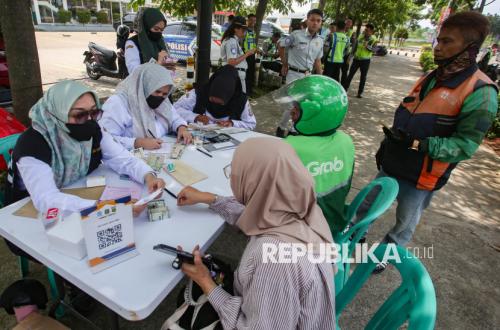
The local tax revenue sharing scheme in South Sulawesi demonstrates impressive performance. Throughout 2025, the total allocation of motor vehicle tax (PKB) and motor vehicle ownership transfer fee (BBNKB) revenue sharing to districts and cities reached Rp1.048 trillion, rounded to approximately Rp1.05 trillion.
This figure marks a new chapter in strengthening regional fiscal capacity, particularly after the effective implementation of the tax revenue sharing scheme following the latest regulations on central and local financial relations.
Of this total, Makassar City Government received the largest portion. The provincial capital obtained an allocation of approximately Rp393 billion.
The substantial amount received by Makassar reflects the high economic activity and motor vehicle ownership in the region, while also underscoring its strategic role as the growth centre in South Sulawesi.
The Secretary of the South Sulawesi Provincial Government, Jufri Rahman, stated that this achievement is a strong indicator that the tax revenue sharing policy is capable of significantly driving increases in regional revenues.
According to him, this scheme not only expands the fiscal space for local governments but also opens opportunities for accelerating digital-based public service transformations.
“This year, 2026, is the second year of implementing local tax revenue sharing, and the results are already showing significant impacts,” said Jufri in his statement in Makassar on Friday.
He explained that the tax revenue sharing in question encompasses three main types, namely PKB revenue sharing, BBNKB revenue sharing, and non-metallic minerals and rocks tax (MBLB) revenue sharing.
These three instruments form the new backbone in the revenue sharing scheme between the provincial government and districts/cities.
The presence of revenue sharing is seen as bringing fundamental changes in local tax governance. Previously, distributions relied more on transfer mechanisms; now, regions have a larger portion from collected revenue sources.
Thus, districts and cities are not merely recipients but are encouraged to actively optimise tax collection.
Jufri emphasised that such optimisation requires strong synergy between the provincial government and district/city governments.
According to him, without solid coordination, the revenue potential from tax revenue sharing will not be maximised.