
Surge in Indonesian Citizens Becoming Street Money Changers Ahead of Ramadan, Returning Home with Substantial Earnings
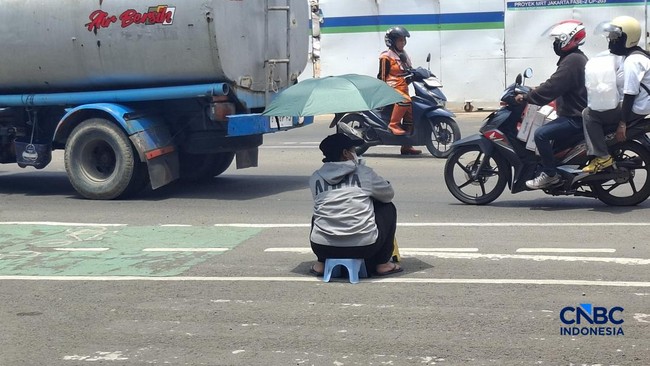
Jakarta — Ahead of Eid al-Fitr, a unique phenomenon appears on the streets each year as many Indonesians require small denomination notes to distribute as Eid gifts (angpau) to family members and relatives.
This phenomenon involves street-based money exchange services, commonly referred to as “inang-inang” (money changers).
Inang-inang operators begin appearing ahead of the Eid period due to high demand for currency exchange services, prompting many to capitalise on this as an annual business opportunity.
According to CNBC Indonesia’s observation in the Old Town and Asemka Market areas in North Jakarta on Thursday, 12 March 2026, inang-inang operators began appearing at 11:00 WIB, with numbers significantly increasing by 12:00 WIB.
They lined up offering customers various denominations from 2,000 rupiah to 100,000 rupiah notes. Generally, the most sought-after denominations are between 2,000 and 10,000 rupiah. A service charge of 15% is levied on each transaction.
The potential profits are substantial, reaching tens of millions of rupiah. One operator, Yeni, offers denominations from 2,000 to 20,000 rupiah notes and reported being able to exchange between 5 million to 10 million rupiah daily.
“Here we can exchange money in denominations of 2,000, 5,000, 10,000, and 20,000 rupiah notes, with a 15% fee on each transaction, minimum exchange of 100,000 rupiah,” Yeni told CNBC Indonesia on Thursday, 12 March 2026.
Yeni explained that the money used in exchange services comes from a “boss” who provides capital worth hundreds of millions of rupiah. These bosses are the primary financiers of the service. Through a “lending” system, service providers obtain new currency notes to exchange on the streets. These notes are returned after being distributed throughout the day.
“Tens of millions in capital. We borrow from the boss, and when we return home we repay what we borrowed. Whatever remains, that’s what we take home,” she added.
This arrangement explains the relatively high service charges imposed on customers, as service providers themselves incur charges when borrowing capital and notes from their boss.
According to Yeni, bosses set a 15% fee, with 12% going to the boss and the remaining 3% to the street operator.
“The boss already takes 12%, so we only take 3%,” she said.
Although street operators earn modest profits from each exchange, average daily turnover reaches tens of millions of rupiah. As the Eid period approaches, profit potential increases further, with service charges potentially rising.
“We can earn tens of millions, and the closer we get to Eid, the greater the profits. The capital I know of from the boss is around 30 million rupiah, but when it’s busy, we can earn 50 million rupiah, so profits can reach 20 million rupiah,” she noted.
In contrast, another money exchanger, Fani, reported average daily earnings of approximately 15 million rupiah. These earnings comprise both capital recovery and profits from the service fee. According to Fani, the peak earning period typically occurs two days before Eid.
“On average we earn about 15 million rupiah profit, and during the busy period two days before Eid, we can earn even more,” Fani said.