
Surabaya's Flood-Free Drive Boosted by Three New Pump Stations
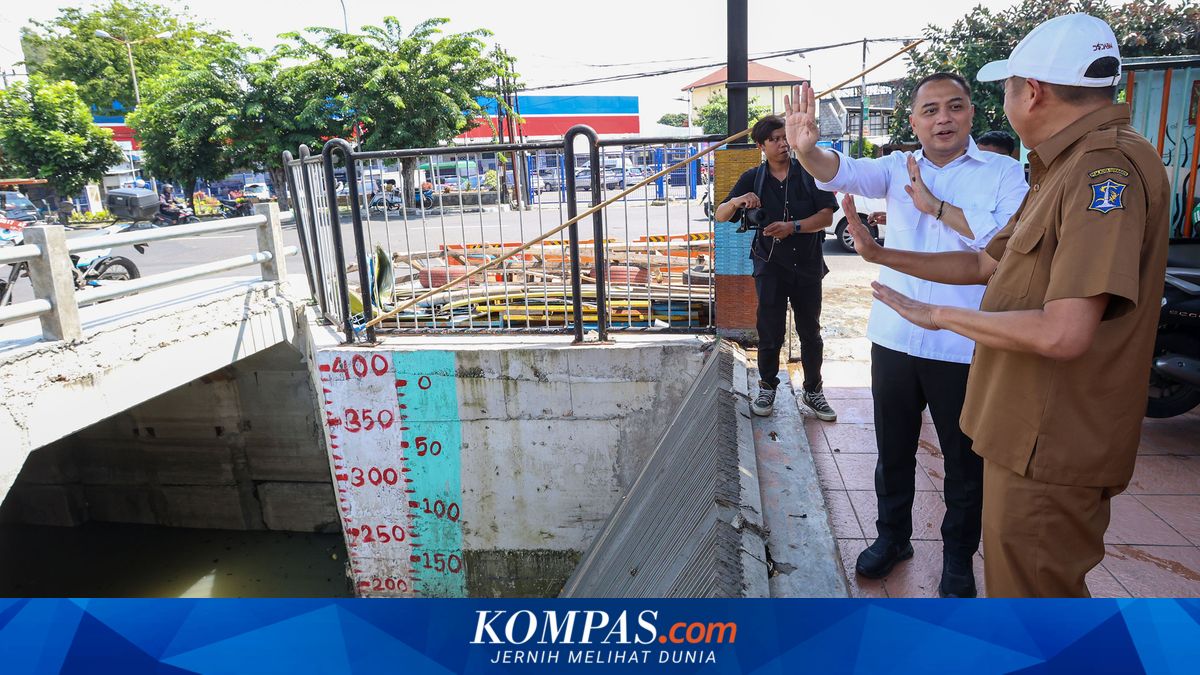
Surabaya City Government’s efforts to resolve flooding and waterlogging in the southern and eastern districts are beginning to show tangible results. Three new pump stations have been operational since January 2026 as part of the city’s flood control strategy. The stations are located in Margorejo Indah, Dukuh Menanggal, and Ahmad Yani. Each has a capacity of 6.5 cubic metres per second, equipped with three pumps and trash screens to accelerate water flow.
During a visit to the Dukuh Menanggal pump station on Monday, 4 May 2026, Mayor Eri Cahyadi stated that flood management in the southern and eastern areas is a key priority, with a target to resolve it this year. To support this target, the city has implemented a series of strategic steps, including building pump stations, dredging channels, adjusting water elevation, and constructing storage facilities.
“This is part of Surabaya City Government’s 2026 projects, as our target is to eliminate flooding by this year,” Eri said in a statement on 25 May 2026.
He added that the new pumps accelerate water drainage and reduce pressure on channels in densely populated areas. The city also plans to build additional pumps in vulnerable spots such as Panjang Jiwo near a petrol station, Nginden Intan Timur Road, and outside Bethany Church in Nginden.
“We will construct new pump stations in Panjang Jiwo opposite a petrol station and outside Bethany Church in Nginden this year,” he said.
Eri explained that a key issue in the southern area is disproportionate water flow accumulation. Previously, water from Karah and Jambangan flowed into Avour Wonorejo, causing flooding and backups.
“If Margorejo floods, water backs up and causes Karah and Jambangan to flood too,” he said.
Based on field assessments, the city has utilised the wider-capacity Kebon Agung channel, connecting it to the Surabaya River via pumps. Under this scheme, water from Karah and Jambangan no longer flows to Margorejo and Avour Wonorejo.
“Therefore, I ordered the flow towards Margorejo to be closed and redirected to Kebon Agung, while Margorejo’s flow continues to Avour Wonorejo,” he explained.
He added that distributing the load ensures fairness and prevents concentration at a single point.
Eri stressed that mapping water flow is crucial for flood management. Changes in direction, channel elevation, and pump positions must be precisely calculated for optimal flood control.
“That’s why I’ve asked district heads, sub-district chiefs, and department heads to understand water flow. If the direction changes, elevation must be adjusted accordingly,” he said.
During the inspection, sub-district and district heads were also instructed on using tools like theodolites and water levels for elevation measurement. A comprehensive understanding from upstream to downstream is key to resolving local waterlogging, he added.
In addition to building pump stations, the city has adjusted construction methods for eastern channels. Along the Jemursari to Sarono Jiwo section, Corrugated Concrete Sheet Pile (CCSP) techniques will be used.
In Panjang Jiwo, channel widening is not feasible due to 150-kilovolt overhead power lines. As an alternative, the city will build road-based storage facilities to divert water to main rivers or pump stations.
“The storage facilities’ role is to distribute water,” he said.
Beyond infrastructure, the city acknowledges that land use changes and reduced absorption areas due to dense housing contribute to waterlogging.
“When all absorption areas are replaced by housing, rainwater flows directly into drainage systems,” he explained.
Despite this, Mayor Eri is confident that targeted waterlogging sites will be flood-free by November 2026. He said these measures are part of short-term strategies for southern and eastern areas.
“Insha’Allah, by November, even during rain, the visited sites will no longer experience waterlogging. These short-term actions are being done this year so next year we can focus on other areas,” he added.
Surabaya’s Public Works and Water Resources Director Hidayat Syah said pump station construction adapts to shifting waterlogging points due to rapid development.
“Previously, there were many green open spaces, but with more housing, rainwater no longer soaks into the ground and instead flows directly into channels,” Hidayat said.
He added that channel loads have consequently increased significantly.
According to Hidayat, the three new pumps have effectively reduced local waterlogging since their January operation.
For example, Ahmad Yani Pump Station addresses waterlogging in Gayung Kebonsari, Injoko, and Kebonsari Barat areas, while Margorejo Pump Station tackles issues in Margorejo, Bendul Merisi, and Sidosermo.
“Since January, Sidosermo has seen significant reductions in waterlogging and faster drainage. Margorejo’s channels are currently being refined,” he explained.
Meanwhile, Dukuh Menanggal Pump Station focuses on reducing waterlogging in Gayungsari Timur, Wisma Pagesangan, and Menanggal Road by directing water to the Surabaya-Sidoarjo border river.
In addition to building pump stations