
Surabaya Residents Fail to See Total Lunar Eclipse Due to Overcast Sky
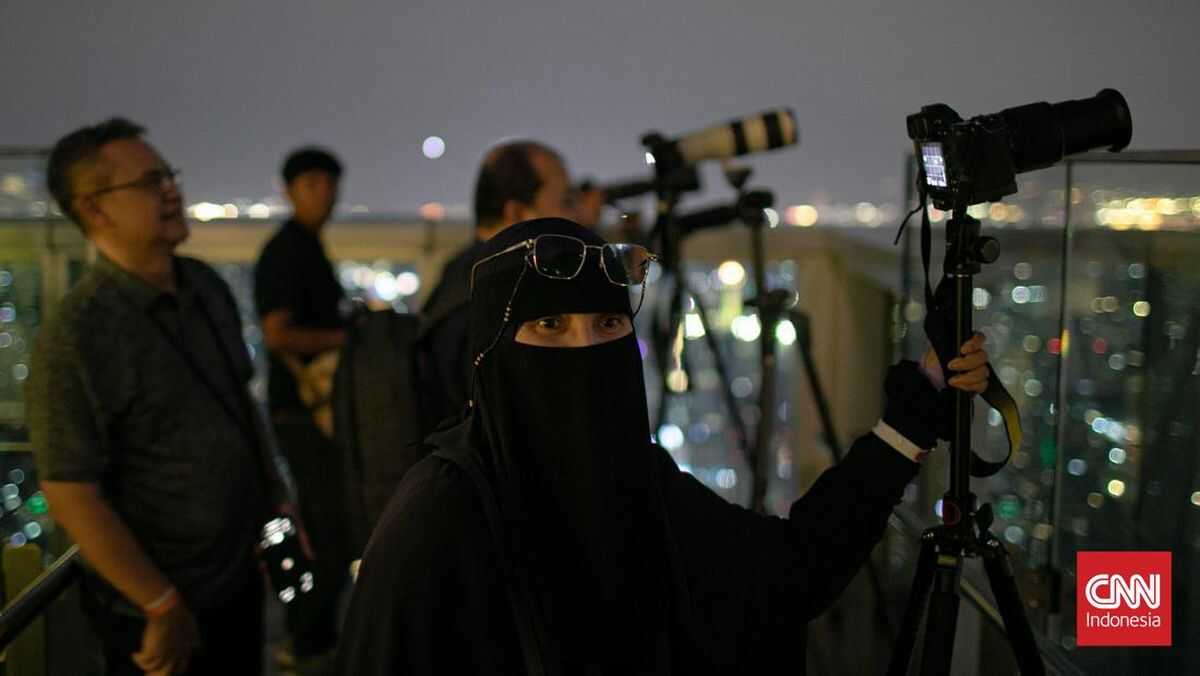
Surabaya residents were unable to observe the Total Lunar Eclipse on Tuesday, 3 March, as cloud cover blanketed the skies of East Java. Weather conditions and thick cloud cover were the primary reasons residents could not visually enjoy the Blood Moon phenomenon.
Andi Siti Maryam, astronomy lecturer at the Faculty of Islamic Studies and Civilisation at Universitas Muhammadiyah Surabaya (Umsura), said that, from an astronomical perspective, the Moon should have been in totality precisely at Maghrib time.
‘Mestinya saat maghrib tadi karena ini bulan purnama. Dia akan terbit bersamaan dengan terbenamnya matahari. Jadi, mestinya saat kita buka puasa, bulan sudah terbit di timur,’ he said in Indonesian; English translation: ‘It should have been at Maghrib because this is a full moon. It rises together with the sunset. So, it should be when we break the fast, the Moon has already risen in the east,’ Andi said.
Observational data indicate that the total phase of this lunar eclipse lasted nearly an hour, starting at 18:04 WIB and ending at 19:02 WIB. In clear skies, the Moon should have radiated a deep reddish hue.
‘If the total phase were visible, it would all look red,’ he said.
After passing the peak of totality at 19:02 WIB, the eclipse entered a partial phase before finally ending at 20:17 WIB.
Although the observation team was prepared, the sky above the City of Heroes remained unfriendly from sunset until near the end of the phenomenon.
‘Up to now it has not been visible. There was a brief glimmer of light at the Moon’s position, but it could not be observed clearly,’ Andi explained.
Monitoring centred around Umsura campus confirmed that overcast clouds enveloped the entire observation area.
‘In Surabaya, particularly at Universitas Muhammadiyah Surabaya, it was not visible this time because the clouds were thick,’ he said.
For the observation, the team had prepared equipment including a 71 mm diameter refractor telescope paired with a DSLR camera to capture surface details of the Moon.
‘The 71 mm refractor is actually quite capable of viewing Moon details, including craters and the bright-dark contrast of the surface, but because it was obscured by clouds, the observations were not optimal,’ he concluded.