
Surabaya City Government Accelerates Pancasila Village Programme, with 12,000 Civil Servants and Youth Supporting 1,361 Neighbourhood Units
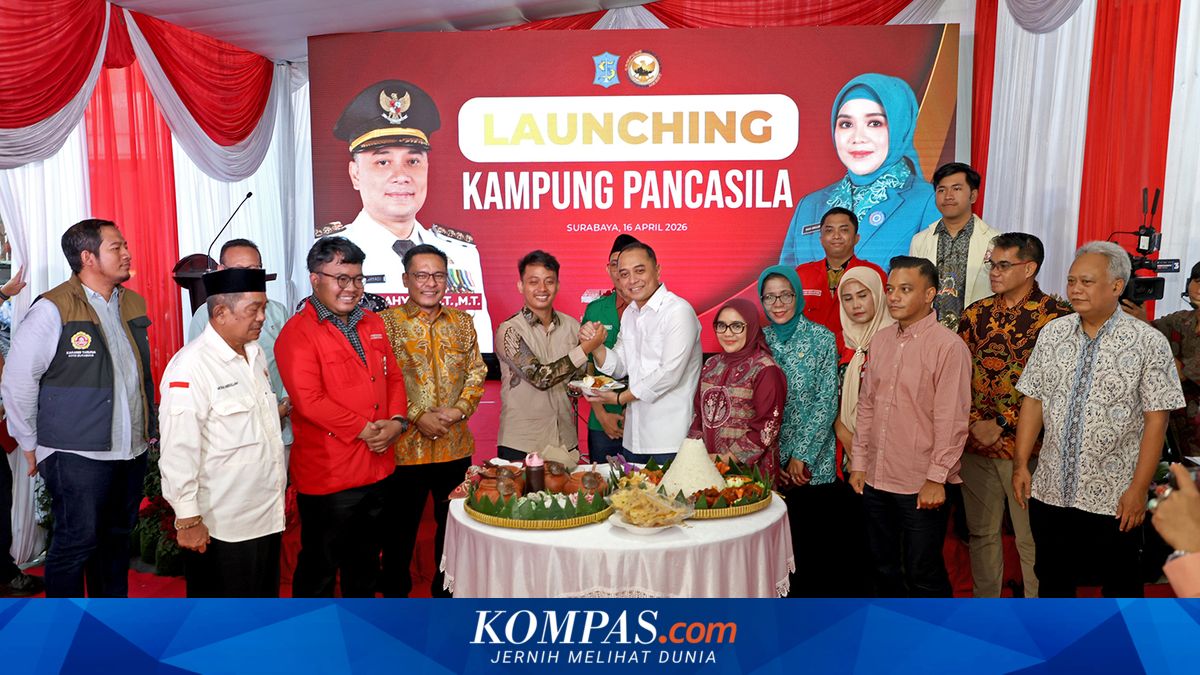
The Surabaya City Government is accelerating the strengthening of mutual cooperation values through the Kampung Pancasila programme. This initiative involves youth and 12,000 Civil Servants (ASN) to support 1,361 Rukun Warga (RW) neighbourhood units. This step is aimed at reviving social solidarity at the village level, which has long been the foundation of the City of Heroes. In the programme, thousands of ASN and youth involved become part of the city’s strategy to ensure the concrete implementation of Pancasila values at the grassroots level. This commitment was affirmed by Surabaya Mayor Eri Cahyadi during the launch of Kampung Pancasila 2026 in RW 2 Krembangan Bhakti, Kemayoran Ward, Krembangan District, on Thursday (16/4/2026). The event was attended by interfaith leaders, community organisations, youth groups and students, as well as representatives from 1,361 RW virtually. “Surabaya has had high tolerance since the 1960s. This is what we must hold on to and continue. Kampung Pancasila must not stop, and Surabaya must stand firm with mutual cooperation,” said Mayor Eri in a written statement received by Kompas.com on Monday (20/4/2026). Because building Surabaya cannot rely solely on the government without active community support, especially from the younger generation. “If you say Surabaya must prosper without youth movement, that’s impossible. The local government cannot solve those problems alone,” he said. Mayor Eri exemplified the concept of collective welfare through the practice of distributing zakat, infaq, and sedekah (ZIS) during the leadership of Sayyidina Utsman bin Affan. According to him, this good practice remains highly relevant if applied in the current era. “Why was the country prosperous during Sayyidina Utsman’s time? Because the capable people and those obligated to pay zakat and infaq were combined. The collected funds were given to the needy in the village,” he explained. Through Kampung Pancasila, the Surabaya City Government encourages strengthening in various fields, including environment, social culture, community, and economy. In the environmental sector, Mayor Eri urged residents to start sorting waste at home because it has economic value that can be used for social activities. “Imagine if plastic bottles are separated in each RW, then the bottles are sold. The collected items can generate money that goes into the RW treasury and is used for social movements. That’s extraordinary,” said Mayor Eri. Furthermore, in the social and cultural sector, Kampung Pancasila is also directed at strengthening solidarity among residents, especially in helping underprivileged communities through mutual cooperation mechanisms. He underlined the importance of targeted aid distribution by prioritising the needs of residents in the local RW. “Sometimes we don’t want to give sedekah to the RW, but through other institutions. In the end, other institutions don’t distribute the infaq we provide to our RW, but to other places. Meanwhile, in the RW environment, there are still those who can’t go to school, there are still those who are poor,” he explained. He emphasised that every problem should be solvable at the RW level with government support. However, this requires active reporting from the community, from Kader Surabaya Hebat (KSH), PKK, to RT/RW officials. “If there are problems with public facilities or children who can’t go to school, it should be resolved at the RW level with the city government’s involvement. But can the city government do it alone? Of course not, if there are no reports, no movement from the RW. Therefore, I hope every RW will be supported by ASN,” said Mayor Eri. In addition, Mayor Eri also invited all elements of society to actively participate in supporting Kampung Pancasila, including students, youth organisations, and religious groups. According to him, Surabaya’s success in resolving various problems is not done by the government alone, but through community mutual cooperation. “Insyaallah, we will move together and join hands to make Surabaya prosperous. Not because of the mayor, but because of the RT/RW, PKK, KSH, and community leaders in Surabaya,” he said. The Head of the Kampung Pancasila Task Force of Surabaya City, Irvan Widyanto, added that the programme is directed at strengthening community empowerment at the RW level by emphasising mutual cooperation values. “The Kampung Pancasila programme is expected to empower all elements of society at the RW level to collaborate together,” said Irvan. Irvan also explained that the Kampung Pancasila concept stems from Surabaya’s experience in facing the Covid-19 pandemic. At that time, mutual cooperation values grew spontaneously in the community without waiting for government intervention. “It happened in all villages without orders. So, the spontaneity of mutual cooperation (by residents) was done to overcome problems in the village itself,” he said. This experience was then formulated by Mayor Eri Cahyadi into the Kampung Pancasila philosophy by strengthening social solidarity at the RW level to help residents in need. Therefore, the programme targets various issues, from preventing poverty and malnutrition, access to education for children, to economic empowerment of residents. As a form of strengthening Kampung Pancasila, the Surabaya City Government is deploying around 12,000 ASN as supporters. ASN and local youth will support 1,361 RW so that the programme runs effectively and directly reaches residents’ needs. “Approximately 12,000 ASN in the Surabaya City Government are assigned directly to become supporting ASN. They will support 1,361 RW to mutual cooperate with the community,” said Irvan. In its implementation, Kampung Pancasila is divided into four main pillars, namely environment, community, economy, and social culture. Irvan also emphasised that the key to the programme’s success lies in the involvement of all elements.